

1.0
Cite Score 2025
SJR: 0.129 / SNIP: 0.140

JMERC
Owner
Janbazan Medical and Engineering Research Center (JMERC) is the owner of IJWPH.
Volume 17, Issue 4 (2025)
3 2025, 17(4): 349-354 |
Back to browse issues page
Request Type:




History
Received: 2025/05/24 | Accepted: 2025/07/3 | Published: 2025/11/19
Received: 2025/05/24 | Accepted: 2025/07/3 | Published: 2025/11/19
How to cite this article
Menati R, Omidi N, Omidi M R, Mohamadpour S. Effect of Communication Skills Training Intervention on Reducing Social Isolation. 3 2025; 17 (4) :349-354
URL: http://ijwph.daneshafarand.org/article-3-85656-en.html
URL: http://ijwph.daneshafarand.org/article-3-85656-en.html
Download citation:
BibTeX | RIS | EndNote | Medlars | ProCite | Reference Manager | RefWorks
Send citation to:


Rights and permissions
BibTeX | RIS | EndNote | Medlars | ProCite | Reference Manager | RefWorks
Send citation to:


Full-Text (HTML) (60 Views)
Introduction
Social isolation is a condition in which individuals, due to structural or individual reasons, are deprived of meaningful social interactions [1]. This phenomenon not only affects the quality of life of the ageing [2], but is also associated with serious consequences such as depression, cognitive decline, an increased risk of cardiovascular diseases, and reduced life expectancy [3]. According to WHO reports, over [percentage] of the ageing population worldwide experience social isolation [4]. In developing societies such as Iran, cultural factors, economic conditions, and the digital divide have made these statistics considerably more concerning, particularly given changes in family structures and urbanization trends [1]. In Ilam city, with its [specific population characteristics], the ageing population faces growing challenges of social isolation [5]. Social isolation among the ageing is often reinforced by an erosion of social roles and diminished interpersonal competence [6]. In this context, communication skills serve not merely as behavioral tools but as foundational elements for rebuilding lost social connections [7]. As older adults experience reduced participation in familial and community roles, a decline in their ability to express emotions, initiate conversations, and resolve misunderstandings may further marginalize them [8]. These deficits not only perpetuate withdrawal but also create a negative feedback loop that deepens their isolation [9]. Long-term social isolation has been linked to deteriorating mental health, including anxiety, depression, and feelings of worthlessness [10]. It can also aggravate physical conditions by reducing motivation for self-care and decreasing access to timely support [11]. Accordingly, strengthening communication skills may function as both a preventive and remedial approach to restoring their sense of inclusion [12]. In light of increasing longevity and shifting societal structures, addressing social isolation through communicative empowerment becomes a key aspect of healthy ageing.
Among various interventions, communication skills training has emerged as a promising strategy [13]. By enhancing self-efficacy and personal competencies, it can potentially reintegrate ageing individuals into social interaction networks. The ageing period is characterized by extensive role changes, reduced physical mobility, and loss of support networks. In Ilam city, despite strong family values in the local culture, field evidence indicates that [percentage] of ageing individuals describe their social interactions as minimal [14, 15]. Factors such as children living apart, unfamiliarity with communication technologies, and weak conversational skills exacerbate this isolation [16]. Previous studies have shown that prolonged social isolation not only threatens mental health [17, 18], but also imposes heavy costs on healthcare systems [19, 20]. Most existing interventions in Iran focus on support services [21] rather than empowering the ageing through practical training.
This study examined whether communication skills training (including active listening, clear expression of needs, and conflict management) can reduce the social gap and increase participation among Ilam’s ageing. The significance becomes clearer when considering that improved communication skills help rebuild support networks while enhancing feelings of belonging and self-worth. Given Ilam’s demographic and cultural characteristics, this study sought to evaluate the effectiveness of a structured training program while developing a localized model for similar regions.
Materials and Methods
Ths quasi-experimental study, with a pre-test–post-test design and a control group included all ageing residents of Ilam city in 2023–2024, from which 40 individuals were selected using convenience sampling and randomly assigned to two experimental (20 people) and control (20 people) groups. The inclusion criteria were age over 60 years, residence in Ilam city, absence of severe cognitive disorders (assessed using the MMSE test), and willingness to participate in the study. The sample size was determined based on similar previous studies using GPower software, considering an effect size of 0.8, power of 0.80, and α=0.05, which indicated that a minimum of 34 participants would be sufficient; however, 40 participants were included to improve the statistical reliability.
Ethical approval was obtained from the relevant institutional review board. All participants provided written informed consent. Confidentiality was maintained, and participants were informed of their right to withdraw. The control group received the intervention post-study. The experimental group participated in 8 sessions of a 90-minute communication skills training program, which included practical training on eye contact, active listening, clear expression of needs, conflict management, and assertiveness enhancement. These sessions were held weekly at the ageing center in Ilam city. The control group did not receive any intervention during this period.
The data collection tool was the standardized Social Loneliness Scale Index (SLSI), completed by both groups in two stages: a pre-test (before the intervention) and a post-test (one month after the intervention). This questionnaire was designed and validated by Zhang in 2024 [22]. It comprises 20 items on a 5-point Likert scale, ranging from “strongly disagree” (score 1) to “strongly agree” (score 5), and measures four main components: Emotional loneliness (6 items, e.g., "I feel like no one understands me"), Interactional loneliness (5 items, e.g., "I meet my friends very rarely"), Structural loneliness (5 items, e.g., "My access to social centers is limited"), Perceived loneliness (4 items, e.g., "I feel detached from society").
The reliability of the questionnaire was confirmed with Cronbach’s alpha coefficients of 0.89 for the total scale and between 0.78 and 0.85 for the subscales. Its validity was established through convergent validity with the UCLA Loneliness Scale (correlation coefficient: 0.72) and appropriate discriminant validity to distinguish between high-risk and normal groups. The total score of the questionnaire ranges from 20 to 100, with higher scores indicating higher levels of social loneliness. This tool was selected for the present study due to its suitable psychometric properties, short completion time (about 15 minutes), and high sensitivity in measuring intervention-induced changes.
To control for confounding parameters, the groups were matched on age, gender, and education level. Ethical considerations included informing participants about data confidentiality and their right to withdraw from the study at any stage. After the study, the training program was also offered to the control group.
For data analysis, descriptive statistics (means and standard deviations) and inferential statistics were used. The normality of the data distribution was assessed using the Shapiro–Wilk test. An independent t-test was used to compare the mean social loneliness scores between the two groups at the pre-test stage. To analyze the intervention effect, analyses of covariance (ANCOVA) were employed, controlling for the pre-test scores. Additionally, a paired t-test was conducted to examine within-group changes from pre-test to post-test. All analyses were performed using SPSS software (version 26) at a significance level of 0.05. Cohen’s d was used to measure the effect size, where values of 0.2–0.5 were considered small, 0.5–0.8 medium, and above 0.8 large. To ensure the reliability of the research tool, Cronbach’s alpha coefficient was calculated, yielding a value above 0.7, indicating acceptable reliability of the tool. Levene’s test confirmed the equality of variances between the two groups.
Findings
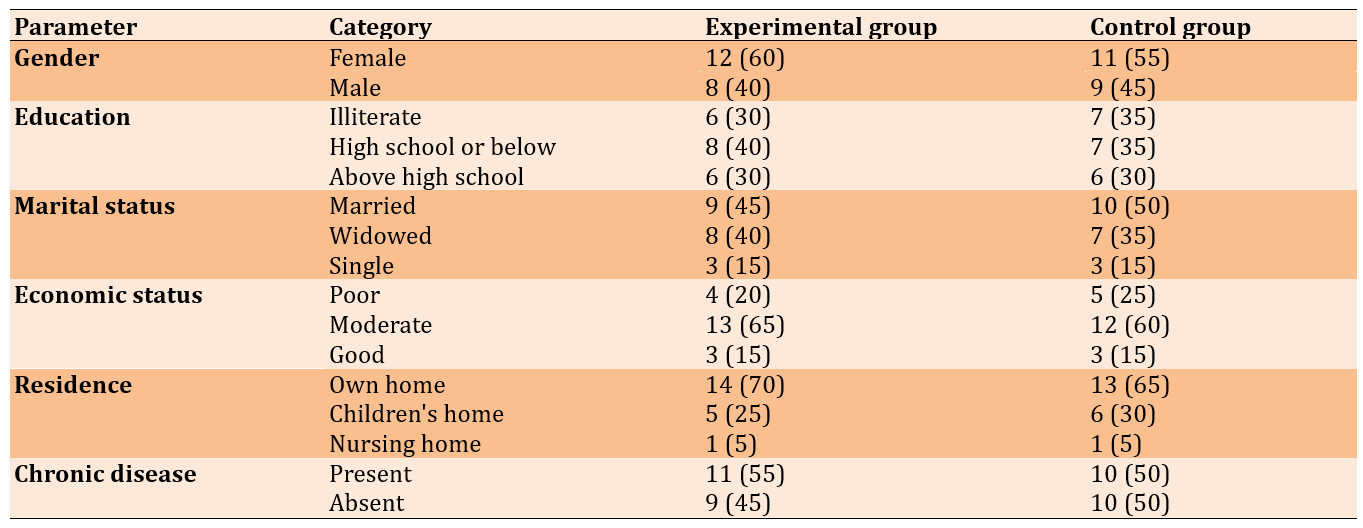
Participants in both the experimental and control groups were matched on key parameters. In the experimental group, the age range was between 62 and 78 years, with a mean age of 68.4±5.2 years, while the control group had an age range of 61 to 76 years, with a mean age of 67.9±4.8 years. Regarding gender, the experimental group consisted of 12 women (60%) and 8 men (40%), whereas the control group had 11 women (55%) and 9 men (45%). The education level was reasonably distributed in both groups: in the experimental group, 6 participants (30%) were illiterate, 8 (40%) had a diploma or sub-diploma, and 6 (30%) had education beyond a diploma. This distribution in the control group was 7 (35%), 7 (35%), and 6 (30%), respectively. In terms of marital status, the experimental group included 9 married individuals (45%), 8 widowed/divorced (40%), and 3 single individuals (15%), while these figures in the control group were 10 (50%), 7 (35%), and 3 (15%), respectively. The economic status of most participants in both groups was at a moderate level (65% in the experimental group and 60% in the control group). Additionally, 70% of the experimental group and 65% of the control group lived in their own homes, while the rest resided in their children’s homes or care facilities. Regarding the history of chronic diseases, 11 participants (55%) in the experimental group and 10 (50%) in the control group had at least one chronic condition, with hypertension and diabetes being the most common (Table 1).
Table 1. Frequency of demographic characteristics of participants in the experimental and control groups
Both the experimental and control groups suffered from significant levels of social isolation. In the experimental group, the mean total social isolation score was 62.3±7.1 out of 100, indicating a moderate-to-high level of isolation. In this group, the mean score for emotional isolation (17.5±3.2) was the highest among all components. Interactional isolation, with a mean score of 15.8±2.9, ranked second. Structural isolation (14.6±2.7) and perceived isolation (14.4±2.3) were at similar levels.
In the control group, the mean total social isolation score was 61.8±6.7, showing no significant difference from the experimental group (p>0.05). The distribution of component scores in this group was also similar to that of the experimental group: Emotional isolation (17.2±3.1), interactional isolation (15.6±2.8), structural isolation (14.3±2.6), and perceived isolation (14.7±2.4). These results indicate that, prior to the intervention, the two groups were fully comparable in terms of both the level and pattern of social isolation.
There was no statistically significant difference between the two groups in any of the social isolation components at the pre-test stage (p>0.05). It is worth noting that in both groups, emotional isolation had the highest score, indicating the most profound dimension of isolation experienced by the ageing in the city of Ilam (Table 2).
Table 2. Comparison of social isolation components between groups before the intervention

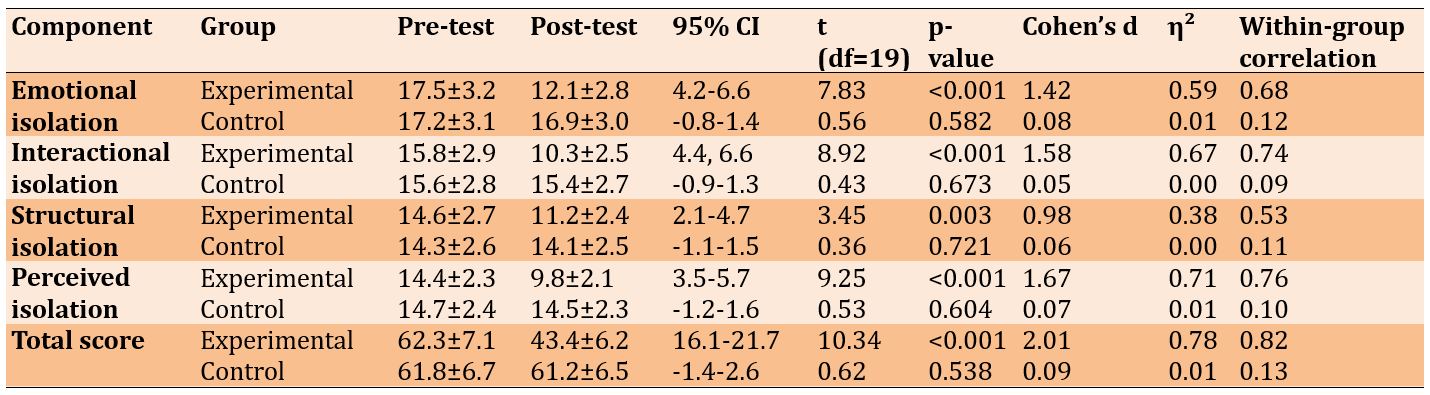
The communication skills training intervention had a significant effect on reducing social isolation among the ageing (Table 3). In the experimental group that received the training, the mean total social isolation score decreased from 62.3±7.1 in the pre-test to 43.4±6.2 in the post-test, indicating a significant improvement in social isolation status. In contrast, no noticeable change was observed in the control group.
Regarding social isolation components, the greatest effect of the intervention was observed on perceived isolation, which showed a 4.6-point reduction. The interactional isolation component also showed significant improvement, with a 5.5-point decrease. Emotional isolation decreased by 5.4 points, and structural isolation decreased by 3.4 points.
The paired t-test was significant for all components in the experimental group (p<0.01). Cohen’s d was calculated as 2.01 for the total score, indicating a large intervention effect. For individual components, the effect size ranged between 0.98 and 1.67, all falling within the medium-to-large range.
ANCOVA, controlling for pre-test scores, showed a significant difference between the two groups (F=68.24; df=1, 37). The eta-squared coefficient (η²=0.65) indicated that 65% of the variance in post-test scores was explained by the intervention.
Within-group correlations, indicating measurement stability, were 0.82 for the total score and ranged between 0.53 and 0.76 for the components, confirming the reliability of the measurement tool. The 95% confidence interval for score differences did not include zero in any case, further confirming the significance of the changes.
Table 3. Effect of the intervention on social isolation
Discussion
This study aimed to evaluate the effectiveness of a communication skills training intervention in reducing social isolation among ageing individuals in Ilam city. The communication skills training intervention had a significant impact on reducing social isolation. The 30% reduction in the total social isolation score in the experimental group (from 62.3 to 43.4) is consistent with findings from studies, such as Zheng et al. [23], showing that psychosocial interventions can break the cycle of isolation through direct and indirect mechanisms (by reducing depression). In particular, the 4.6-point reduction in the perceived isolation component aligns with the results of Liu et al. [24], emphasizing the mediating role of the subjective perception of isolation [24].
The educational intervention had a remarkable impact on the interactive isolation of the ageing. The substantial 5.5-point reduction in interactive isolation, which showed the greatest improvement among all components, aligns with the results of Shimada et al. [21], who demonstrated that even limited increases in social interactions can have significant health outcomes. This improvement is likely due to the practical exercises designed in the current study, similar to the training programs used by Wang et al. [25]. However, the more limited reduction in structural isolation (3.4 points) confirms the results of Svensson et al. [18], indicating that individual interventions alone are insufficient to change environmental structures [18].
In addition to the observed psychological benefits, another less-discussed yet important dimension of the intervention’s effectiveness lies in its differential impact across components of social isolation. While the largest reduction was noted in interactive isolation (5.5 points), the emotional component (despite showing a 5.4-point improvement) remained the highest scoring dimension post-intervention. This suggests that although emotional isolation is responsive to targeted training, it is likely shaped by deeper socio-cultural and relational dynamics that require longer-term or layered interventions. The persistence of a relatively high score in emotional isolation may reflect internalized feelings of disconnection rooted in cultural expectations and family structures, especially among the Iranian elderly, as also implied by Jiang et al. [26]. Therefore, while communication training helps initiate emotional reconnection, its full impact may emerge more gradually and in concert with broader societal support.
Furthermore, an often-overlooked aspect in social isolation research is the distinction between structural and subjective experiences of isolation. The current intervention yielded modest improvements in structural isolation (3.4 points), aligning with the understanding that changes in social networks or living arrangements demand systemic and environmental transformation. This is supported by Svensson et al. [18], who underscore the limits of individual-level interventions in addressing macro-level structural barriers. However, the observed enhancement in perceived isolation (4.6 points) suggests that altering the perception of connectedness may be just as critical as changing actual social conditions. This divergence reinforces the importance of designing interventions that not only expand access but also build internal confidence and emotional receptivity toward social engagement. The training sessions in this study, with their emphasis on practical role-playing and empathy-building, appear to have contributed directly to this psychological reframing.
Regarding emotional isolation, the 5.4-point reduction post-intervention, though statistically significant, still left the mean score of this component (12.1±2.8) higher than those of the other dimensions of social isolation. This pattern may stem from multiple factors: First, as Zhang showed in his study on Chinese ageing, the emotional dimensions of isolation (particularly feelings of loneliness and lack of deep connections) often have deeper socio-cultural roots that require longer-term interventions to change [22]. Second, consistent with the findings of Jiang et al. [26], traditional attitudes toward the role of the ageing in Iranian families may have hindered full emotional improvements, as these attitudes are structurally embedded in family relationships. These findings highlight the importance of designing multidimensional interventions that simultaneously focus on communication skills, rebuilding the social roles of the ageing, and changing cultural attitudes.
Comparing the effectiveness of the current intervention with other intervention methods, particularly emerging technologies, such as voice assistants, reveals important insights. According to Marziali et al., who systematically reviewed the use of voice assistants in reducing social isolation [27], these technologies are useful in facilitating access to information and services, but have limited impact on improving the emotional and qualitative dimensions of social relationships. In contrast, the current face-to-face intervention, designed around direct human interaction, shows significant improvements in both emotional (sense of belonging and reduced loneliness) and interactive (quantitative and qualitative enhancement of social relationships) dimensions. This superiority can be attributed to the multidimensional nature of human communication, which includes nonverbal elements, empathy, and emotional responsiveness—factors that current technologies cannot fully replicate. Kidman et al. also support this view, showing that human-centered interventions, particularly in societies where face-to-face communication is part of the cultural norm [28], have more sustained effectiveness. However, this comparison does not negate the value of technology but rather emphasizes the need for intelligent integration of both approaches to achieve optimal results.
The stability of scores in the control group also confirms the findings of longitudinal studies, such as Zheng et al., showing that social isolation tends to persist without targeted intervention [23]. This underscores the necessity of planning for sustained interventions, as suggested in Shimada et al. [21]. Based on our findings and similar research, it is recommended that future interventions combine human-centered approaches and digital technologies. For example, simple communication platforms (such as video messaging) could be used to facilitate ongoing interactions between in-person sessions, or communication skills training programs could be integrated with voice assistants tailored to the needs of the ageing. Additionally, designing multidimensional interventions that simultaneously focus on improving individual skills, changing social attitudes, and modifying environmental structures could enhance program effectiveness. However, it should be noted that this study faced limitations such as convenience sampling and lack of long-term follow-up with participants, which may affect the generalizability of the results.
Conclusion
Communication skills training is significantly effective in reducing social isolation among ageing individuals.
Acknowledgments: We would like to express our sincere gratitude to Ilam University of Medical Sciences for their financial and administrative support in conducting this research. We also extend our appreciation to all the elderly participants who generously contributed their time and shared their experiences. Special thanks to the staff at the Aging Center of Ilam City for their cooperation in facilitating the training sessions.
Ethical Permissions: All ethical principles, including informed consent, confidentiality, and the right to withdraw from the study, were strictly observed. Participants were assured that their personal information would remain confidential and would only be used for research purposes.
Conflicts of Interests: The authors declare that there is no conflict of interest regarding the publication of this paper.
Authors' Contribution: Menati R (First Author), Introduction Writer/Methodologist/Main Researcher/Discussion Writer (25%); Omidi N (Second Author), Assistant Researcher/Discussion Writer/Statistical Analyst (25%); Omidi MR (Third Author), Introduction Writer/Assistant Researcher (25%); Mohamadpour S (Fourth Author), Introduction Writer/Assistant Researcher/Discussion Writer (25%)
Funding/Support: This research was financially supported by Ilam University of Medical Sciences. The funding body had no role in the study design, data collection, analysis, or manuscript preparation.
Social isolation is a condition in which individuals, due to structural or individual reasons, are deprived of meaningful social interactions [1]. This phenomenon not only affects the quality of life of the ageing [2], but is also associated with serious consequences such as depression, cognitive decline, an increased risk of cardiovascular diseases, and reduced life expectancy [3]. According to WHO reports, over [percentage] of the ageing population worldwide experience social isolation [4]. In developing societies such as Iran, cultural factors, economic conditions, and the digital divide have made these statistics considerably more concerning, particularly given changes in family structures and urbanization trends [1]. In Ilam city, with its [specific population characteristics], the ageing population faces growing challenges of social isolation [5]. Social isolation among the ageing is often reinforced by an erosion of social roles and diminished interpersonal competence [6]. In this context, communication skills serve not merely as behavioral tools but as foundational elements for rebuilding lost social connections [7]. As older adults experience reduced participation in familial and community roles, a decline in their ability to express emotions, initiate conversations, and resolve misunderstandings may further marginalize them [8]. These deficits not only perpetuate withdrawal but also create a negative feedback loop that deepens their isolation [9]. Long-term social isolation has been linked to deteriorating mental health, including anxiety, depression, and feelings of worthlessness [10]. It can also aggravate physical conditions by reducing motivation for self-care and decreasing access to timely support [11]. Accordingly, strengthening communication skills may function as both a preventive and remedial approach to restoring their sense of inclusion [12]. In light of increasing longevity and shifting societal structures, addressing social isolation through communicative empowerment becomes a key aspect of healthy ageing.
Among various interventions, communication skills training has emerged as a promising strategy [13]. By enhancing self-efficacy and personal competencies, it can potentially reintegrate ageing individuals into social interaction networks. The ageing period is characterized by extensive role changes, reduced physical mobility, and loss of support networks. In Ilam city, despite strong family values in the local culture, field evidence indicates that [percentage] of ageing individuals describe their social interactions as minimal [14, 15]. Factors such as children living apart, unfamiliarity with communication technologies, and weak conversational skills exacerbate this isolation [16]. Previous studies have shown that prolonged social isolation not only threatens mental health [17, 18], but also imposes heavy costs on healthcare systems [19, 20]. Most existing interventions in Iran focus on support services [21] rather than empowering the ageing through practical training.
This study examined whether communication skills training (including active listening, clear expression of needs, and conflict management) can reduce the social gap and increase participation among Ilam’s ageing. The significance becomes clearer when considering that improved communication skills help rebuild support networks while enhancing feelings of belonging and self-worth. Given Ilam’s demographic and cultural characteristics, this study sought to evaluate the effectiveness of a structured training program while developing a localized model for similar regions.
Materials and Methods
Ths quasi-experimental study, with a pre-test–post-test design and a control group included all ageing residents of Ilam city in 2023–2024, from which 40 individuals were selected using convenience sampling and randomly assigned to two experimental (20 people) and control (20 people) groups. The inclusion criteria were age over 60 years, residence in Ilam city, absence of severe cognitive disorders (assessed using the MMSE test), and willingness to participate in the study. The sample size was determined based on similar previous studies using GPower software, considering an effect size of 0.8, power of 0.80, and α=0.05, which indicated that a minimum of 34 participants would be sufficient; however, 40 participants were included to improve the statistical reliability.
Ethical approval was obtained from the relevant institutional review board. All participants provided written informed consent. Confidentiality was maintained, and participants were informed of their right to withdraw. The control group received the intervention post-study. The experimental group participated in 8 sessions of a 90-minute communication skills training program, which included practical training on eye contact, active listening, clear expression of needs, conflict management, and assertiveness enhancement. These sessions were held weekly at the ageing center in Ilam city. The control group did not receive any intervention during this period.
The data collection tool was the standardized Social Loneliness Scale Index (SLSI), completed by both groups in two stages: a pre-test (before the intervention) and a post-test (one month after the intervention). This questionnaire was designed and validated by Zhang in 2024 [22]. It comprises 20 items on a 5-point Likert scale, ranging from “strongly disagree” (score 1) to “strongly agree” (score 5), and measures four main components: Emotional loneliness (6 items, e.g., "I feel like no one understands me"), Interactional loneliness (5 items, e.g., "I meet my friends very rarely"), Structural loneliness (5 items, e.g., "My access to social centers is limited"), Perceived loneliness (4 items, e.g., "I feel detached from society").
The reliability of the questionnaire was confirmed with Cronbach’s alpha coefficients of 0.89 for the total scale and between 0.78 and 0.85 for the subscales. Its validity was established through convergent validity with the UCLA Loneliness Scale (correlation coefficient: 0.72) and appropriate discriminant validity to distinguish between high-risk and normal groups. The total score of the questionnaire ranges from 20 to 100, with higher scores indicating higher levels of social loneliness. This tool was selected for the present study due to its suitable psychometric properties, short completion time (about 15 minutes), and high sensitivity in measuring intervention-induced changes.
To control for confounding parameters, the groups were matched on age, gender, and education level. Ethical considerations included informing participants about data confidentiality and their right to withdraw from the study at any stage. After the study, the training program was also offered to the control group.
For data analysis, descriptive statistics (means and standard deviations) and inferential statistics were used. The normality of the data distribution was assessed using the Shapiro–Wilk test. An independent t-test was used to compare the mean social loneliness scores between the two groups at the pre-test stage. To analyze the intervention effect, analyses of covariance (ANCOVA) were employed, controlling for the pre-test scores. Additionally, a paired t-test was conducted to examine within-group changes from pre-test to post-test. All analyses were performed using SPSS software (version 26) at a significance level of 0.05. Cohen’s d was used to measure the effect size, where values of 0.2–0.5 were considered small, 0.5–0.8 medium, and above 0.8 large. To ensure the reliability of the research tool, Cronbach’s alpha coefficient was calculated, yielding a value above 0.7, indicating acceptable reliability of the tool. Levene’s test confirmed the equality of variances between the two groups.
Findings
Participants in both the experimental and control groups were matched on key parameters. In the experimental group, the age range was between 62 and 78 years, with a mean age of 68.4±5.2 years, while the control group had an age range of 61 to 76 years, with a mean age of 67.9±4.8 years. Regarding gender, the experimental group consisted of 12 women (60%) and 8 men (40%), whereas the control group had 11 women (55%) and 9 men (45%). The education level was reasonably distributed in both groups: in the experimental group, 6 participants (30%) were illiterate, 8 (40%) had a diploma or sub-diploma, and 6 (30%) had education beyond a diploma. This distribution in the control group was 7 (35%), 7 (35%), and 6 (30%), respectively. In terms of marital status, the experimental group included 9 married individuals (45%), 8 widowed/divorced (40%), and 3 single individuals (15%), while these figures in the control group were 10 (50%), 7 (35%), and 3 (15%), respectively. The economic status of most participants in both groups was at a moderate level (65% in the experimental group and 60% in the control group). Additionally, 70% of the experimental group and 65% of the control group lived in their own homes, while the rest resided in their children’s homes or care facilities. Regarding the history of chronic diseases, 11 participants (55%) in the experimental group and 10 (50%) in the control group had at least one chronic condition, with hypertension and diabetes being the most common (Table 1).
Table 1. Frequency of demographic characteristics of participants in the experimental and control groups
Both the experimental and control groups suffered from significant levels of social isolation. In the experimental group, the mean total social isolation score was 62.3±7.1 out of 100, indicating a moderate-to-high level of isolation. In this group, the mean score for emotional isolation (17.5±3.2) was the highest among all components. Interactional isolation, with a mean score of 15.8±2.9, ranked second. Structural isolation (14.6±2.7) and perceived isolation (14.4±2.3) were at similar levels.
In the control group, the mean total social isolation score was 61.8±6.7, showing no significant difference from the experimental group (p>0.05). The distribution of component scores in this group was also similar to that of the experimental group: Emotional isolation (17.2±3.1), interactional isolation (15.6±2.8), structural isolation (14.3±2.6), and perceived isolation (14.7±2.4). These results indicate that, prior to the intervention, the two groups were fully comparable in terms of both the level and pattern of social isolation.
There was no statistically significant difference between the two groups in any of the social isolation components at the pre-test stage (p>0.05). It is worth noting that in both groups, emotional isolation had the highest score, indicating the most profound dimension of isolation experienced by the ageing in the city of Ilam (Table 2).
Table 2. Comparison of social isolation components between groups before the intervention
The communication skills training intervention had a significant effect on reducing social isolation among the ageing (Table 3). In the experimental group that received the training, the mean total social isolation score decreased from 62.3±7.1 in the pre-test to 43.4±6.2 in the post-test, indicating a significant improvement in social isolation status. In contrast, no noticeable change was observed in the control group.
Regarding social isolation components, the greatest effect of the intervention was observed on perceived isolation, which showed a 4.6-point reduction. The interactional isolation component also showed significant improvement, with a 5.5-point decrease. Emotional isolation decreased by 5.4 points, and structural isolation decreased by 3.4 points.
The paired t-test was significant for all components in the experimental group (p<0.01). Cohen’s d was calculated as 2.01 for the total score, indicating a large intervention effect. For individual components, the effect size ranged between 0.98 and 1.67, all falling within the medium-to-large range.
ANCOVA, controlling for pre-test scores, showed a significant difference between the two groups (F=68.24; df=1, 37). The eta-squared coefficient (η²=0.65) indicated that 65% of the variance in post-test scores was explained by the intervention.
Within-group correlations, indicating measurement stability, were 0.82 for the total score and ranged between 0.53 and 0.76 for the components, confirming the reliability of the measurement tool. The 95% confidence interval for score differences did not include zero in any case, further confirming the significance of the changes.
Table 3. Effect of the intervention on social isolation
Discussion
This study aimed to evaluate the effectiveness of a communication skills training intervention in reducing social isolation among ageing individuals in Ilam city. The communication skills training intervention had a significant impact on reducing social isolation. The 30% reduction in the total social isolation score in the experimental group (from 62.3 to 43.4) is consistent with findings from studies, such as Zheng et al. [23], showing that psychosocial interventions can break the cycle of isolation through direct and indirect mechanisms (by reducing depression). In particular, the 4.6-point reduction in the perceived isolation component aligns with the results of Liu et al. [24], emphasizing the mediating role of the subjective perception of isolation [24].
The educational intervention had a remarkable impact on the interactive isolation of the ageing. The substantial 5.5-point reduction in interactive isolation, which showed the greatest improvement among all components, aligns with the results of Shimada et al. [21], who demonstrated that even limited increases in social interactions can have significant health outcomes. This improvement is likely due to the practical exercises designed in the current study, similar to the training programs used by Wang et al. [25]. However, the more limited reduction in structural isolation (3.4 points) confirms the results of Svensson et al. [18], indicating that individual interventions alone are insufficient to change environmental structures [18].
In addition to the observed psychological benefits, another less-discussed yet important dimension of the intervention’s effectiveness lies in its differential impact across components of social isolation. While the largest reduction was noted in interactive isolation (5.5 points), the emotional component (despite showing a 5.4-point improvement) remained the highest scoring dimension post-intervention. This suggests that although emotional isolation is responsive to targeted training, it is likely shaped by deeper socio-cultural and relational dynamics that require longer-term or layered interventions. The persistence of a relatively high score in emotional isolation may reflect internalized feelings of disconnection rooted in cultural expectations and family structures, especially among the Iranian elderly, as also implied by Jiang et al. [26]. Therefore, while communication training helps initiate emotional reconnection, its full impact may emerge more gradually and in concert with broader societal support.
Furthermore, an often-overlooked aspect in social isolation research is the distinction between structural and subjective experiences of isolation. The current intervention yielded modest improvements in structural isolation (3.4 points), aligning with the understanding that changes in social networks or living arrangements demand systemic and environmental transformation. This is supported by Svensson et al. [18], who underscore the limits of individual-level interventions in addressing macro-level structural barriers. However, the observed enhancement in perceived isolation (4.6 points) suggests that altering the perception of connectedness may be just as critical as changing actual social conditions. This divergence reinforces the importance of designing interventions that not only expand access but also build internal confidence and emotional receptivity toward social engagement. The training sessions in this study, with their emphasis on practical role-playing and empathy-building, appear to have contributed directly to this psychological reframing.
Regarding emotional isolation, the 5.4-point reduction post-intervention, though statistically significant, still left the mean score of this component (12.1±2.8) higher than those of the other dimensions of social isolation. This pattern may stem from multiple factors: First, as Zhang showed in his study on Chinese ageing, the emotional dimensions of isolation (particularly feelings of loneliness and lack of deep connections) often have deeper socio-cultural roots that require longer-term interventions to change [22]. Second, consistent with the findings of Jiang et al. [26], traditional attitudes toward the role of the ageing in Iranian families may have hindered full emotional improvements, as these attitudes are structurally embedded in family relationships. These findings highlight the importance of designing multidimensional interventions that simultaneously focus on communication skills, rebuilding the social roles of the ageing, and changing cultural attitudes.
Comparing the effectiveness of the current intervention with other intervention methods, particularly emerging technologies, such as voice assistants, reveals important insights. According to Marziali et al., who systematically reviewed the use of voice assistants in reducing social isolation [27], these technologies are useful in facilitating access to information and services, but have limited impact on improving the emotional and qualitative dimensions of social relationships. In contrast, the current face-to-face intervention, designed around direct human interaction, shows significant improvements in both emotional (sense of belonging and reduced loneliness) and interactive (quantitative and qualitative enhancement of social relationships) dimensions. This superiority can be attributed to the multidimensional nature of human communication, which includes nonverbal elements, empathy, and emotional responsiveness—factors that current technologies cannot fully replicate. Kidman et al. also support this view, showing that human-centered interventions, particularly in societies where face-to-face communication is part of the cultural norm [28], have more sustained effectiveness. However, this comparison does not negate the value of technology but rather emphasizes the need for intelligent integration of both approaches to achieve optimal results.
The stability of scores in the control group also confirms the findings of longitudinal studies, such as Zheng et al., showing that social isolation tends to persist without targeted intervention [23]. This underscores the necessity of planning for sustained interventions, as suggested in Shimada et al. [21]. Based on our findings and similar research, it is recommended that future interventions combine human-centered approaches and digital technologies. For example, simple communication platforms (such as video messaging) could be used to facilitate ongoing interactions between in-person sessions, or communication skills training programs could be integrated with voice assistants tailored to the needs of the ageing. Additionally, designing multidimensional interventions that simultaneously focus on improving individual skills, changing social attitudes, and modifying environmental structures could enhance program effectiveness. However, it should be noted that this study faced limitations such as convenience sampling and lack of long-term follow-up with participants, which may affect the generalizability of the results.
Conclusion
Communication skills training is significantly effective in reducing social isolation among ageing individuals.
Acknowledgments: We would like to express our sincere gratitude to Ilam University of Medical Sciences for their financial and administrative support in conducting this research. We also extend our appreciation to all the elderly participants who generously contributed their time and shared their experiences. Special thanks to the staff at the Aging Center of Ilam City for their cooperation in facilitating the training sessions.
Ethical Permissions: All ethical principles, including informed consent, confidentiality, and the right to withdraw from the study, were strictly observed. Participants were assured that their personal information would remain confidential and would only be used for research purposes.
Conflicts of Interests: The authors declare that there is no conflict of interest regarding the publication of this paper.
Authors' Contribution: Menati R (First Author), Introduction Writer/Methodologist/Main Researcher/Discussion Writer (25%); Omidi N (Second Author), Assistant Researcher/Discussion Writer/Statistical Analyst (25%); Omidi MR (Third Author), Introduction Writer/Assistant Researcher (25%); Mohamadpour S (Fourth Author), Introduction Writer/Assistant Researcher/Discussion Writer (25%)
Funding/Support: This research was financially supported by Ilam University of Medical Sciences. The funding body had no role in the study design, data collection, analysis, or manuscript preparation.
Keywords:
References
1. Gharib M, Hajghani J, Cheraghmakani H, Rashedi V. Validity and reliability of the Persian version of Alzheimer's disease-related quality of life (P-ADRQL) questionnaire among older Iranian adults. Aging Health Res. 2025;5(2):100229. [Link] [DOI:10.1016/j.ahr.2025.100229]
2. Güler A, Yıldırım M. Social isolation, loneliness, death stress and life satisfaction in older adults: A serial mediation study. Geriatr Nurs. 2025;62(Pt B):78-85. [Link] [DOI:10.1016/j.gerinurse.2025.01.037]
3. Liu X, Chen JH, Gao B, Zhang WJ. Social isolation and depressive symptoms among older adults with different functional status in China: A latent class analysis. J Affect Disord. 2025;375:478-85. [Link] [DOI:10.1016/j.jad.2025.01.156]
4. Zhang X, Wei N, Li M, Li L, Lv X, Zhang Y, et al. Sickness presenteeism, job burnout, social support and health-related productivity loss among nurses in the Chinese nurses' health cohort study (TARGET): A cross-sectional survey. Int J Nurs Stud. 2025;162:104962. [Link] [DOI:10.1016/j.ijnurstu.2024.104962]
5. Nasirpour N, Mojtabai R, Savari E, Hajebi A, Rahimi-Movaghar A, Motevalian A. Objective socioeconomic status, subjective social status, and mental disorders in Iranian mental health survey (IranMHS): A mediation analysis. J Affect Disord. 2025;372:279-86. [Link] [DOI:10.1016/j.jad.2024.12.019]
6. Lachaud J, Yusuf AA, Maelzer F, Perri M, Gogosis E, Ziegler C, et al. Social isolation and loneliness among people living with experience of homelessness: A scoping review. BMC Public Health. 2024;24(1):2515. [Link] [DOI:10.1186/s12889-024-19850-7]
7. Mahdie B, Khatooni M, Senmar M, Movahedeh H, Zarei F, Motalebi SA, et al. The predictive role of social isolation in COVID-19 anxiety among older adults. BMC Geriatr. 2025;25(1):375. [Link] [DOI:10.1186/s12877-025-06046-w]
8. Farina CL, Moreno J, Schneidereith T. Using simulation to improve communication skills. Nurs Clin North Am. 2024;59(3):437-48. [Link] [DOI:10.1016/j.cnur.2024.02.007]
9. Pan C, Yu L, Cao N. Reciprocal relations of social isolation and multimorbidity in Chinese elderly. Am J Prev Med. 2025;68(1):91-7. [Link] [DOI:10.1016/j.amepre.2024.08.020]
10. Lyu C, Siu K, Xu I, Osman I, Zhong J. Social isolation changes and long-term outcomes among older adults. JAMA Netw Open. 2024;7(7):e2424519. [Link] [DOI:10.1001/jamanetworkopen.2024.24519]
11. Tu L, Li Y, Ren X, Jiang M, Han L, Zheng X. The association of social isolation and loneliness with sarcopenia among the middle-aged and elderly in China. BMC Psychiatry. 2024;24(1):513. [Link] [DOI:10.1186/s12888-024-05958-y]
12. Abbasi A, Farokhzadian J, Torkaman M, Miri S. Schema therapy in partially sighted individuals with a focus on social isolation and self-esteem: An interventional study. BMC Psychiatry. 2025;25(1):289. [Link] [DOI:10.1186/s12888-025-06732-4]
13. Alimoradzadeh R, Jahangiri K, Alimoradzadeh R. Foresight older adults' quality of life in the aging crisis in Iran: A systematic review and meta-analysis. Exp Gerontol. 2025;200:112671. [Link] [DOI:10.1016/j.exger.2024.112671]
14. Alivandi Vafa M, Fathi A, Akbarzadeh Nami R, Bejani H. A comparative study of perceived stress, loneliness, anxiety and marital boredom in veteran and ordinary people's wives. Sci J Mil Psychol. 2022;13(50):105-29. [Persian] [Link]
15. Tabesh F, Maleki F, Nouri F, Zarepur E, Haghighatdoost F, Ghaffari S, et al. Association of whole and refined grains food consumption with coronary artery disease in a multi-center, case-control study of Iranian adults: Iran Premature Coronary Artery Disease (IPAD). Nutr Metab Cardiovasc Dis. 2025;35(7):103866. [Link] [DOI:10.1016/j.numecd.2025.103866]
16. Lai-Yi Wong E, Qiu H, Ho KF, Wai-Ling Cheung A, Leung H, Chen FY, et al. Association of ambient temperature with social isolation among the community-dwelling Chinese older adults: A cross-sectional study in Hong Kong. Heliyon. 2025;11(1):e41721. [Link] [DOI:10.1016/j.heliyon.2025.e41721]
17. Hounkpatin H, Islam N, Stuart B, Santer M, Farmer A, Dambha-Miller H. The association of loneliness and social isolation with multimorbidity over 14 years in older adults in England: A population-based cohort study. Arch Gerontol Geriatr. 2025;131:105763. [Link] [DOI:10.1016/j.archger.2025.105763]
18. Svensson M, Ekström H, Elmståhl S, Rosso A. Association of polypharmacy, fall-risk-increasing drugs, and cardiovascular drugs with loneliness and social isolation among older adults. Arch Gerontol Geriatr Plus. 2024;1(4):100089. [Link] [DOI:10.1016/j.aggp.2024.100089]
19. Shafiei SS, Mosavi Viyaye F. The lived experience of women in war-affected families; A reflection on the role of a wife in a veteran's family. J Iran Soc Stud. 2022;16(1):78-99. [Persian] [Link]
20. Wang X, Wang Y, Zhang F, Ge D, Guo Z. Associations between social isolation, perceived ageism and subjective well-being among rural Chinese older adults: A cross-sectional study. Geriatr Nurs. 2024;59:598-603. [Link] [DOI:10.1016/j.gerinurse.2024.08.014]
21. Shimada H, Doi T, Tsutsumimoto K, Makino K, Harada K, Tomida K, et al. Combined effects of social isolation and loneliness on disability incidence in older adults. Arch Gerontol Geriatr. 2025;131:105749. [Link] [DOI:10.1016/j.archger.2025.105749]
22. Zhang D. Pain and the risk of social isolation and loneliness in older Chinese adults: Do gender, age, and education make a difference?. Soc Sci Med. 2024;363:117486. [Link] [DOI:10.1016/j.socscimed.2024.117486]
23. Zheng DD, Lee DJ, Rundek T, Lam BL, Gregori NZ, Curiel RE, et al. Visual impairment and cognitive function in aging adults: Sex and age differences in mediating effect of social isolation and depression. Am J Ophthalmol. 2025;274:196-208. [Link] [DOI:10.1016/j.ajo.2025.02.043]
24. Liu Q, Huang Y, Jin Y, Wang B, Li Y, Zhou W, et al. Effects of loneliness and social isolation on sarcopenia among community-dwelling older adults: The mediating role of depressive symptoms and cognitive function. J Affect Disord. 2025;380:308-16. [Link] [DOI:10.1016/j.jad.2025.03.143]
25. Wang M, Li W, Ding Z, Chen J, Mei Z, Song Y, et al. Social isolation and depressive symptoms among Chinese older adults: Serial mediating roles of social support and resilience. Geriatr Nurs. 2025;61:589-95. [Link] [DOI:10.1016/j.gerinurse.2024.12.027]
26. Jiang HX, Ding C, Liu YC, Yu J. Good sleep quality shields older adults from depressive symptoms linked to isolation: Comparing online and in-person social connections. Geriatr Nurs. 2025;62(Pt B):51-7. [Link] [DOI:10.1016/j.gerinurse.2025.01.035]
27. Marziali RA, Franceschetti C, Dinculescu A, Nistorescu A, Kristály DM, Moșoi AA, et al. Reducing loneliness and social isolation of older adults through voice assistants: Literature review and bibliometric analysis. J Med Internet Res. 2024;26:e50534. [Link] [DOI:10.2196/50534]
28. Kidman PG, Curtis RG, Watson A, Maher CA. When and why adults abandon lifestyle behavior and mental health mobile apps: Scoping review. J Med Internet Res. 2024;26:e56897. [Link] [DOI:10.2196/56897]