

1.0
Cite Score 2025
SJR: 0.129 / SNIP: 0.140

JMERC
Owner
Janbazan Medical and Engineering Research Center (JMERC) is the owner of IJWPH.
Volume 17, Issue 4 (2025)
3 2025, 17(4): 407-412 |
Back to browse issues page
Request Type:




History
Received: 2025/10/20 | Accepted: 2025/11/25 | Published: 2025/11/30
Received: 2025/10/20 | Accepted: 2025/11/25 | Published: 2025/11/30
How to cite this article
Hussein A. Quality of Life and Socio-Demographic Determinants in Physically Disabled Adults in Al-Hilla. 3 2025; 17 (4) :407-412
URL: http://ijwph.daneshafarand.org/article-3-85662-en.html
URL: http://ijwph.daneshafarand.org/article-3-85662-en.html
Download citation:
BibTeX | RIS | EndNote | Medlars | ProCite | Reference Manager | RefWorks
Send citation to:


Rights and permissions
BibTeX | RIS | EndNote | Medlars | ProCite | Reference Manager | RefWorks
Send citation to:


Department of Community Health Nursing, College of Nursing, University of Al Kut, Wasit, Iraq
Full-Text (HTML) (59 Views)
Introduction
Disability refers to any mental, physical, or cognitive condition that can limit a person’s activities or movement. The number of disabled adults worldwide has significantly increased, particularly in recent years, due to various life-span changes. Today, the global disability rate has risen to a level corresponding to the world population at the beginning of the twentieth and twenty-first centuries—possibly reaching up to 15%. Based on current global estimates, approximately 900 million people are living with disabilities, more than 80% of whom reside in third-world and developing countries, representing about 13.5% of the total population [1]. Despite advancements in diverse scientific fields, the overall rate of disability occurrence remains stable. While scientific progress enables the detection, prediction, and control of certain causes of disability, it also produces innovations and discoveries that may themselves introduce new risk factors [2]. The term disability encompasses multiple aspects, including functional impairment, limitations in activity, and restrictions in participation [3]. Moreover, disability has various implications for the burden and loss of health, as health is defined by an individual’s capacity to function across different domains of well-being [4].
Quality of life is defined by the World Health Organization as “an individual’s perception of their position in life in the context of the culture and value systems in which they live and in relation to their goals, expectations, standards, and concerns” [5]. Quality of life is a multifaceted, complex concept that varies from city to city and region to region and can be defined by various indicators. Standard indicators of quality of life include wealth, employment, environment, physical and mental health, education, recreation and leisure time, social belonging, religious beliefs, safety, security, and freedom [6]. As life changes, the quality of life also fluctuates. A high quality of life is usually characterized by happiness, satisfaction, and the ability to overcome problems [7]. It reflects an individual’s overall sense of well-being across many domains, like environmental conditions, psychological state, physical health, and social relationships. Quality of life is shaped by how people perceive their place within their societal and cultural contexts, considering their expectations, personal aspirations, and their values. It is a universal concept that applies to everyone, independent of disability status, circumstances, or background [8]. Memisevic]. Not paying attention to this issue and treating quality of life equally across all cities has led to a decline in quality of life in many cities, especially in medium and small cities, in recent years.
Disabled adults experience varying degrees of difficulty in performing ‘normal’ activities and consequently lose the capacity to fulfill typical social functions [9]. Compared to people without disabilities, those with disabilities are more prone to encounter socioeconomic, physical, and policy-related barriers, which can affect various aspects of their lives. Disability among adults is not merely a health problem; it also encompasses the challenges these individuals face, including the interaction between physical limitations and their social environment. Disabled adults are generally identified as having a physical or mental impairment that has a substantial and long-term adverse effect on their ability to perform normal day-to-day activities. Social engagement is often restricted among individuals with physical disabilities, resulting in a diminished quality of life due to limitations in daily living activities [10]. Disability can interfere with one's ability to function in society, given societal norms and inaccessible, ableist systems [11]. Such barriers to social participation can be damaging to mental health. Disabled adults exhibit markedly and dramatically higher chances of anxiety and depression diagnoses. They are also estimated to have greater psychological distress independent of anxiety and depression diagnoses, with these diagnoses predicting higher psychological distress disparities between people with and without disability [12]. Disability can limit a person’s willingness and ability to take part in formal social activities, which are active forms of social participation involving organized, structured interactions.
Disabled adults encounter numerous barriers stemming from restricted participation, which negatively affects their health outcomes, education, social and economic involvement, and quality of life. They are more likely to experience low education levels, poverty, reduced social inclusion, and increased dependency [13]. Services provided to people with disabilities constitute one of the most critical social factors influencing their behavior and treatment approaches and, consequently, directly or indirectly affect the personality of the disabled person as well as their level of personal and social adjustment [14].
Recently, there has been growing scientific and societal attention to the quality of life of disabled adults [15-17]. This shift in attention has been driven by the transition from the medical model of disability, which emphasizes treatment and diagnosis, to the social model, which highlights participation, inclusion, and the overall well-being of people with disabilities in society. The quality of life of disabled people is increasingly becoming a central focus for interventions and an important metric for assessing the effect of various rehabilitation and support programs. Several factors affect quality of life, like health status, gender, age, education, and employment status.
Investigating the impact of physical disability on lifestyle among physically disabled adults is essential for understanding how physical limitations influence daily activities, social participation, mental well‑being, employment opportunities, and overall quality of life. Physical disability often extends beyond functional impairment, affecting independence, mobility, access to healthcare, social relationships, and economic stability. By examining these lifestyle dimensions, researchers can identify specific challenges faced by physically disabled adults and highlight gaps in support systems, rehabilitation services, and public health interventions. The results can provide evidence-based insights that inform policymakers, healthcare professionals, and community organizations in developing inclusive programs, improving accessibility, promoting adaptive strategies, and enhancing social integration. Ultimately, studying this issue advances equity, empowers individuals with disabilities, and fosters environments that support active, healthy, and dignified living.
This study aimed to identify the level of quality of life and the socio-demographic characteristics of physically disabled individuals—including age, gender, social condition, academic achievement, occupation, and residential area—as well as to determine the degree, causes, and duration of disability and the levels of quality-of-life domains among disabled adults.
Instrument and Methods
This descriptive-analytic study was conducted retrospectively among disabled adults attending the Babylon Rehabilitation Center in Al-Hilla City, Babylon Governorate, Iraq. The sample size was calculated to be 89 using G*Power. To account for the drop, 100 records of adults aged 18 years and older who had been diagnosed with a physical disability (acquired, congenital, or disease-related) were selected via available sampling over a 6-month period from December 2023 to May 2024.
Data were collected using a questionnaire comprising three parts: Part I concerned socio-demographic data (age group, gender, social condition, academic achievement, occupation, and residence); Part II was the Sheehan Disability Scale (SDS) [5], which was used to measure the severity of disability. It has 5 items measured on an 11-point (3 items) and 7-point (2 items) scale. The tool's total score ranged from 0 to 30. Part III was the World Health Organization Quality of Life-BREF Scale (WHOQOL-BREF) [8], which comprises four quality-of-life domains and is used to assess the impact of physical disability on lifestyle among adults with physical disabilities. It has 26 items measured on a 5-point Likert scale. The total score was calculated according to WHOQOL-BREF scoring guidelines. The reliability of the questionnaire was assessed in the pilot study using Cronbach’s alpha (0.93), indicating adequate internal consistency and measurement equivalence.
After obtaining the necessary legal permissions and ethics committee approval to use recorded data from registered patients, the researchers approached the Babylon Rehabilitation Center, selected samples from the registered records, contacted the subjects, and explained the study's objectives to them. Informed consent was obtained from all participants.
Data were analyzed using descriptive statistics in SPSS 26 software. Chi-square test and independent t-test were used for data analysis.
Findings
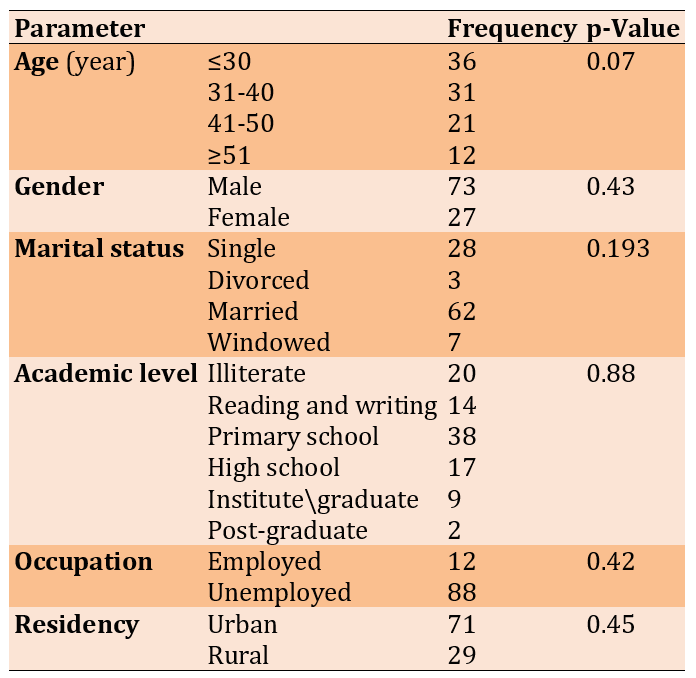
The majority of disabled adults were in the age group of equal to or less than 30 years. Most participants were male, married, had completed primary education, were unemployed, and lived in urban areas (Table 1).
Table 1. Frequency of participants’ socio-demographic data (n=100)
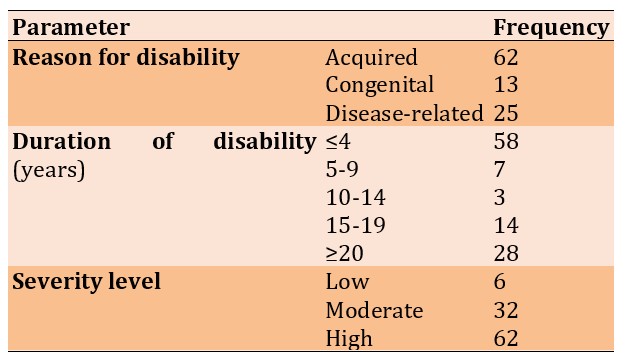
More than half of the participants reported an acquired cause of physical disability (62 cases). The duration of disability varied, with the largest proportion experiencing disability for 4 years or less (58 cases). In terms of severity, most participants had a high level of physical disability (62 cases; Table 2)
Table 2. Frequency distribution of physical disability characteristics
Quality-of-life scores among adults with physical disabilities indicated poor levels in the physical, psychological, and environmental domains, while the social domain showed a moderate level. Mean score further supported these domain classifications (Table 3).
Table 3. Comparing the frequency of quality of life categories in samples accordDing to the levels (n=100)
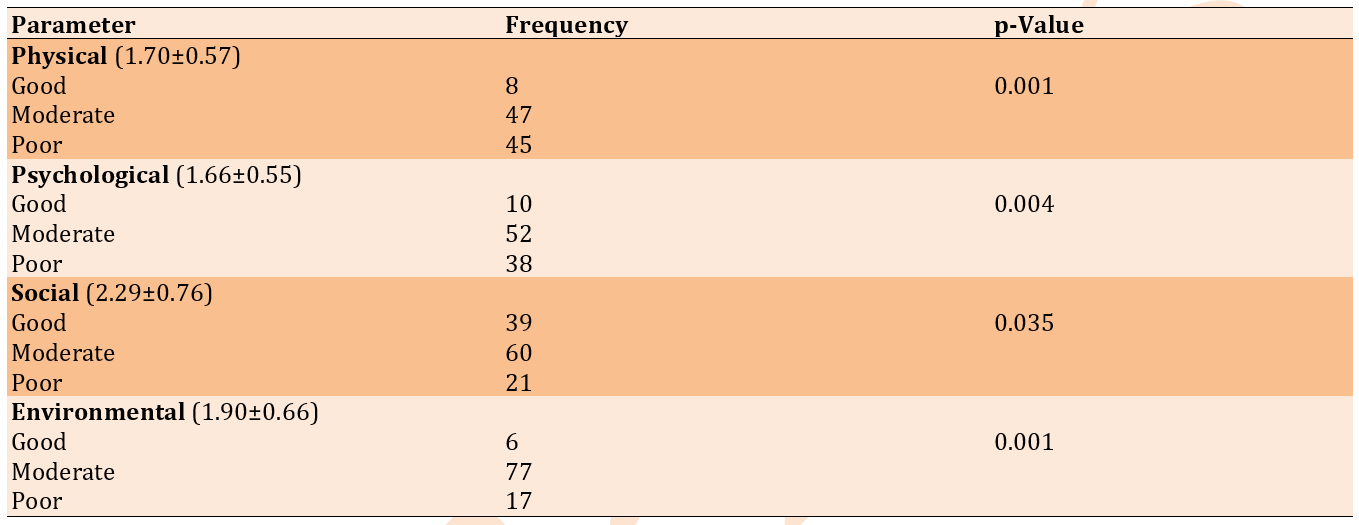
The overall assessment of quality of life among adults with physical disabilities indicated a moderate level, with most participants falling within this category.
Discussion
This study aimed to assess the quality of life and the socio-demographic characteristics of physically disabled individuals, including age, gender, social condition, academic achievement, occupation, and residential area. The majority of disabled adults were aged 30 years or younger, which aligns with the age range used in Kuvalekar et al.'s sample in Taluk Udupi City, India [2]. Population aging is linked to an elevation in the prevalence of disabilities. Improving the quality of life of older individuals with disabilities has become an inevitable requirement of civilizational and social progress. Recently, there has been a steady increase in the number of older adults and those with disabilities across Europe and worldwide, with the main reasons being the rise in average life expectancy and the decrease in birth rates. Disability affects the quality of life of older adults, impacting various aspects of their daily functioning, overall well-being, and social integration. The prevalence of disability among older adults increases with age and becomes especially evident after the age of 80 [18].
Although previous literature highlights substantial gender differences in disability patterns and related socioeconomic vulnerabilities, we found that quality of life among adults with physical disabilities was not significantly influenced by gender. In our sample, males accounted for 73 cases, similar to Al-Bahadli's findings in Iraq [19]. However, several studies have reported that older women exhibit a higher prevalence of disability than older men and experience greater functional limitations [20]. Evidence also suggests marked sex disparities in health and disability in older age, with women generally living longer but experiencing more disabling, non‑fatal conditions, whereas men are more likely to develop life‑threatening diseases associated with earlier mortality [21]. Furthermore, older women often face cumulative socioeconomic disadvantages, including lower education, income, occupational status, and financial security, which may increase vulnerability to disability‑related burdens. Despite these documented disparities, the absence of a significant association between gender and quality of life in our study suggests that other contextual or supportive factors—such as family support, coping strategies, or access to services—may play a more central role in shaping perceived quality of life than demographic characteristics alone. This finding supports the study conclusion that quality of life among adults with physical disabilities is not determined by age group, gender, marital status, academic level, occupation, or residence.
Regarding marital status, more than half of the sample were married. This result is similar to the study of Khlaif and Mohammed in Iraq [22]. Regarding academic achievement, the majority of the sample had a primary school education, similar to the findings of Kuvalekar et al. in India [2]. The majority of the study sample were unemployed. This result can be compared with the study conducted by Kaka et al. in Nigeria [23]. In another research, lower education was associated with lower quality of life in the social, physical, and psychological domains. Also, single individuals generally had a lower quality of life in the social, psychological, and environmental domains [24].
While we found no significant influence of marital status, academic achievement, or employment on the quality of life among adults with physical disabilities, other research indicates a more nuanced relationship. In our sample, over half of the participants were married, aligning with findings from Khlaif and Mohammed in Iraq [22]. Similarly, the majority of participants had a primary school education, consistent with findings from Kuvalekar et al. in India [2], and a large proportion were unemployed, a finding comparable to that of Kaka et al. in Nigeria [23]. However, the literature also presents evidence suggesting that lower educational attainment is associated with reduced quality of life across social, physical, and psychological domains. Additionally, single individuals have been found to report lower quality of life in social, psychological, and environmental domains [24]. The divergence between these findings and our own may stem from several factors. The specific support systems, community resources, or adaptive strategies available to individuals in our study population may effectively mitigate the potential negative impacts of lower education or unemployment on their overall quality of life. The resilience and coping mechanisms of individuals with physical disabilities, irrespective of their marital or employment status, could also be a critical, unmeasured factor contributing to their perceived quality of life. This supports our overall conclusion that quality of life for adults with physical disability is not influenced by characteristics, such as age group, gender, marital status, academic level, job, or residence.
Also, more than half of the respondents lived in urban areas, which is consistent with a study conducted by Pawłowska-Cyprysiak et al. in Poland [25]. In relation to the duration of disability, half of the respondents had been suffering from disability for 1-5 years. This result agrees with the study by Khlaif and Mohammed in Iraq [22]. Regarding the severity of disability, more than half of the respondents were impaired. This result agrees with the study conducted in Gaza by Salah [26].
The sample had a moderate level in all domains of quality of life. Family support, religious beliefs, wheelchairs, and artificial limbs may have partially helped to reduce the impact of disability. This result agrees with the study conducted by Khlaif and Mohammed in Iraq [22].
Government agencies and non-governmental organizations must conduct training programs for people with physical disabilities to teach them new skills to help them find employment and increase their capacity for social engagement. The Ministry of Education should provide educational courses to people with physical disabilities to improve literacy and raise awareness. The Ministry of Youth and Sport should provide recreational and sports facilities for people with special needs to help them reintegrate into society.
Considering the ongoing aging of societies worldwide, it is essential to expand research on introducing systemic alterations to improve the quality of life and functioning of older adults. A thorough understanding of the problem associated with disability, functioning, and quality of life among older adults in relation to different health-related and sociodemographic factors is of great importance. This understanding is especially significant for implementing and planning medical, social care, and other support programs for older adults.
Conclusion
Physically disabled adults have a moderate level of quality of life, and their quality of life is not influenced by their age, gender, marital status, academic level, job, or residence.
Acknowledgments: We are grateful to the Dean of the Faculty for his continuous support, critical review of the manuscript, and valuable comments.
Ethical Permissions: The study was approved by the Ethics Committee of the College of Nursing, University of Kut.
Conflicts of Interest: There were no conflicts of interest.
Authors' Contribution: Hussein AFA (First Author), Introduction Writer/Methodologist/Main Researcher/Discussion Writer/Statistical Analyst (100%)
Funding/Support: This work was carried out with support from the College of Nursing, University of Al Kut, which provided all necessary opportunities for its completion.
Disability refers to any mental, physical, or cognitive condition that can limit a person’s activities or movement. The number of disabled adults worldwide has significantly increased, particularly in recent years, due to various life-span changes. Today, the global disability rate has risen to a level corresponding to the world population at the beginning of the twentieth and twenty-first centuries—possibly reaching up to 15%. Based on current global estimates, approximately 900 million people are living with disabilities, more than 80% of whom reside in third-world and developing countries, representing about 13.5% of the total population [1]. Despite advancements in diverse scientific fields, the overall rate of disability occurrence remains stable. While scientific progress enables the detection, prediction, and control of certain causes of disability, it also produces innovations and discoveries that may themselves introduce new risk factors [2]. The term disability encompasses multiple aspects, including functional impairment, limitations in activity, and restrictions in participation [3]. Moreover, disability has various implications for the burden and loss of health, as health is defined by an individual’s capacity to function across different domains of well-being [4].
Quality of life is defined by the World Health Organization as “an individual’s perception of their position in life in the context of the culture and value systems in which they live and in relation to their goals, expectations, standards, and concerns” [5]. Quality of life is a multifaceted, complex concept that varies from city to city and region to region and can be defined by various indicators. Standard indicators of quality of life include wealth, employment, environment, physical and mental health, education, recreation and leisure time, social belonging, religious beliefs, safety, security, and freedom [6]. As life changes, the quality of life also fluctuates. A high quality of life is usually characterized by happiness, satisfaction, and the ability to overcome problems [7]. It reflects an individual’s overall sense of well-being across many domains, like environmental conditions, psychological state, physical health, and social relationships. Quality of life is shaped by how people perceive their place within their societal and cultural contexts, considering their expectations, personal aspirations, and their values. It is a universal concept that applies to everyone, independent of disability status, circumstances, or background [8]. Memisevic]. Not paying attention to this issue and treating quality of life equally across all cities has led to a decline in quality of life in many cities, especially in medium and small cities, in recent years.
Disabled adults experience varying degrees of difficulty in performing ‘normal’ activities and consequently lose the capacity to fulfill typical social functions [9]. Compared to people without disabilities, those with disabilities are more prone to encounter socioeconomic, physical, and policy-related barriers, which can affect various aspects of their lives. Disability among adults is not merely a health problem; it also encompasses the challenges these individuals face, including the interaction between physical limitations and their social environment. Disabled adults are generally identified as having a physical or mental impairment that has a substantial and long-term adverse effect on their ability to perform normal day-to-day activities. Social engagement is often restricted among individuals with physical disabilities, resulting in a diminished quality of life due to limitations in daily living activities [10]. Disability can interfere with one's ability to function in society, given societal norms and inaccessible, ableist systems [11]. Such barriers to social participation can be damaging to mental health. Disabled adults exhibit markedly and dramatically higher chances of anxiety and depression diagnoses. They are also estimated to have greater psychological distress independent of anxiety and depression diagnoses, with these diagnoses predicting higher psychological distress disparities between people with and without disability [12]. Disability can limit a person’s willingness and ability to take part in formal social activities, which are active forms of social participation involving organized, structured interactions.
Disabled adults encounter numerous barriers stemming from restricted participation, which negatively affects their health outcomes, education, social and economic involvement, and quality of life. They are more likely to experience low education levels, poverty, reduced social inclusion, and increased dependency [13]. Services provided to people with disabilities constitute one of the most critical social factors influencing their behavior and treatment approaches and, consequently, directly or indirectly affect the personality of the disabled person as well as their level of personal and social adjustment [14].
Recently, there has been growing scientific and societal attention to the quality of life of disabled adults [15-17]. This shift in attention has been driven by the transition from the medical model of disability, which emphasizes treatment and diagnosis, to the social model, which highlights participation, inclusion, and the overall well-being of people with disabilities in society. The quality of life of disabled people is increasingly becoming a central focus for interventions and an important metric for assessing the effect of various rehabilitation and support programs. Several factors affect quality of life, like health status, gender, age, education, and employment status.
Investigating the impact of physical disability on lifestyle among physically disabled adults is essential for understanding how physical limitations influence daily activities, social participation, mental well‑being, employment opportunities, and overall quality of life. Physical disability often extends beyond functional impairment, affecting independence, mobility, access to healthcare, social relationships, and economic stability. By examining these lifestyle dimensions, researchers can identify specific challenges faced by physically disabled adults and highlight gaps in support systems, rehabilitation services, and public health interventions. The results can provide evidence-based insights that inform policymakers, healthcare professionals, and community organizations in developing inclusive programs, improving accessibility, promoting adaptive strategies, and enhancing social integration. Ultimately, studying this issue advances equity, empowers individuals with disabilities, and fosters environments that support active, healthy, and dignified living.
This study aimed to identify the level of quality of life and the socio-demographic characteristics of physically disabled individuals—including age, gender, social condition, academic achievement, occupation, and residential area—as well as to determine the degree, causes, and duration of disability and the levels of quality-of-life domains among disabled adults.
Instrument and Methods
This descriptive-analytic study was conducted retrospectively among disabled adults attending the Babylon Rehabilitation Center in Al-Hilla City, Babylon Governorate, Iraq. The sample size was calculated to be 89 using G*Power. To account for the drop, 100 records of adults aged 18 years and older who had been diagnosed with a physical disability (acquired, congenital, or disease-related) were selected via available sampling over a 6-month period from December 2023 to May 2024.
Data were collected using a questionnaire comprising three parts: Part I concerned socio-demographic data (age group, gender, social condition, academic achievement, occupation, and residence); Part II was the Sheehan Disability Scale (SDS) [5], which was used to measure the severity of disability. It has 5 items measured on an 11-point (3 items) and 7-point (2 items) scale. The tool's total score ranged from 0 to 30. Part III was the World Health Organization Quality of Life-BREF Scale (WHOQOL-BREF) [8], which comprises four quality-of-life domains and is used to assess the impact of physical disability on lifestyle among adults with physical disabilities. It has 26 items measured on a 5-point Likert scale. The total score was calculated according to WHOQOL-BREF scoring guidelines. The reliability of the questionnaire was assessed in the pilot study using Cronbach’s alpha (0.93), indicating adequate internal consistency and measurement equivalence.
After obtaining the necessary legal permissions and ethics committee approval to use recorded data from registered patients, the researchers approached the Babylon Rehabilitation Center, selected samples from the registered records, contacted the subjects, and explained the study's objectives to them. Informed consent was obtained from all participants.
Data were analyzed using descriptive statistics in SPSS 26 software. Chi-square test and independent t-test were used for data analysis.
Findings
The majority of disabled adults were in the age group of equal to or less than 30 years. Most participants were male, married, had completed primary education, were unemployed, and lived in urban areas (Table 1).
Table 1. Frequency of participants’ socio-demographic data (n=100)
More than half of the participants reported an acquired cause of physical disability (62 cases). The duration of disability varied, with the largest proportion experiencing disability for 4 years or less (58 cases). In terms of severity, most participants had a high level of physical disability (62 cases; Table 2)
Table 2. Frequency distribution of physical disability characteristics
Quality-of-life scores among adults with physical disabilities indicated poor levels in the physical, psychological, and environmental domains, while the social domain showed a moderate level. Mean score further supported these domain classifications (Table 3).
Table 3. Comparing the frequency of quality of life categories in samples accordDing to the levels (n=100)
The overall assessment of quality of life among adults with physical disabilities indicated a moderate level, with most participants falling within this category.
Discussion
This study aimed to assess the quality of life and the socio-demographic characteristics of physically disabled individuals, including age, gender, social condition, academic achievement, occupation, and residential area. The majority of disabled adults were aged 30 years or younger, which aligns with the age range used in Kuvalekar et al.'s sample in Taluk Udupi City, India [2]. Population aging is linked to an elevation in the prevalence of disabilities. Improving the quality of life of older individuals with disabilities has become an inevitable requirement of civilizational and social progress. Recently, there has been a steady increase in the number of older adults and those with disabilities across Europe and worldwide, with the main reasons being the rise in average life expectancy and the decrease in birth rates. Disability affects the quality of life of older adults, impacting various aspects of their daily functioning, overall well-being, and social integration. The prevalence of disability among older adults increases with age and becomes especially evident after the age of 80 [18].
Although previous literature highlights substantial gender differences in disability patterns and related socioeconomic vulnerabilities, we found that quality of life among adults with physical disabilities was not significantly influenced by gender. In our sample, males accounted for 73 cases, similar to Al-Bahadli's findings in Iraq [19]. However, several studies have reported that older women exhibit a higher prevalence of disability than older men and experience greater functional limitations [20]. Evidence also suggests marked sex disparities in health and disability in older age, with women generally living longer but experiencing more disabling, non‑fatal conditions, whereas men are more likely to develop life‑threatening diseases associated with earlier mortality [21]. Furthermore, older women often face cumulative socioeconomic disadvantages, including lower education, income, occupational status, and financial security, which may increase vulnerability to disability‑related burdens. Despite these documented disparities, the absence of a significant association between gender and quality of life in our study suggests that other contextual or supportive factors—such as family support, coping strategies, or access to services—may play a more central role in shaping perceived quality of life than demographic characteristics alone. This finding supports the study conclusion that quality of life among adults with physical disabilities is not determined by age group, gender, marital status, academic level, occupation, or residence.
Regarding marital status, more than half of the sample were married. This result is similar to the study of Khlaif and Mohammed in Iraq [22]. Regarding academic achievement, the majority of the sample had a primary school education, similar to the findings of Kuvalekar et al. in India [2]. The majority of the study sample were unemployed. This result can be compared with the study conducted by Kaka et al. in Nigeria [23]. In another research, lower education was associated with lower quality of life in the social, physical, and psychological domains. Also, single individuals generally had a lower quality of life in the social, psychological, and environmental domains [24].
While we found no significant influence of marital status, academic achievement, or employment on the quality of life among adults with physical disabilities, other research indicates a more nuanced relationship. In our sample, over half of the participants were married, aligning with findings from Khlaif and Mohammed in Iraq [22]. Similarly, the majority of participants had a primary school education, consistent with findings from Kuvalekar et al. in India [2], and a large proportion were unemployed, a finding comparable to that of Kaka et al. in Nigeria [23]. However, the literature also presents evidence suggesting that lower educational attainment is associated with reduced quality of life across social, physical, and psychological domains. Additionally, single individuals have been found to report lower quality of life in social, psychological, and environmental domains [24]. The divergence between these findings and our own may stem from several factors. The specific support systems, community resources, or adaptive strategies available to individuals in our study population may effectively mitigate the potential negative impacts of lower education or unemployment on their overall quality of life. The resilience and coping mechanisms of individuals with physical disabilities, irrespective of their marital or employment status, could also be a critical, unmeasured factor contributing to their perceived quality of life. This supports our overall conclusion that quality of life for adults with physical disability is not influenced by characteristics, such as age group, gender, marital status, academic level, job, or residence.
Also, more than half of the respondents lived in urban areas, which is consistent with a study conducted by Pawłowska-Cyprysiak et al. in Poland [25]. In relation to the duration of disability, half of the respondents had been suffering from disability for 1-5 years. This result agrees with the study by Khlaif and Mohammed in Iraq [22]. Regarding the severity of disability, more than half of the respondents were impaired. This result agrees with the study conducted in Gaza by Salah [26].
The sample had a moderate level in all domains of quality of life. Family support, religious beliefs, wheelchairs, and artificial limbs may have partially helped to reduce the impact of disability. This result agrees with the study conducted by Khlaif and Mohammed in Iraq [22].
Government agencies and non-governmental organizations must conduct training programs for people with physical disabilities to teach them new skills to help them find employment and increase their capacity for social engagement. The Ministry of Education should provide educational courses to people with physical disabilities to improve literacy and raise awareness. The Ministry of Youth and Sport should provide recreational and sports facilities for people with special needs to help them reintegrate into society.
Considering the ongoing aging of societies worldwide, it is essential to expand research on introducing systemic alterations to improve the quality of life and functioning of older adults. A thorough understanding of the problem associated with disability, functioning, and quality of life among older adults in relation to different health-related and sociodemographic factors is of great importance. This understanding is especially significant for implementing and planning medical, social care, and other support programs for older adults.
Conclusion
Physically disabled adults have a moderate level of quality of life, and their quality of life is not influenced by their age, gender, marital status, academic level, job, or residence.
Acknowledgments: We are grateful to the Dean of the Faculty for his continuous support, critical review of the manuscript, and valuable comments.
Ethical Permissions: The study was approved by the Ethics Committee of the College of Nursing, University of Kut.
Conflicts of Interest: There were no conflicts of interest.
Authors' Contribution: Hussein AFA (First Author), Introduction Writer/Methodologist/Main Researcher/Discussion Writer/Statistical Analyst (100%)
Funding/Support: This work was carried out with support from the College of Nursing, University of Al Kut, which provided all necessary opportunities for its completion.
Keywords:
References
1. Hamead MA, Wahid HSA. Evaluation of physically-disabled fighters' quality of life at rehabilitation military center in Al-Basra City. Med Leg Update. 2020;20(2):555-8. [Link]
2. Kuvalekar K, Kamath R, Ashok L, Shetty B, Mayya S, Chandrasekaran V. Quality of life among persons with physical disability in Udupi Taluk: A cross-sectional study. J Family Med Prim Care. 2015;4(1):69-73. [Link] [DOI:10.4103/2249-4863.152258]
3. Hadi B, Mohammed S. Impact of the COVID-19 pandemic on the nurses' quality of life in Iraq. Iran Rehabil J. 2022;20(2):279-86. [Link] [DOI:10.32598/irj.20.2.1745.4]
4. Radhi MM, Al-Eqabi QAK, Hindi NKK. Rehabilitation problems of people with motor disabilities at Babylon center for rehabilitation of the disabled. Med J Babylon. 2023;20(4):838-43. [Link] [DOI:10.4103/MJBL.MJBL_674_23]
5. Zahra A, Hassan MS, Park JH, Hassan SU, Parveen N. Role of environmental quality of life in physical activity status of individuals with and without physical disabilities in Saudi Arabia. Int J Environ Res Public Health. 2022;19(7):4228. [Link] [DOI:10.3390/ijerph19074228]
6. Biagini A, Bastiani L, Sebastiani L. The impact of physical activity on the quality of life of a sample of Italian people with physical disability. Front Sports Act Living. 2022;4:884074. [Link] [DOI:10.3389/fspor.2022.884074]
7. Naderi Nobandegani, Z. Modeling the Quality of Marital Relationship Based on Dyadic Coping: The Mediating Role of We-ness Concept in Married People. J Appl Psychol Res. 2022;13(2): 351-364. [Link]
8. Memisevic H, Ibralic I. Quality of Life and Disability. In: Bennett G, Goodall E (editors). The Palgrave Encyclopedia of Disability. Cham: Palgrave Macmillan; 2025. [Link] [DOI:10.1007/978-3-031-40858-8_459-1]
9. Buffart LM, Westendorp T, Van Den Berg-Emons RJ, Stam HJ, Roebroeck ME. Perceived barriers to and facilitators of physical activity in young adults with childhood-onset physical disabilities. J Rehabil Med. 2009;41(11):881-5. [Link] [DOI:10.2340/16501977-0420]
10. Piercy KL, Troiano RP, Ballard RM, Carlson SA, Fulton JE, Galuska DA, et al. The Physical Activity Guidelines for Americans. JAMA. 2018;320(19):2020-28. [Link] [DOI:10.1001/jama.2018.14854]
11. Catherine AO, Tara W, Lela ME, Jorge V, NaTasha DH. Indicators of poor mental health and stressors during the COVID-19 pandemic, by disability status: A cross-sectional analysis. Disabil Health J. 2021; 14(4,): 101110. [Link] [DOI:10.1016/j.dhjo.2021.101110]
12. Jamie Koenig MSW, Kiley JM, Lauren B, Psychological distress and mental health diagnoses in adults by disability and functional difficulty status: Findings from the 2021 national health interview survey. Disabil Health J. 2024; 17(4):101641. [Link] [DOI:10.1016/j.dhjo.2024.101641]
13. Kehayia E, Swaine B, Longo C, Ahmed S, Archambault P, Fung J, et al. Creating a rehabilitation living lab to optimize participation and inclusion for persons with physical disabilities. Alter. 2014;8(3):151-7. [Link] [DOI:10.1016/j.alter.2014.03.006]
14. WHO. WHO global disability action plan 2014-2021: Better health for all people with disability. Geneva: World Health Organization; 2015. [Link]
15. Adenanthera LD, Nurul I, Izza M. Sheltered workshop model on social protection and empowerment of people with disabilities (PwDs) to prepare competitive human resources in the era of the ASEAN economic community. Int J Innov Creat Chang. 2020;12(8). [Link]
16. Rekik M, Salah AH, Sghir M, Ksibi I, Said W, Kessomtini W. Assessment of the quality of life of lower-limb amputees with orthosis. Ann Phys Rehabil Med. 2015;58(Suppl 1):e18-9. [Link] [DOI:10.1016/j.rehab.2015.07.050]
17. Dębicka J, Mazurek E, Szalonka K. Health status and lifestyle of the mentally and physically disabled. Eur Res Stud J. 2020;23(2):488-99. [Link] [DOI:10.35808/ersj/1605]
18. Souto RMCV, Corassa RB, Souto Júnior JV, Morais Neto OL. Prevalence of disability and associated functional limitations among older adults in Brazil. PLOS Glob Public Health. 2024;4(11):e0003225. [Link] [DOI:10.1371/journal.pgph.0003225]
19. Al-Bahadli. Quality of life for orthotic users in Baghdad cityAl-rusafa sector [dissertation]. Baghdad: College Council of Health and Medical Technology, Baghdad University; 2010. [Link]
20. Augustsson E, Rehnberg J, Simmons C, Rodrigues R, Kadi S, Ilinca S, et al. Can sex differences in old age disabilities be attributed to socioeconomic conditions? Evidence from a mapping review of the literature. J Popul Ageing. 2023;16:761-80. [Link] [DOI:10.1007/s12062-022-09395-1]
21. Uccheddu D, Gauthier AH, Steverink N, Emery T. Gender and socioeconomic inequalities in health at older ages across different European welfare clusters: Evidence from SHARE data, 2004-2015. Eur Sociol Rev. 2019;3(3):346-62. [Link] [DOI:10.1093/esr/jcz007]
22. Khlaif AA, Mohammed Q. Quality of life of physically disabled adults at Thi Qar rehabilitation center in al-Nasiriyah City. Int J Sci Res. 2015;6(10):624-8. [Link]
23. Kaka B, Ogwumike O, Adeniyi AF. Factors associated with health-related quality of life among post-paralytic polio survivors in Nigeria. Afr J Physiother Rehabil Sci. 2011;3(1):17-22. [Link] [DOI:10.4314/ajprs.v3i1.4]
24. Sozańska A, Sozański B, Wilmowska-Pietruszyńska A. Impact of disability and selected factors on the quality of life in the older people in southeastern Poland - a cross-sectional study. BMC Public Health. 2026;26(1278). [Link] [DOI:10.1186/s12889-026-26898-0]
25. Pawłowska-Cyprysiak K, Konarska M, Zołnierczyk-Zreda D. Self-perceived quality of life of people with physical disabilities and labour force participation. Int J Occup Saf Ergon. 2013;19(2):185-93. [Link] [DOI:10.1080/10803548.2013.11076977]
26. Salah A. Feelings of happiness in relation to life orientation among a sample physically disabled people hurt by the Israeli aggression in Gaza. J Al-Aqsa Univ Ser Hum Sci. 2013;17(1):154-92. [Arabic] [Link]