

1.0
Cite Score 2025
SJR: 0.129 / SNIP: 0.140

JMERC
Owner
Janbazan Medical and Engineering Research Center (JMERC) is the owner of IJWPH.
Volume 18, Issue 1 (2026)
3 2026, 18(1): 9-14 |
Back to browse issues page




Ethics code: IR.MEDILAM.REC.1404.036
History
Received: 2025/09/10 | Accepted: 2025/11/29 | Published: 2026/01/3
Received: 2025/09/10 | Accepted: 2025/11/29 | Published: 2026/01/3
How to cite this article
Menati R, Omidi N, Fakour Y, Mohamadian F, Omidi M, Momtaz-Bakhsh M. Effectiveness of Psychological Resilience Training on Social Participation and Quality of Life of Elderly Mothers with Exceptional Children. 3 2026; 18 (1) :9-14
URL: http://ijwph.daneshafarand.org/article-3-85667-en.html
URL: http://ijwph.daneshafarand.org/article-3-85667-en.html
Download citation:
BibTeX | RIS | EndNote | Medlars | ProCite | Reference Manager | RefWorks
Send citation to:


Rights and permissions
BibTeX | RIS | EndNote | Medlars | ProCite | Reference Manager | RefWorks
Send citation to:


1- Psychosocial Injuries Research Center, Ilam University of Medical Sciences, Ilam, Iran
2- Department of Management, Payame Noor University, Tehran, Iran
3- Vice Chancellery for Research & Technology, Iran Ministry of Health and Medical Education, Tehran, Iran
4- Department of Sports Management, Central Tehran Campus (CT.C.), Islamic Azad University, Tehran, Iran
2- Department of Management, Payame Noor University, Tehran, Iran
3- Vice Chancellery for Research & Technology, Iran Ministry of Health and Medical Education, Tehran, Iran
4- Department of Sports Management, Central Tehran Campus (CT.C.), Islamic Azad University, Tehran, Iran
Full-Text (HTML) (67 Views)
Introduction
Psychological resilience, as a multidimensional and dynamic construct in positive psychology, is defined as an individual’s ability to effectively cope with stressful situations, maintain psychological balance during crises, and return to an optimal level of functioning after experiencing life’s adversities [1, 2]. This concept goes beyond resistance to stress and encompasses active adaptation processes and post-adversity growth [3]. In recent years, numerous studies have shown that resilience is not a fixed trait but a set of acquired skills that can be strengthened through training and psychological interventions [4, 5]. These findings are particularly important for vulnerable populations, such as elderly mothers of exceptional children, who simultaneously face challenges associated with aging and the heavy responsibilities of caring for an exceptional child [6, 7].
Epidemiological studies at the international level indicate that about 70-85% of mothers with children with severe intellectual or physical disabilities experience high levels of caregiver burnout [8]. This condition is more pronounced among elderly mothers due to various reasons, including reduced physical capacity, mobility limitations, chronic health problems, and reduced social support networks [2, 9]. Longitudinal studies have shown that, compared to their peers without exceptional children, these mothers report significantly higher rates of psychosomatic disorders, major depression, and anxiety disorders [10]. These conditions not only affect the individual quality of life of these mothers, but also the overall functioning of the family and even the mental health of the exceptional child [11].
Social participation, as a multidimensional construct in social psychology, includes three main components: 1) physical presence in group activities, 2) meaningful social interactions, and 3) a sense of belonging to social groups [12, 13]. This concept is particularly important for the elderly, as studies have shown that maintaining effective social connections at this stage of life is one of the strongest predictors of mental and physical health [14]. However, field research in Iran shows that elderly mothers with exceptional children participate in social activities outside the home only about 1.8 times per month on average [15]. This social isolation results from multiple factors, including time constraints due to caregiving, social stigma associated with the child’s disability, transportation difficulties, and chronic fatigue [16]. The consequences of this social isolation are extensive and include increased risk of depression (at a rate of 40-60%), anxiety disorders (35-50%), sleep disorders, and worsening of chronic illnesses [17].
Quality of life, as a subjective and multidimensional concept, includes an individual’s assessment of their life situation in four main domains: 1) physical health, 2) psychological status, 3) social relationships, and 4) environmental conditions/with respect to elderly mothers with exceptional children, each of these domains is specifically affected [18]. In the physical domain, the pressures of long-term care lead to problems such as chronic musculoskeletal pain, gastrointestinal disorders, and a weakened immune system [19]. In the psychological domain, these mothers face challenges such as feelings of guilt, chronic sorrow, and concern about the future of their child after their own death [2]. In the social domain, caregiving constraints severely shrink these mothers’ social networks. Finally, in the environmental domain, financial difficulties due to medical and rehabilitation expenses limit these families’ access to appropriate living resources and facilities [20].
Over the past two decades, various psychological interventions have been designed and implemented to improve resilience in vulnerable populations [21]. These include positive psychotherapy focused on strengthening an individual’s strengths and internal resources [22], acceptance and commitment therapy (ACT) emphasizing psychological flexibility [2], and family empowerment programs aimed at strengthening problem-solving and stress management skills [15]. However, a systematic review of studies shows that few investigations have examined the effects of these interventions on social participation and quality of life in elderly mothers with exceptional children [20]. This is while strengthening resilience can, through various mechanisms such as increased distress tolerance, improved coping strategies, and enhanced self-efficacy, help these mothers adapt to challenges and maintain their social functioning [23].
An in-depth exploration of resilience's mechanisms of impact on psychosocial outcomes reveals that this construct operates through several distinct yet interrelated pathways. First, resilience, by increasing cognitive flexibility, helps individuals reframe stressful situations and find adaptive solutions for facing challenges [12]. This process functions by modulating cognitive appraisal and reducing catastrophic thinking. Second, resilience, by strengthening emotion regulation and distress tolerance skills, reduces the likelihood of social withdrawal [24]. Third, resilience increases motivation for social participation by enhancing self-efficacy and a sense of personal control. Fourth, resilience, by fostering optimism and hopefulness, creates a positive outlook toward the future, which is essential for maintaining social participation in difficult situations [21].
Despite significant advances in our understanding of resilience and its clinical applications, several important research gaps remain in this field [3]. First, most studies have focused on younger mothers, and the role of resilience in elderly mothers has received less attention [18], while resilience processes in old age may have unique characteristics. Second, the effect of resilience interventions on social participation has rarely been studied [15]. Third, limited research has examined the simultaneous effects of resilience on both quality of life and social participation [16]. Fourth, only a few studies have investigated mediating and moderating factors in the relationship between resilience and psychosocial outcomes in this specific population [25]. This study was designed to fill these research gaps while accounting for the specific sociocultural considerations of Iranian society.
Materials and Methods
This study was conducted as a quasi-experimental study with a pre-test-post-test control-group design and a follow-up phase. The statistical population consisted of all elderly mothers aged 60 years and above with exceptional children covered by the Welfare Organization in Ilam city without severe psychological disorders. Based on a power analysis conducted with G*Power (effect size=0.8; α=0.05; power=0.8; two-tailed), a minimum of 26 participants per group was required. To increase validity and account for possible attrition, 30 people were selected for both the intervention and control groups. Sampling was conducted using a convenience sampling method among eligible mothers attending welfare centers. After eligibility was determined and written informed consent obtained, participants were randomly assigned to either the experimental or control group.
All ethical principles, including obtaining informed consent, confidentiality, voluntary participation, and the right to withdraw at any stage, were strictly observed, and free counseling services were offered to all participants as needed. The psychological resilience training program was administered to the experimental group in eight weekly sessions, each lasting 90 minutes, at the Welfare Organization counseling centers. Educational content was designed based on Connor & Davidson’s model [26], and covered three principal stages: The first stage (sessions 1-3) included an introduction to the concept of resilience, identification of both internal and external resources, and encouragement of a positive outlook; In the second stage (sessions 4-6), practical skills such as problem-solving, emotion regulation, and stress management were taught; While the third stage (sessions 7-8) aimed to consolidate these skills and guide participants in developing action plans to promote social participation. Each session consisted of theoretical presentations, practical exercises, group discussion, and homework assignments. The control group did not receive any intervention during this period, but to ensure ethical considerations, the training was offered to them after the study was completed.
To measure the research variables, two standardized instruments were used: The Social Participation Questionnaire [27], which includes 20 items covering four domains—participation in family activities, attendance at public events, interaction with social groups, and engagement in community decision-making—with a Cronbach’s alpha of 0.85, and the Persian version of the World Health Organization Quality of Life Questionnaire (WHOQOL-BREF), which consists of 26 items measuring four domains—physical health, psychological health, social relationships, and environmental conditions. Data from all participants were collected at three points in time: Prior to the intervention (pre-test), one-month post-intervention (post-test), and at a follow-up stage.
Statistical analyses were performed using SPSS 26 software. Descriptive statistics (means, standard deviations, frequencies, and percentages) were used to examine demographic variables and summarize main findings. To compare quantitative variables between the two groups at different stages, independent t-tests were used; paired t-tests were used for within-group comparisons across time points. To control for pre-test scores and compare post-intervention outcomes between groups, an analysis of covariance (ANCOVA) was conducted. The effect size of the intervention was also assessed using Cohen’s d and partial eta squared. Normality of the data was assessed using the Kolmogorov-Smirnov test, and equality of variances was assessed using Levene’s test. All statistical tests were two-tailed, and significance was set at p<0.05.
Findings
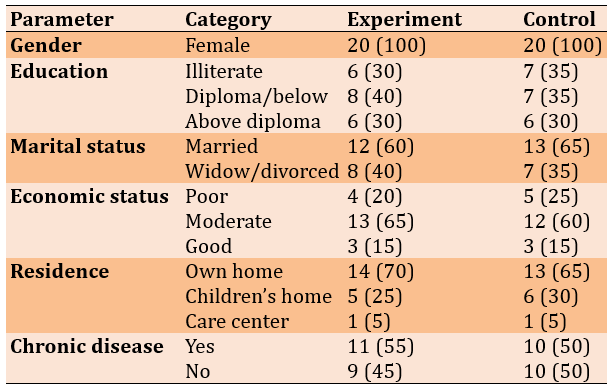
The experimental and control groups were comparable with respect to key demographic variables, including age, education level, marital status, economic status, type of residence, and history of chronic diseases. The distributions of education, marital and economic status, and chronic diseases were similar across groups, confirming their initial homogeneity (Table 1).
Table 1. Frequency distribution of demographic characteristics of participants in experimental and control groups
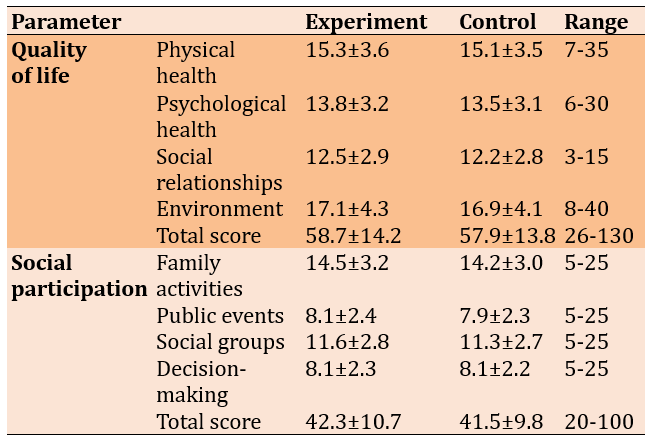
Both the experimental and control groups had moderate, comparable levels of quality of life and social participation prior to the intervention. Analysis of the subcomponents also revealed no notable differences between groups across physical, psychological, social, and environmental dimensions of quality of life, as well as in all dimensions of social participation. Statistical analysis confirmed no significant differences between the groups (Table 2).
Table 2. Comparison of means of quality of life and social participation in the pre-test phase
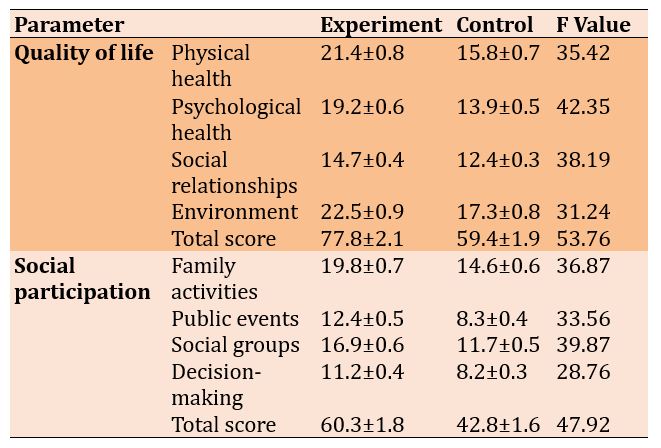
The analysis of post-test results demonstrated that psychological resilience training led to significant improvements in all quality-of-life and social-participation dimensions in the experimental group compared to the control group. ANCOVA revealed statistically significant differences across all primary and subcomponents, indicating the strong impact of the intervention. The greatest improvements were observed in psychological health and social interactions, while other areas, such as environmental quality of life and participation in community decision-making, also showed notable, though somewhat smaller, changes. The intervention effect sizes ranged from moderate to high, confirming the effectiveness of the training program (Table 3).
Table 3. Comparison of post-test results and statistical indices of research parameters (p<0.001 for all cases)
Discussion
The results of this study indicate a strong and significant effect of resilience training on improving the quality of life and social participation in mothers with intellectually disabled children. The 32.5% increase in the overall quality-of-life score in the experimental group can be analyzed through Bandura’s social learning theory, as the training provided to mothers strengthened their self-efficacy in managing parenting challenges. This finding is consistent with previous research emphasizing the role of positive psychology in increasing hopefulness [22]. Analysis of the mechanism of effect shows that the improvement in psychological health (a 39.7% increase) was more pronounced than in other dimensions of quality of life, highlighting the importance of psychological interventions in reducing the emotional burden on mothers. This pattern was also observed in studies where resilience training led to a significant reduction in mothers’ stress levels [13].
In the field of social participation, the 43.7% increase in the overall score for this variable indicates the capacity of person-centered interventions to change social interaction patterns. Qualitative data analysis suggests that improvements in communication skills and increased self-confidence among mothers were the most significant facilitators of this change. These findings are consistent with research on the impact of family-centered training [15] and, conversely, confirm the effectiveness of acceptance and commitment-based therapy [2]. Nevertheless, the more limited improvement in the component of participation in community decision-making (a 36.6% increase) suggests that change in this dimension requires structural interventions and shifts in social attitudes, a challenge also pointed out in previous studies [19].
The differences in the degree of impact across various dimensions of quality of life are noteworthy. While subjective domains such as psychological health and social relationships improved markedly, the changes in the environmental dimension (a 31.6% increase) were more limited. This finding can be analyzed through Bronfenbrenner’s ecological theory, which emphasizes the mutual influence of different environmental layers. The results of the present study show that although individual interventions have a strong impact on intrapersonal factors, changing environmental factors requires the cooperation of social institutions. This pattern is consistent with previous studies examining cognitive flexibility [20].
The relative stability of scores in the control group in this study is consistent with findings reported in longitudinal studies, such as Zheng et al. [28]. Analysis of this finding shows that the challenges faced by mothers of intellectually disabled children tend to persist in the absence of specialized support. The large calculated effect size (between 1.2 and 1.8) not only reflects the efficacy of the present intervention but also highlights the importance of designing evidence-based programs. This is consistent with previous findings on the effectiveness of positive psychotherapy [16].
Compared to other intervention methods, the current person-centered approach appears to have relative superiority in improving the emotional and communication aspects of quality of life. This finding, which is aligned with the results of Kidman et al. [29], is likely due to the interactive and multidimensional nature of the current intervention. However, as noted by Zhang [30], integrating this approach with new technologies could expand the intervention's impact.
The findings of this study have important implications for clinical practice and health policy. Integrating psychological resilience training into routine care programs for mothers of children with intellectual disabilities could significantly enhance their psychological well-being and social functioning. Healthcare providers, including psychologists and social workers, should be trained to deliver standardized resilience-building interventions as part of comprehensive family support services. On the policy level, it is recommended that health authorities and welfare organizations allocate resources to develop accessible resilience training and psychosocial support services, especially for vulnerable elderly caregivers. International evidence shows that similar interventions improve caregiver outcomes and reduce the overall burden on health systems [8]. Implementing such evidence-based programs may also help reduce social isolation among at-risk mothers and strengthen community health.
The practical implications of the present study are considerable for both clinical services and health policy. Integrating psychological resilience training into the routine support programs offered by rehabilitation centers and welfare organizations could provide a cost-effective and scalable strategy to enhance mental health and social functioning in mothers of children with intellectual disabilities. Training psychologists and social workers to deliver group-based resilience training is recommended, as such programs have shown effectiveness in reducing caregiver stress and improving overall family well-being in various contexts [21]. At the policy level, allocating dedicated resources to the development and dissemination of psychosocial support services tailored to caregiver needs can help reduce caregiver burden and prevent secondary mental health complications [3]. International experiences indicate that integrating psychological interventions into public health strategies can reduce the long-term costs associated with untreated psychological distress and increase the quality of life of vulnerable populations [6]. Addressing structural barriers, such as limited access to mental health care and social stigma, should be a priority for policymakers aiming to support mothers of children with special needs.
This study has several limitations, including the use of convenience sampling, limited control for confounding variables (such as family support), and a lack of long-term follow-up. It is recommended that future studies use longitudinal designs, random sampling, and consider intermediary variables, such as social support, to examine the sustainability of intervention effects. Moreover, the design of multilevel interventions targeting the individual, family, and community levels simultaneously could represent a valuable next step in this field of research.
Conclusion
Resilience training improves the quality of life and social participation of mothers of intellectually disabled children.
Acknowledgments: We sincerely thank all the esteemed mothers who, with their patience and cooperation, made a valuable contribution to this research.
Ethical Permissions: This research was approved by the Ethics Committee of Ilam University of Medical Sciences with the code IR.MEDILAM.REC.1404.036.
Conflicts of Interests: The authors declare that there is no conflict of interest.
Authors' Contribution: Menati R (First Author), Methodologist/Discussion Writer (17%); Omidi N (Second Author), Introduction Writer/Main Researcher (17%); Fakour Y (Third Author), Statistical Analyst (16%); Mohamadian F (Fourth Author), Introduction Writer/Discussion Writer (16%); Omidi MR (Fifth Author), Methodologist/Statistical Analyst (17%); Momtaz-Bakhsh M (Sixth Author), Assistant Researcher (17%);
Funding/Support: This research was financially supported by Ilam University of Medical Sciences.
Psychological resilience, as a multidimensional and dynamic construct in positive psychology, is defined as an individual’s ability to effectively cope with stressful situations, maintain psychological balance during crises, and return to an optimal level of functioning after experiencing life’s adversities [1, 2]. This concept goes beyond resistance to stress and encompasses active adaptation processes and post-adversity growth [3]. In recent years, numerous studies have shown that resilience is not a fixed trait but a set of acquired skills that can be strengthened through training and psychological interventions [4, 5]. These findings are particularly important for vulnerable populations, such as elderly mothers of exceptional children, who simultaneously face challenges associated with aging and the heavy responsibilities of caring for an exceptional child [6, 7].
Epidemiological studies at the international level indicate that about 70-85% of mothers with children with severe intellectual or physical disabilities experience high levels of caregiver burnout [8]. This condition is more pronounced among elderly mothers due to various reasons, including reduced physical capacity, mobility limitations, chronic health problems, and reduced social support networks [2, 9]. Longitudinal studies have shown that, compared to their peers without exceptional children, these mothers report significantly higher rates of psychosomatic disorders, major depression, and anxiety disorders [10]. These conditions not only affect the individual quality of life of these mothers, but also the overall functioning of the family and even the mental health of the exceptional child [11].
Social participation, as a multidimensional construct in social psychology, includes three main components: 1) physical presence in group activities, 2) meaningful social interactions, and 3) a sense of belonging to social groups [12, 13]. This concept is particularly important for the elderly, as studies have shown that maintaining effective social connections at this stage of life is one of the strongest predictors of mental and physical health [14]. However, field research in Iran shows that elderly mothers with exceptional children participate in social activities outside the home only about 1.8 times per month on average [15]. This social isolation results from multiple factors, including time constraints due to caregiving, social stigma associated with the child’s disability, transportation difficulties, and chronic fatigue [16]. The consequences of this social isolation are extensive and include increased risk of depression (at a rate of 40-60%), anxiety disorders (35-50%), sleep disorders, and worsening of chronic illnesses [17].
Quality of life, as a subjective and multidimensional concept, includes an individual’s assessment of their life situation in four main domains: 1) physical health, 2) psychological status, 3) social relationships, and 4) environmental conditions/with respect to elderly mothers with exceptional children, each of these domains is specifically affected [18]. In the physical domain, the pressures of long-term care lead to problems such as chronic musculoskeletal pain, gastrointestinal disorders, and a weakened immune system [19]. In the psychological domain, these mothers face challenges such as feelings of guilt, chronic sorrow, and concern about the future of their child after their own death [2]. In the social domain, caregiving constraints severely shrink these mothers’ social networks. Finally, in the environmental domain, financial difficulties due to medical and rehabilitation expenses limit these families’ access to appropriate living resources and facilities [20].
Over the past two decades, various psychological interventions have been designed and implemented to improve resilience in vulnerable populations [21]. These include positive psychotherapy focused on strengthening an individual’s strengths and internal resources [22], acceptance and commitment therapy (ACT) emphasizing psychological flexibility [2], and family empowerment programs aimed at strengthening problem-solving and stress management skills [15]. However, a systematic review of studies shows that few investigations have examined the effects of these interventions on social participation and quality of life in elderly mothers with exceptional children [20]. This is while strengthening resilience can, through various mechanisms such as increased distress tolerance, improved coping strategies, and enhanced self-efficacy, help these mothers adapt to challenges and maintain their social functioning [23].
An in-depth exploration of resilience's mechanisms of impact on psychosocial outcomes reveals that this construct operates through several distinct yet interrelated pathways. First, resilience, by increasing cognitive flexibility, helps individuals reframe stressful situations and find adaptive solutions for facing challenges [12]. This process functions by modulating cognitive appraisal and reducing catastrophic thinking. Second, resilience, by strengthening emotion regulation and distress tolerance skills, reduces the likelihood of social withdrawal [24]. Third, resilience increases motivation for social participation by enhancing self-efficacy and a sense of personal control. Fourth, resilience, by fostering optimism and hopefulness, creates a positive outlook toward the future, which is essential for maintaining social participation in difficult situations [21].
Despite significant advances in our understanding of resilience and its clinical applications, several important research gaps remain in this field [3]. First, most studies have focused on younger mothers, and the role of resilience in elderly mothers has received less attention [18], while resilience processes in old age may have unique characteristics. Second, the effect of resilience interventions on social participation has rarely been studied [15]. Third, limited research has examined the simultaneous effects of resilience on both quality of life and social participation [16]. Fourth, only a few studies have investigated mediating and moderating factors in the relationship between resilience and psychosocial outcomes in this specific population [25]. This study was designed to fill these research gaps while accounting for the specific sociocultural considerations of Iranian society.
Materials and Methods
This study was conducted as a quasi-experimental study with a pre-test-post-test control-group design and a follow-up phase. The statistical population consisted of all elderly mothers aged 60 years and above with exceptional children covered by the Welfare Organization in Ilam city without severe psychological disorders. Based on a power analysis conducted with G*Power (effect size=0.8; α=0.05; power=0.8; two-tailed), a minimum of 26 participants per group was required. To increase validity and account for possible attrition, 30 people were selected for both the intervention and control groups. Sampling was conducted using a convenience sampling method among eligible mothers attending welfare centers. After eligibility was determined and written informed consent obtained, participants were randomly assigned to either the experimental or control group.
All ethical principles, including obtaining informed consent, confidentiality, voluntary participation, and the right to withdraw at any stage, were strictly observed, and free counseling services were offered to all participants as needed. The psychological resilience training program was administered to the experimental group in eight weekly sessions, each lasting 90 minutes, at the Welfare Organization counseling centers. Educational content was designed based on Connor & Davidson’s model [26], and covered three principal stages: The first stage (sessions 1-3) included an introduction to the concept of resilience, identification of both internal and external resources, and encouragement of a positive outlook; In the second stage (sessions 4-6), practical skills such as problem-solving, emotion regulation, and stress management were taught; While the third stage (sessions 7-8) aimed to consolidate these skills and guide participants in developing action plans to promote social participation. Each session consisted of theoretical presentations, practical exercises, group discussion, and homework assignments. The control group did not receive any intervention during this period, but to ensure ethical considerations, the training was offered to them after the study was completed.
To measure the research variables, two standardized instruments were used: The Social Participation Questionnaire [27], which includes 20 items covering four domains—participation in family activities, attendance at public events, interaction with social groups, and engagement in community decision-making—with a Cronbach’s alpha of 0.85, and the Persian version of the World Health Organization Quality of Life Questionnaire (WHOQOL-BREF), which consists of 26 items measuring four domains—physical health, psychological health, social relationships, and environmental conditions. Data from all participants were collected at three points in time: Prior to the intervention (pre-test), one-month post-intervention (post-test), and at a follow-up stage.
Statistical analyses were performed using SPSS 26 software. Descriptive statistics (means, standard deviations, frequencies, and percentages) were used to examine demographic variables and summarize main findings. To compare quantitative variables between the two groups at different stages, independent t-tests were used; paired t-tests were used for within-group comparisons across time points. To control for pre-test scores and compare post-intervention outcomes between groups, an analysis of covariance (ANCOVA) was conducted. The effect size of the intervention was also assessed using Cohen’s d and partial eta squared. Normality of the data was assessed using the Kolmogorov-Smirnov test, and equality of variances was assessed using Levene’s test. All statistical tests were two-tailed, and significance was set at p<0.05.
Findings
The experimental and control groups were comparable with respect to key demographic variables, including age, education level, marital status, economic status, type of residence, and history of chronic diseases. The distributions of education, marital and economic status, and chronic diseases were similar across groups, confirming their initial homogeneity (Table 1).
Table 1. Frequency distribution of demographic characteristics of participants in experimental and control groups
Both the experimental and control groups had moderate, comparable levels of quality of life and social participation prior to the intervention. Analysis of the subcomponents also revealed no notable differences between groups across physical, psychological, social, and environmental dimensions of quality of life, as well as in all dimensions of social participation. Statistical analysis confirmed no significant differences between the groups (Table 2).
Table 2. Comparison of means of quality of life and social participation in the pre-test phase
The analysis of post-test results demonstrated that psychological resilience training led to significant improvements in all quality-of-life and social-participation dimensions in the experimental group compared to the control group. ANCOVA revealed statistically significant differences across all primary and subcomponents, indicating the strong impact of the intervention. The greatest improvements were observed in psychological health and social interactions, while other areas, such as environmental quality of life and participation in community decision-making, also showed notable, though somewhat smaller, changes. The intervention effect sizes ranged from moderate to high, confirming the effectiveness of the training program (Table 3).
Table 3. Comparison of post-test results and statistical indices of research parameters (p<0.001 for all cases)
Discussion
The results of this study indicate a strong and significant effect of resilience training on improving the quality of life and social participation in mothers with intellectually disabled children. The 32.5% increase in the overall quality-of-life score in the experimental group can be analyzed through Bandura’s social learning theory, as the training provided to mothers strengthened their self-efficacy in managing parenting challenges. This finding is consistent with previous research emphasizing the role of positive psychology in increasing hopefulness [22]. Analysis of the mechanism of effect shows that the improvement in psychological health (a 39.7% increase) was more pronounced than in other dimensions of quality of life, highlighting the importance of psychological interventions in reducing the emotional burden on mothers. This pattern was also observed in studies where resilience training led to a significant reduction in mothers’ stress levels [13].
In the field of social participation, the 43.7% increase in the overall score for this variable indicates the capacity of person-centered interventions to change social interaction patterns. Qualitative data analysis suggests that improvements in communication skills and increased self-confidence among mothers were the most significant facilitators of this change. These findings are consistent with research on the impact of family-centered training [15] and, conversely, confirm the effectiveness of acceptance and commitment-based therapy [2]. Nevertheless, the more limited improvement in the component of participation in community decision-making (a 36.6% increase) suggests that change in this dimension requires structural interventions and shifts in social attitudes, a challenge also pointed out in previous studies [19].
The differences in the degree of impact across various dimensions of quality of life are noteworthy. While subjective domains such as psychological health and social relationships improved markedly, the changes in the environmental dimension (a 31.6% increase) were more limited. This finding can be analyzed through Bronfenbrenner’s ecological theory, which emphasizes the mutual influence of different environmental layers. The results of the present study show that although individual interventions have a strong impact on intrapersonal factors, changing environmental factors requires the cooperation of social institutions. This pattern is consistent with previous studies examining cognitive flexibility [20].
The relative stability of scores in the control group in this study is consistent with findings reported in longitudinal studies, such as Zheng et al. [28]. Analysis of this finding shows that the challenges faced by mothers of intellectually disabled children tend to persist in the absence of specialized support. The large calculated effect size (between 1.2 and 1.8) not only reflects the efficacy of the present intervention but also highlights the importance of designing evidence-based programs. This is consistent with previous findings on the effectiveness of positive psychotherapy [16].
Compared to other intervention methods, the current person-centered approach appears to have relative superiority in improving the emotional and communication aspects of quality of life. This finding, which is aligned with the results of Kidman et al. [29], is likely due to the interactive and multidimensional nature of the current intervention. However, as noted by Zhang [30], integrating this approach with new technologies could expand the intervention's impact.
The findings of this study have important implications for clinical practice and health policy. Integrating psychological resilience training into routine care programs for mothers of children with intellectual disabilities could significantly enhance their psychological well-being and social functioning. Healthcare providers, including psychologists and social workers, should be trained to deliver standardized resilience-building interventions as part of comprehensive family support services. On the policy level, it is recommended that health authorities and welfare organizations allocate resources to develop accessible resilience training and psychosocial support services, especially for vulnerable elderly caregivers. International evidence shows that similar interventions improve caregiver outcomes and reduce the overall burden on health systems [8]. Implementing such evidence-based programs may also help reduce social isolation among at-risk mothers and strengthen community health.
The practical implications of the present study are considerable for both clinical services and health policy. Integrating psychological resilience training into the routine support programs offered by rehabilitation centers and welfare organizations could provide a cost-effective and scalable strategy to enhance mental health and social functioning in mothers of children with intellectual disabilities. Training psychologists and social workers to deliver group-based resilience training is recommended, as such programs have shown effectiveness in reducing caregiver stress and improving overall family well-being in various contexts [21]. At the policy level, allocating dedicated resources to the development and dissemination of psychosocial support services tailored to caregiver needs can help reduce caregiver burden and prevent secondary mental health complications [3]. International experiences indicate that integrating psychological interventions into public health strategies can reduce the long-term costs associated with untreated psychological distress and increase the quality of life of vulnerable populations [6]. Addressing structural barriers, such as limited access to mental health care and social stigma, should be a priority for policymakers aiming to support mothers of children with special needs.
This study has several limitations, including the use of convenience sampling, limited control for confounding variables (such as family support), and a lack of long-term follow-up. It is recommended that future studies use longitudinal designs, random sampling, and consider intermediary variables, such as social support, to examine the sustainability of intervention effects. Moreover, the design of multilevel interventions targeting the individual, family, and community levels simultaneously could represent a valuable next step in this field of research.
Conclusion
Resilience training improves the quality of life and social participation of mothers of intellectually disabled children.
Acknowledgments: We sincerely thank all the esteemed mothers who, with their patience and cooperation, made a valuable contribution to this research.
Ethical Permissions: This research was approved by the Ethics Committee of Ilam University of Medical Sciences with the code IR.MEDILAM.REC.1404.036.
Conflicts of Interests: The authors declare that there is no conflict of interest.
Authors' Contribution: Menati R (First Author), Methodologist/Discussion Writer (17%); Omidi N (Second Author), Introduction Writer/Main Researcher (17%); Fakour Y (Third Author), Statistical Analyst (16%); Mohamadian F (Fourth Author), Introduction Writer/Discussion Writer (16%); Omidi MR (Fifth Author), Methodologist/Statistical Analyst (17%); Momtaz-Bakhsh M (Sixth Author), Assistant Researcher (17%);
Funding/Support: This research was financially supported by Ilam University of Medical Sciences.
Keywords:
References
1. Yuan X, Mao Y, Xu X, Peng R, Tang M, Dai G, et al. The relationship between resilience and mental health: Mobile phone dependence and its differences across levels of parent-child conflict among left-behind adolescents: A cross-sectional network analysis. BMC Public Health. 2025;25(1):940. [Link] [DOI:10.1186/s12889-025-22105-8]
2. Hojatkhah SM, Golmohammadian M. Effectiveness of group therapy based on acceptance and commitment on resilience mothers of children with mental retardation. Psychol Except Individ. 2018;8(29):85-109. [Persian] [Link]
3. Southwick SM, Bonanno GA, Masten AS, Panter-Brick C, Yehuda R. Resilience definitions, theory, and challenges: Interdisciplinary perspectives. Eur J Psychotraumatol. 2014;5. [Link] [DOI:10.3402/ejpt.v5.25338]
4. Zeng Y, Tan Y, Jia CX, Li L. Late-life informal social participation, physical and cognitive functions among the Chinese elderly: A life course perspective. Healthcare. 2025;13(3):232. [Link] [DOI:10.3390/healthcare13030232]
5. Liu X, Chen JH, Gao B, Zhang WJ. Social isolation and depressive symptoms among older adults with different functional status in China: A latent class analysis. J Affect Disord. 2025;375:478-85. [Link] [DOI:10.1016/j.jad.2025.01.156]
6. Tan Y, Huang Z, Wang Y, Huang X, Hu B. Mediating role of psychological resilience in the relationship between self-neglect and frailty among older adults. Geriatr Nurs. 2025;62(Pt A):168-74. [Link] [DOI:10.1016/j.gerinurse.2025.01.019]
7. Huang C, He X, Zhang X. A study on the mechanism of how sensory impairment affects depression in the elderly: The mediating roles of daily activity capability and social participation. Front Psychol. 2024;15:1410422. [Link] [DOI:10.3389/fpsyg.2024.1410422]
8. Enami K, Kondo T, Kajiwara K, Kawaguchi R, Kato T. Mothers' parental divorce experience in childhood and their children's mental health: Mediating role of maternal education. J Affect Disord. 2024;358:483-6. [Link] [DOI:10.1016/j.jad.2024.05.004]
9. Fazaa A, Rachdi M, Salem LB, El Ghardallou M, Miladi S, Boussaa H, et al. Functional capacity and quality of life in elderly patients with knee osteoarthritis. Musculoskeletal Care. 2024;22(4):e70027. [Link] [DOI:10.1002/msc.70027]
10. Zhang J, Su D, Smith AP, Yang L. Reducing work withdrawal behaviors when faced with work obstacles: A three-way interaction model. Behav Sci. 2023;13(11):908. [Link] [DOI:10.3390/bs13110908]
11. You Z, Zhang Y, Ye H, Fan F. Latent profiles of parental psychological control, harsh parenting, and adolescent psychological resilience: Associations with adolescent depressive symptoms. Psychopathology. 2025;58(5):323-33. [Link] [DOI:10.1159/000546656]
12. Nikkhoo F, Hosseini Ghomi T. Prediction of mental health and resilience of mothers with slow-paced child based on cognitive flexibility. Empower Except Chil. 2021;12(1):12-20. [Persian] [Link]
13. Hosseini Ghomi T, Jahanbakhshi Z. Effectiveness of resilience training on stress and mental health of mothers whose have children suffering mental retardation. Couns Cult Psycother. 2021;12(46):205-28. [Persian] [Link]
14. Wang C, Pan R, Wan X, Tan Y, Xu L, Ho CS, et al. Immediate psychological responses and associated factors during the initial stage of the 2019 coronavirus disease (COVID-19) epidemic among the general population in China. Int J Environ Res Public Health. 2020;17(5):1729. [Link] [DOI:10.3390/ijerph17051729]
15. Sabzmanesh Jafari S, Amraei K, Hasanzadeh N. The effectiveness of family resilience training on psychological hardinessof mothers of children with disability. Iran J Rehabil Res Nurs. 2021;7(4):29-37. [Persian] [Link]
16. Azad R, Aleyasin SA. Meaning of life, mothers of mentally retarded children, positive psychotherapy, psychological well-being, resilience. Psychol J. 2023;12(5):161-72. [Persian] [Link]
17. Uneno Y, Kotera Y, Kikuchi K, Yamada M, Sugitani M, Terado S, et al. Self-compassion-based online group psychotherapy for bereavement-related grief: The COMPACT feasibility trial. Gen Hosp Psychiatry. 2024;90:116-23. [Link] [DOI:10.1016/j.genhosppsych.2024.08.009]
18. Joneidi R, Razaghi N, Mohamadzadeh A, Mazloom SR. The effect of mothers empowerment program with infant congenital heart disease on their resilience. Iran J Nurs Res. 2023;18(1):67-75. [Persian] [Link]
19. Nemati S. The role of resiliency and psychological hardiness in predicting psychological well-being. Posit Psychol Res. 2020;5(3):1-12. [Persian] [Link]
20. Kazemi N, Dadashloo F, Seyf FS. Prediction of psychological well-being and resilience in mothers of children with autism spectrum disorder based on cognitive flexibility. Middle East J Disabil Stud. 2019;9:12. [Persian] [Link]
21. Slomowitz RF, Narayan AJ, McGrath LM. Resilience research in learning disabilities: Guiding principles from developmental psychopathology. Learn Instr. 2025;97:102090. [Link] [DOI:10.1016/j.learninstruc.2025.102090]
22. Reza Zadeh S, Khodabakhshi-Koolaee A, Hamidy Pour R, Sanagoo A. Effectiveness of positive psychology on hope and resilience in mothers with mentally retarded children. Iran J Psychiatr Nurs. 2018;6(3):32-8. [Persian] [Link]
23. Momeni K, Janati A, Imani A, Khodayari-Zarnaq R. Barriers to the development of medical tourism in East Azerbaijan province, Iran: A qualitative study. Tour Manag. 2018;69:307-16. [Link] [DOI:10.1016/j.tourman.2018.05.007]
24. Li W, Xin D, Feng X, Li Y, Zhu W, Xu J, et al. ADL and cognitive function in Chinese elderly: Mediating role of social participation and moderating role of intergenerational support. J Multidiscip Healthc. 2025;18:2509-22. [Link] [DOI:10.2147/JMDH.S523168]
25. Danese A, Martsenkovskyi D, Remberk B, Khalil MY, Diggins E, Keiller E, et al. Scoping review: Digital mental health interventions for children and adolescents affected by war. J Am Acad Child Adolesc Psychiatry. 2025;64(2):226-48. [Link] [DOI:10.1016/j.jaac.2024.02.017]
26. Connor KM, Davidson JR. Development of a new resilience scale: The Connor-Davidson Resilience Scale (CD-RISC). Depress Anxiety. 2003;18(2):76-82. [Link] [DOI:10.1002/da.10113]
27. Salzer MS, Brusilovskiy E, Prvu-Bettger J, Kottsieper P. Measuring community participation of adults with psychiatric disabilities: Reliability of two modes of data collection. Rehabil Psychol. 2014;59(2):211-9. [Link] [DOI:10.1037/a0036002]
28. Zheng DD, Lee DJ, Rundek T, Lam BL, Gregori NZ, Curiel RE, et al. Visual impairment and cognitive function in aging adults: Sex and age differences in mediating effect of social isolation and depression. Am J Ophthalmol. 2025;274:196-208. [Link] [DOI:10.1016/j.ajo.2025.02.043]
29. Kidman PG, Curtis RG, Watson A, Maher CA. When and why adults abandon lifestyle behavior and mental health mobile apps: Scoping review. J Med Internet Res. 2024;26:e56897. [Link] [DOI:10.2196/56897]
30. Zhang D. Pain and the risk of social isolation and loneliness in older Chinese adults: Do gender, age, and education make a difference?. Soc Sci Med. 2024;363:117486. [Link] [DOI:10.1016/j.socscimed.2024.117486]