

1.0
Cite Score 2025
SJR: 0.129 / SNIP: 0.140

JMERC
Owner
Janbazan Medical and Engineering Research Center (JMERC) is the owner of IJWPH.
Volume 18, Issue 1 (2026)
3 2026, 18(1): 57-64 |
Back to browse issues page
Request Type:




History
Received: 2026/05/4 | Accepted: 2026/01/29 | Published: 2026/01/29
Received: 2026/05/4 | Accepted: 2026/01/29 | Published: 2026/01/29
How to cite this article
Hasanvand B. Effect of Functional Training on Brain-Derived Neurotropic Factor and Cognitive Flexibility in Obese Elderly Men. 3 2026; 18 (1) :57-64
URL: http://ijwph.daneshafarand.org/article-3-85671-en.html
URL: http://ijwph.daneshafarand.org/article-3-85671-en.html
Download citation:
BibTeX | RIS | EndNote | Medlars | ProCite | Reference Manager | RefWorks
Send citation to:


Rights and permissions
BibTeX | RIS | EndNote | Medlars | ProCite | Reference Manager | RefWorks
Send citation to:


Department of Physical Education, Khor.C. (Khorramabad Campus), Islamic Azad University, Khorramabad, Iran
Full-Text (HTML) (84 Views)
Introduction
Aging is considered one of the major global challenges of today. According to credible reports, a significant proportion of the population over the age of 65 suffers from obesity. Due to sedentary lifestyles and reduced physical activity associated with modern, mechanized living, the prevalence of this condition is steadily increasing, bringing numerous complications for this segment of society [1]. Statistics indicate that the prevalence of overweight is higher among men than among women [2].
There is growing evidence that obesity has detrimental effects on the brain and cognitive functioning. Among the many aging-related issues, cognitive decline—particularly in executive functions such as cognitive flexibility—holds special significance [3]. Cognitive flexibility, defined as the ability to shift attention between tasks, adapt to changes, and think beyond fixed patterns, is a key factor in maintaining independence and quality of life in older adults. Any impairment in this domain can lead to deficits in processes such as problem-solving, planning, and everyday decision-making [4].
Previous studies have also demonstrated a link between changes in body composition (e.g., obesity and overweight) and cognitive dysfunction in the elderly [3, 5]. Supporting this evidence, research findings have shown that executive functions (EFs) in these individuals are significantly impaired, with noticeable deficits in cognitive performance and working memory [6]. Thus, the evidence suggests a direct relationship between obesity and impairments in executive functions [7].
Immunometabolic alterations induced by obesity have been identified as one of the key mechanisms underlying cognitive dysfunction [8]. Supporting this notion, previous research has shown that both abnormal fat accumulation and cognitive impairments are associated with reduced concentrations of brain-derived neurotrophic factor (BDNF), a critical protein linked to neuronal health and brain function [9, 10].
BDNF is the most abundant neurotrophic factor in the body, and its role in modulating neurodegenerative processes is well established. As a member of the neurotrophin family, BDNF contributes to neural plasticity, differentiation, and survival. Studies have demonstrated that BDNF levels significantly decline in conditions such as glucose dysregulation, type 2 diabetes, hyperglycemia, obesity, and insulin resistance. Conversely, physical activity-induced increases in BDNF secretion are considered one of the mechanisms underlying enhanced neuroprotection and cognitive performance [9].
Given the link between obesity, cognitive impairment, and BDNF levels, developing effective weight-loss strategies to mitigate such disorders and improve executive functions is of great importance. In this context, exercise is recognized as a cost-effective and practical intervention [11]. Previous findings have clearly demonstrated the relationship between physical activity, improved fitness, and reductions in body mass index (BMI). Moreover, exercise has been identified as a key factor in enhancing cognitive and brain function. Both aerobic and resistance training have been extensively studied in this regard [12].
However, most existing research has focused on aerobic exercise [13], likely due to its historical emphasis in neurocognitive studies and early findings—particularly in animal models—suggesting that resistance training does not significantly elevate BDNF levels [14]. For instance, acute aerobic exercise has been shown to increase tissue metabolism, leading to physiological changes such as elevated cardiac output, vascular stress, energy demands, and biological responses to hypoxia. These physiological responses—especially hypoxia—and increased cerebral and peripheral blood flow contribute to elevated BDNF levels [13].
Notably, considerable variability has been observed in BDNF levels following different types of exercise interventions, which appears to be influenced by factors such as individual differences, exercise intensity, and duration [15]. Research on the effects of resistance training and BDNF suggests a strong association between variables, such as the dosage and prescription method of resistance exercise, and changes in BDNF levels [16]. These changes may occur through multiple mechanisms, including cardiovascular adaptations, heightened sympathetic activity, and increased lactate production [17].
It is important to note that previous studies have reported inconsistent findings regarding the impact of resistance training on BDNF. While many have observed increases in BDNF, others have reported no significant changes [16]. These discrepancies are likely due to variations in how the exercise protocols were administered. Therefore, combining aerobic and resistance training may produce a synergistic effect, leading to more pronounced increases in BDNF.
Although the beneficial effects of exercise have been well documented in healthy individuals, considerable uncertainty remains regarding its impact on obese older adults [18]. Some researchers argue that evidence for improvements in executive function from exercise is limited [18], while others maintain that the findings are consistent and positive [19]. For example, Walsh & Tschakovsky conducted a study on elderly men and women and found that eight weeks of resistance training significantly increased BDNF levels [20]. Similarly, Ledreux et al. examined the effects of six months of aerobic exercise in healthy older adults and reported that the intervention not only significantly elevated serum BDNF levels but also increased hippocampal volume and improved spatial memory [21].
Moreover, previous studies have faced methodological and empirical limitations. For instance, the American College of Sports Medicine (ACSM) recommends that exercise prescriptions aimed at improving health and physical fitness should be based on the FITT principle—frequency, intensity, time, and type—with specific guidelines regarding how many days per week (frequency), how hard the exercise is (intensity), how long each session lasts (time), and what kind of exercise is performed (type) [19]. However, prior research has provided relatively limited information on these exercise-prescription parameters.
As a result, a specific training approach known as functional training has recently gained attention among researchers. This method incorporates both endurance and resistance components and emphasizes functional, multi-joint movements through aerobic activity and muscle strengthening [22]. Functional exercises can be adapted to any fitness level and typically involve greater muscular engagement than repetitive aerobic routines, thereby improving cardiovascular endurance, strength, and flexibility [22, 23].
Functional training also includes full-body exercises that engage movement patterns across multiple planes, delivered in short, intense, and varied circuit-style sessions. These sessions apply stress to various physiological systems in a balanced and integrative manner [24]. Some previous studies have demonstrated the beneficial effects of this type of training on anthropometric and body composition parameters in overweight women [25]. Furthermore, functional training has emerged as one of the leading global fitness trends [26], utilizing complex movement patterns that appear to increase energy expenditure—making it particularly appealing to individuals with obesity [27, 28].
Given the high prevalence of obesity and cognitive decline among elderly men, and the urgent need for effective interventions, the present study aimed to investigate the effects of a functional training program on serum BDNF levels and cognitive flexibility in obese older men. It was assumed that this exercise regimen would not only help modulate obesity-related risk factors but also enhance brain plasticity and cognitive flexibility through increased BDNF levels. Therefore, the findings may inform the development of targeted exercise programs and practical strategies to improve brain health and quality of life in obese elderly populations.
Materials and Methods
Design and participants
This study employed a quasi-experimental design with a pre-test/post-test structure and a control group and was conducted on 412 healthy men aged 60 to 75 years residing in elderly care centers in Khorramabad. The minimum sample size was determined to be 26 obese elderly men (13 per group), calculated using G*Power 3.1.9.2 with an alpha level of 5%, beta of 80%, and an effect size of 0.3. To account for potential dropout, a total of 30 obese elderly men were selected [29]. Sampling was conducted using a convenience method, and participants were randomly assigned to either the functional training group or the control group.
Inclusion criteria were a body mass index (BMI) greater than 30kg/m², the ability to walk 10 meters independently, the ability to stand independently for at least 10 seconds, normal vision, the ability to follow simple instructions, not having limiting musculoskeletal disorders, neurological disorders (e.g., stroke, Parkinson’s disease, paralysis), cardiovascular diseases, uncontrolled high blood pressure, memory-related dementia (defined as scoring below 22 out of 30 on the Mini-Mental State Examination), and no illness or medication affecting balance and movement. To ensure safety and capability, all participants were asked to perform these movements one week prior to the start of the study.
Instrument
Developed by Marshal Folstein in 1975, the Mini-Mental State Examination (MMSE) screens for cognitive decline in older adults. The MMSE consists of 20 items, yielding a total score of 30. A score below 22 indicates probable cognitive impairment. The questionnaire includes five subscales, including orientation, registration, attention and calculation, recent memory, and various language functions. The reliability coefficient was reported as 0.87 using Cronbach’s alpha, and the instrument's validity was confirmed through discriminant analysis between dementia and healthy groups. In Iran, the reliability of this questionnaire was reported as 0.81 using Cronbach’s alpha [29]. In the present study, the questionnaire's reliability was 0.72.
Originally developed by Stroop in 1935, the Stroop test assesses selective attention and cognitive flexibility and is widely used in cognitive evaluations [28]. The version used in this study was a computerized adaptation based on standard Stroop test variables. The test consists of three stages. Stage 1 is color naming, where participants are asked to identify colored circles (red, blue, yellow, green) displayed randomly on a computer monitor by pressing the corresponding color-labeled keys on the keyboard. This stage serves as a training phase and does not influence the final results. Stage 2 is congruent and incongruent word recognition. A total of 96 color words—48 congruent and 48 incongruent—are randomly and sequentially displayed on the monitor. Participants must respond solely to the color of the word, ignoring its semantic meaning, by pressing the corresponding labeled key. Each stimulus is presented for 2 seconds, with an inter-stimulus interval of 800 milliseconds. Stage 3 is rapid color identification colored. Circles (red, yellow, green, blue) are shown in succession, and participants must quickly press the corresponding labeled keys. They are instructed that the visual color may differ from the word’s meaning, with emphasis placed on identifying the color itself. The key performance indicators measured in this test were accuracy, defined as the number of correct responses, and speed, defined as the mean reaction time for correct responses, measured in milliseconds.
Procedure
Serum levels of brain-derived neurotrophic factor (BDNF) were measured using an enzyme-linked immunosorbent assay (ELISA) kit. Specifically, the Promega BDNF Emax ImmunoAssay System (Catalog No. G7611), manufactured in the United States, was employed according to the manufacturer’s standard protocol. The kit features a sensitivity of 15.6 picograms per milliliter and a detection range of 0.325 to 20 nanograms per milliliter.
At the outset of this study, necessary coordination was established with the elderly care center in Khorramabad, and ethical approval was obtained. After explaining the objectives and significance of the research, official permissions for implementation were secured. The study was conducted from September to November 2023. Following approval, participants underwent pre-test assessments. After a 12-hour overnight fast, blood samples were collected from participants between 8:00 and 9:00 AM at Noor Laboratory in Khorramabad by a qualified specialist. To prevent post-sampling hypotension, each participant was provided with a small cake and a glass of milk (approximately 300 calories). Subsequently, participants completed the computerized Stroop test to assess their executive functions. Based on their pre-test scores for executive function and serum BDNF levels, participants were randomly assigned to two homogeneous groups: Functional training and control. The intervention phase then commenced, consisting of eight weeks of training, with three sessions per week, each lasting 40 minutes. Participants in the functional training group engaged in the prescribed exercise regimen, while the control group continued their usual daily activities. Post-test assessments were conducted 48 hours after the final training session. As in the pre-test phase, blood samples were collected after a 12-hour fast between 8:00 and 9:00 AM at Noor Laboratory. Participants then completed the Stroop test again to reassess their executive functions.
As recommended by La Scala Teixeira et al. [26], participants in the functional training group followed a supervised, in-person exercise protocol designed to enhance various physical capacities through an integrated, synergistic, and balanced approach. All training sessions were conducted in a controlled environment equipped with ergometers (treadmills and stationary bicycles) and resistance-training equipment and accessories.
Participants engaged in functional training three times per week, including both aerobic and resistance-based exercises. Each session lasted 45 minutes and was structured as follows: 5 minutes of warm-up, 15 minutes of aerobic exercise, 15 minutes of functional resistance training, and 5 minutes of cool-down.
Aerobic exercises were performed on treadmills or bicycles at a moderate intensity, corresponding to a Borg rating of perceived exertion (RPE) of 4-6. Resistance training was organized in a circuit format, consisting of three rounds across eight stations. Each round involved 40 seconds of activity followed by 20 seconds of passive rest.
The functional training program incorporated integrated resistance exercises. These activities included simultaneous upper- and lower-limb movements, multiplanar motions, core stability drills, motor coordination, and balance training. The intensity was maintained at an RPE of 4-6 on a 0-10 scale throughout weeks 1-8. The training was delivered in a circuit format with 8 stations, involving 40 seconds of exercise followed by 20 seconds of rest, repeated for 3 rounds, for a total duration of 25 minutes. This description is adapted from La Scala Teixeira et al. [26].
Statistical analysis
The Shapiro-Wilk test was employed to assess the normality of data distribution. Data analysis was performed using SPSS 22 using analysis of covariance (ANCOVA).
Findings
For the control group (n=15), the average age was 67.50±26.52 years, height was 164.40±13.30cm, weight was 84.50±30.54kg, and BMI was 31.60±2.50kg/m2. For the Experimental group (n=15), the average age was 68.30±23.29 years, height was 165.60±86.94cm, weight was 84.70±53.33kg, and BMI was 31.60±2.50 kg/m2.
In general, changes were observed in the BDNF levels and executive functions in the intervention groups compared to the control group in the post-test phase, relative to the pre-test phase (Table 1).
Table 1. Frequency of brain-derived neurotrophic factor (BDNF) levels, accuracy, and reaction time in pre- and post-test phases

To assess the homogeneity of variances between the experimental and control groups in the post-test phase, Levene’s test was conducted. The results confirmed homogeneity of variances for BDNF (F(1,28)=0.54; p<0.05), accuracy (F(1,28)=0.81; p<0.05), and reaction time (F(1,28)=1.77; p<0.05).
The Shapiro-Wilk test confirmed the normal distribution of scores for BDNF (Z=0.952; df=30; p<0.05), accuracy (Z=0.938; df=30; p<0.05), and reaction time (Z=0.946; df=12; p<0.05).
Correlation analysis revealed significant relationships between pre- and post-test scores for BDNF (r=0.622; p<0.01), accuracy (r=0.413, p<0.01), and reaction time (r=0.589, p<0.01).
The assumption of homogeneity of regression slopes was also examined. The regression slopes for BDNF (F=1.09; df=27; p<0.05), accuracy (F=3.30; df=27; p<0.05), and reaction time (F=2.72; df=27; p<0.05) were similar across groups, indicating a linear relationship between the dependent variables and their predictors.
A statistically significant difference was found between the groups in serum BDNF levels among elderly men, with an effect size of 0.19. Additional results indicated a significant difference in accuracy (number of correct responses) between the groups, with an effect size of 0.16. Furthermore, reaction time (response speed) also showed a significant difference between the groups, with an effect size of 0.17 (Table 2).
Table 2. ANCOVA results for comparing BDNF levels and executive functions between research groups
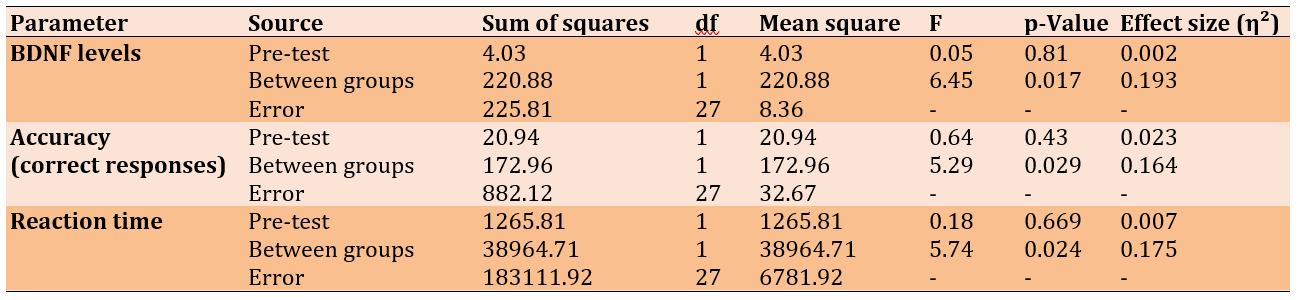
There was a statistically significant difference in BDNF levels between the functional training and control groups (p=0.017; t=5.43). Similarly, response accuracy differed significantly between the two groups (p=0.029; t=4.80). Likewise, the reaction time in the functional training group was significantly different from that of the control group (p=0.024; t=-5.024).
Discussion
The aim of the present study was to investigate the effects of functional training on BDNF levels and executive functions in obese elderly men. Functional training significantly increased BDNF levels in this population. Moreover, the training program led to notable improvements in executive functions, including the number of correct responses and reaction time. Research reported that a three-month high-intensity functional training program improves spatial learning, visual pattern discrimination, and attention span in adolescents. Their findings indicate significant differences in attention-related tasks between the training and control groups [30].
Previous research has demonstrated that BDNF plays a critical role in the mechanisms underlying neurodegenerative diseases, including neuronal survival, growth, differentiation, and plasticity. This protein is essential for learning, memory, and other cognitive functions. Low levels of BDNF have been associated with neuropsychiatric and degenerative disorders, such as Alzheimer’s disease (AD) and depression [14].
BDNF is also considered a key biological mediator of the effects of physical and cognitive training. Its levels in the human body are influenced by various factors, including gender, body weight, nutrition, and age. It is well established that BDNF concentration declines with aging, contributing to neural deterioration in older adults. Additionally, the number of BDNF-specific receptors is reduced in both healthy and AD-affected elderly individuals, limiting their ability to benefit from this neurotrophic factor [13].
Reduced BDNF levels and receptor availability negatively impact hippocampal synaptic plasticity and neurogenesis—two processes crucial for memory and learning. Therefore, physical activity may help counteract age-related cognitive decline by enhancing BDNF levels and supporting hippocampal function [14].
Currie et al. investigated the relationship between serum BDNF levels and cardiorespiratory fitness, reporting an inverse correlation. Specifically, individuals with higher cardiorespiratory fitness exhibit significantly lower BDNF levels. Although the precise mechanisms by which physical exercise affects the nervous system remain unclear, previous research suggests that reductions in oxidative stress and inflammation, increased angiogenesis, secretion of neurotrophins and catecholamines, and enhanced neurogenesis—particularly in the hippocampus—may play a role [31].
Given BDNF’s critical role in neuronal excitability and synaptic function, it is likely that BDNF is one of the key mediators through which physical activity induces structural and functional changes in the brain. Moreover, skeletal muscle, as the largest organ in the body, contributes significantly to neurogenesis, neuronal survival, and plasticity by releasing myokines, such as BDNF, thereby supporting cognitive performance [32].
Evidence suggests that resistance training may be more effective than aerobic training in elevating BDNF levels. High-intensity resistance and interval training have also been shown to be particularly beneficial for cognitive enhancement. Notably, functional training—which typically involves multi-joint movement patterns, balance challenges, and coordination tasks—may be especially effective in stimulating BDNF secretion. Compared to single-mode exercises, functional training demands greater cognitive engagement and activates broader brain regions involved in motor planning and sensorimotor processing, potentially enhancing BDNF signaling [33, 34].
Therefore, functional training, by combining the benefits of both aerobic and resistance modalities, may contribute to increased BDNF levels—a hypothesis supported by the findings of this study. Following a period of functional training, a significant increase in BDNF was observed among obese elderly men, aligning with much of the existing literature. Numerous studies have demonstrated that exercise interventions—particularly those incorporating both aerobic and resistance components—can elevate BDNF levels [35-37].
For example, Alizadeh & Dehghanizadeh [30] found that a functional training program significantly increases BDNF levels in overweight middle-aged women. However, contradictory findings also exist. Ruiz et al., in an 8-week resistance-training study in adults, report no significant post-intervention changes in serum BDNF levels. These discrepancies may be attributed to differences in training type, participant age, and BMI, as the subjects in Ruiz’s study were young and had normal BMI [38].
In contrast, Nascimento et al. [39] report a significant increase in peripheral BDNF levels following a 16-week multimodal training program in elderly individuals with MCL disease. It is worth noting that the average age of participants in Nascimento et al.’s study (66 years) is similar to that of the present study, whereas participants in Ruiz et al.’s [38] study are considerably older (92 years).
It appears that age may serve as a moderating variable in the regulatory response of BDNF to exercise interventions. In line with this, other researchers agree that aging is a biological regulator of peripheral BDNF concentration in humans. Several molecular mechanisms may explain the impact of functional exercise on serum BDNF levels [40, 41].
First, the present study included moderate-intensity aerobic training. It has been suggested that aerobic exercise increases intracellular calcium, thereby enhancing neuronal activity and subsequently stimulating the synthesis and release of BDNF. Additionally, resistance training promotes the synthesis of insulin-like growth factor 1 (IGF-1) in skeletal muscles of older men and women. This anabolic molecule ultimately induces BDNF production in the brain [42].
Moreover, lactate produced during exercise has been shown to enhance BDNF synthesis in the brain. Other mechanisms, such as increased cerebral blood flow, modulation of inflammatory and oxidative responses, and regulation of neurotransmitter systems, also contribute to elevated peripheral BDNF levels. Notably, serum BDNF is released during platelet activation, as platelets are the primary reservoir of circulating neurotrophins [43, 44].
Functional training significantly improved cognitive flexibility in obese elderly men. Supporting this, Pantoja-Cardoso et al. [45] report that functional training improves executive functions in older women. Among younger participants, Ben-Zeev et al. found that high-intensity functional training enhances spatial learning, visual pattern discrimination, and attention span in adolescents. Three months post-intervention, the training group outperformed the control group in all cognitive tasks, suggesting that such training may positively influence academic performance [46].
These observations may be attributed to increased BDNF expression following functional exercise, involving enhanced cellular processing in the brain (synthesis, secretion, uptake, and degradation). Given BDNF’s roles in memory, learning, synaptic plasticity, the maturation of immature neurons, and the longevity of mature neurons, the observed improvements in executive functions among elderly participants may reflect adaptive neurobiological changes [47].
Supporting this, Canton-Martínez et al. demonstrate that functional training increases BDNF expression in the brain—particularly in the hippocampus—via activation of the TrkB receptor. Aerobic exercise has also been shown to stimulate BDNF synthesis and release in brain regions rich in TrkB receptors, thereby promoting synaptic plasticity and enhancing memory, thereby improving cognitive flexibility [48, 49].
Overall, our findings suggest that a period of functional training significantly elevates serum BDNF levels and enhances cognitive flexibility in obese elderly men. Thus, occupational therapists and professionals working with older adults are encouraged to incorporate functional training to promote cognitive flexibility, synaptic connectivity, and BDNF regulation.
However, this study has certain limitations, including a small sample size and limited generalizability. Additionally, because of the cross-sectional design, causal inferences cannot be drawn. A longitudinal prospective study would better clarify the effects of functional training on BDNF and cognitive flexibility in obese elderly men. Finally, since the study was conducted exclusively among elderly men in Khorramabad, caution is advised when interpreting and generalizing the findings.
Conclusion
Functional training elevates serum BDNF levels and enhances cognitive flexibility in obese elderly men.
Acknowledgments: The authors would like to express their sincere gratitude to all individuals who supported the execution of this study, especially the respected elderly participants who took part in the research.
Ethical Permissions: This research was approved by the Islamic Azad University Ethical Committee (IR.IAU.B.REC.1403.044).
Conflicts of Interest: The authors declared no conflicts of interest.
Authors' Contribution: Hasanvand B. performed all study activities (100%).
Funding/Support: It wasn’t funded by any organization.
Aging is considered one of the major global challenges of today. According to credible reports, a significant proportion of the population over the age of 65 suffers from obesity. Due to sedentary lifestyles and reduced physical activity associated with modern, mechanized living, the prevalence of this condition is steadily increasing, bringing numerous complications for this segment of society [1]. Statistics indicate that the prevalence of overweight is higher among men than among women [2].
There is growing evidence that obesity has detrimental effects on the brain and cognitive functioning. Among the many aging-related issues, cognitive decline—particularly in executive functions such as cognitive flexibility—holds special significance [3]. Cognitive flexibility, defined as the ability to shift attention between tasks, adapt to changes, and think beyond fixed patterns, is a key factor in maintaining independence and quality of life in older adults. Any impairment in this domain can lead to deficits in processes such as problem-solving, planning, and everyday decision-making [4].
Previous studies have also demonstrated a link between changes in body composition (e.g., obesity and overweight) and cognitive dysfunction in the elderly [3, 5]. Supporting this evidence, research findings have shown that executive functions (EFs) in these individuals are significantly impaired, with noticeable deficits in cognitive performance and working memory [6]. Thus, the evidence suggests a direct relationship between obesity and impairments in executive functions [7].
Immunometabolic alterations induced by obesity have been identified as one of the key mechanisms underlying cognitive dysfunction [8]. Supporting this notion, previous research has shown that both abnormal fat accumulation and cognitive impairments are associated with reduced concentrations of brain-derived neurotrophic factor (BDNF), a critical protein linked to neuronal health and brain function [9, 10].
BDNF is the most abundant neurotrophic factor in the body, and its role in modulating neurodegenerative processes is well established. As a member of the neurotrophin family, BDNF contributes to neural plasticity, differentiation, and survival. Studies have demonstrated that BDNF levels significantly decline in conditions such as glucose dysregulation, type 2 diabetes, hyperglycemia, obesity, and insulin resistance. Conversely, physical activity-induced increases in BDNF secretion are considered one of the mechanisms underlying enhanced neuroprotection and cognitive performance [9].
Given the link between obesity, cognitive impairment, and BDNF levels, developing effective weight-loss strategies to mitigate such disorders and improve executive functions is of great importance. In this context, exercise is recognized as a cost-effective and practical intervention [11]. Previous findings have clearly demonstrated the relationship between physical activity, improved fitness, and reductions in body mass index (BMI). Moreover, exercise has been identified as a key factor in enhancing cognitive and brain function. Both aerobic and resistance training have been extensively studied in this regard [12].
However, most existing research has focused on aerobic exercise [13], likely due to its historical emphasis in neurocognitive studies and early findings—particularly in animal models—suggesting that resistance training does not significantly elevate BDNF levels [14]. For instance, acute aerobic exercise has been shown to increase tissue metabolism, leading to physiological changes such as elevated cardiac output, vascular stress, energy demands, and biological responses to hypoxia. These physiological responses—especially hypoxia—and increased cerebral and peripheral blood flow contribute to elevated BDNF levels [13].
Notably, considerable variability has been observed in BDNF levels following different types of exercise interventions, which appears to be influenced by factors such as individual differences, exercise intensity, and duration [15]. Research on the effects of resistance training and BDNF suggests a strong association between variables, such as the dosage and prescription method of resistance exercise, and changes in BDNF levels [16]. These changes may occur through multiple mechanisms, including cardiovascular adaptations, heightened sympathetic activity, and increased lactate production [17].
It is important to note that previous studies have reported inconsistent findings regarding the impact of resistance training on BDNF. While many have observed increases in BDNF, others have reported no significant changes [16]. These discrepancies are likely due to variations in how the exercise protocols were administered. Therefore, combining aerobic and resistance training may produce a synergistic effect, leading to more pronounced increases in BDNF.
Although the beneficial effects of exercise have been well documented in healthy individuals, considerable uncertainty remains regarding its impact on obese older adults [18]. Some researchers argue that evidence for improvements in executive function from exercise is limited [18], while others maintain that the findings are consistent and positive [19]. For example, Walsh & Tschakovsky conducted a study on elderly men and women and found that eight weeks of resistance training significantly increased BDNF levels [20]. Similarly, Ledreux et al. examined the effects of six months of aerobic exercise in healthy older adults and reported that the intervention not only significantly elevated serum BDNF levels but also increased hippocampal volume and improved spatial memory [21].
Moreover, previous studies have faced methodological and empirical limitations. For instance, the American College of Sports Medicine (ACSM) recommends that exercise prescriptions aimed at improving health and physical fitness should be based on the FITT principle—frequency, intensity, time, and type—with specific guidelines regarding how many days per week (frequency), how hard the exercise is (intensity), how long each session lasts (time), and what kind of exercise is performed (type) [19]. However, prior research has provided relatively limited information on these exercise-prescription parameters.
As a result, a specific training approach known as functional training has recently gained attention among researchers. This method incorporates both endurance and resistance components and emphasizes functional, multi-joint movements through aerobic activity and muscle strengthening [22]. Functional exercises can be adapted to any fitness level and typically involve greater muscular engagement than repetitive aerobic routines, thereby improving cardiovascular endurance, strength, and flexibility [22, 23].
Functional training also includes full-body exercises that engage movement patterns across multiple planes, delivered in short, intense, and varied circuit-style sessions. These sessions apply stress to various physiological systems in a balanced and integrative manner [24]. Some previous studies have demonstrated the beneficial effects of this type of training on anthropometric and body composition parameters in overweight women [25]. Furthermore, functional training has emerged as one of the leading global fitness trends [26], utilizing complex movement patterns that appear to increase energy expenditure—making it particularly appealing to individuals with obesity [27, 28].
Given the high prevalence of obesity and cognitive decline among elderly men, and the urgent need for effective interventions, the present study aimed to investigate the effects of a functional training program on serum BDNF levels and cognitive flexibility in obese older men. It was assumed that this exercise regimen would not only help modulate obesity-related risk factors but also enhance brain plasticity and cognitive flexibility through increased BDNF levels. Therefore, the findings may inform the development of targeted exercise programs and practical strategies to improve brain health and quality of life in obese elderly populations.
Materials and Methods
Design and participants
This study employed a quasi-experimental design with a pre-test/post-test structure and a control group and was conducted on 412 healthy men aged 60 to 75 years residing in elderly care centers in Khorramabad. The minimum sample size was determined to be 26 obese elderly men (13 per group), calculated using G*Power 3.1.9.2 with an alpha level of 5%, beta of 80%, and an effect size of 0.3. To account for potential dropout, a total of 30 obese elderly men were selected [29]. Sampling was conducted using a convenience method, and participants were randomly assigned to either the functional training group or the control group.
Inclusion criteria were a body mass index (BMI) greater than 30kg/m², the ability to walk 10 meters independently, the ability to stand independently for at least 10 seconds, normal vision, the ability to follow simple instructions, not having limiting musculoskeletal disorders, neurological disorders (e.g., stroke, Parkinson’s disease, paralysis), cardiovascular diseases, uncontrolled high blood pressure, memory-related dementia (defined as scoring below 22 out of 30 on the Mini-Mental State Examination), and no illness or medication affecting balance and movement. To ensure safety and capability, all participants were asked to perform these movements one week prior to the start of the study.
Instrument
Developed by Marshal Folstein in 1975, the Mini-Mental State Examination (MMSE) screens for cognitive decline in older adults. The MMSE consists of 20 items, yielding a total score of 30. A score below 22 indicates probable cognitive impairment. The questionnaire includes five subscales, including orientation, registration, attention and calculation, recent memory, and various language functions. The reliability coefficient was reported as 0.87 using Cronbach’s alpha, and the instrument's validity was confirmed through discriminant analysis between dementia and healthy groups. In Iran, the reliability of this questionnaire was reported as 0.81 using Cronbach’s alpha [29]. In the present study, the questionnaire's reliability was 0.72.
Originally developed by Stroop in 1935, the Stroop test assesses selective attention and cognitive flexibility and is widely used in cognitive evaluations [28]. The version used in this study was a computerized adaptation based on standard Stroop test variables. The test consists of three stages. Stage 1 is color naming, where participants are asked to identify colored circles (red, blue, yellow, green) displayed randomly on a computer monitor by pressing the corresponding color-labeled keys on the keyboard. This stage serves as a training phase and does not influence the final results. Stage 2 is congruent and incongruent word recognition. A total of 96 color words—48 congruent and 48 incongruent—are randomly and sequentially displayed on the monitor. Participants must respond solely to the color of the word, ignoring its semantic meaning, by pressing the corresponding labeled key. Each stimulus is presented for 2 seconds, with an inter-stimulus interval of 800 milliseconds. Stage 3 is rapid color identification colored. Circles (red, yellow, green, blue) are shown in succession, and participants must quickly press the corresponding labeled keys. They are instructed that the visual color may differ from the word’s meaning, with emphasis placed on identifying the color itself. The key performance indicators measured in this test were accuracy, defined as the number of correct responses, and speed, defined as the mean reaction time for correct responses, measured in milliseconds.
Procedure
Serum levels of brain-derived neurotrophic factor (BDNF) were measured using an enzyme-linked immunosorbent assay (ELISA) kit. Specifically, the Promega BDNF Emax ImmunoAssay System (Catalog No. G7611), manufactured in the United States, was employed according to the manufacturer’s standard protocol. The kit features a sensitivity of 15.6 picograms per milliliter and a detection range of 0.325 to 20 nanograms per milliliter.
At the outset of this study, necessary coordination was established with the elderly care center in Khorramabad, and ethical approval was obtained. After explaining the objectives and significance of the research, official permissions for implementation were secured. The study was conducted from September to November 2023. Following approval, participants underwent pre-test assessments. After a 12-hour overnight fast, blood samples were collected from participants between 8:00 and 9:00 AM at Noor Laboratory in Khorramabad by a qualified specialist. To prevent post-sampling hypotension, each participant was provided with a small cake and a glass of milk (approximately 300 calories). Subsequently, participants completed the computerized Stroop test to assess their executive functions. Based on their pre-test scores for executive function and serum BDNF levels, participants were randomly assigned to two homogeneous groups: Functional training and control. The intervention phase then commenced, consisting of eight weeks of training, with three sessions per week, each lasting 40 minutes. Participants in the functional training group engaged in the prescribed exercise regimen, while the control group continued their usual daily activities. Post-test assessments were conducted 48 hours after the final training session. As in the pre-test phase, blood samples were collected after a 12-hour fast between 8:00 and 9:00 AM at Noor Laboratory. Participants then completed the Stroop test again to reassess their executive functions.
As recommended by La Scala Teixeira et al. [26], participants in the functional training group followed a supervised, in-person exercise protocol designed to enhance various physical capacities through an integrated, synergistic, and balanced approach. All training sessions were conducted in a controlled environment equipped with ergometers (treadmills and stationary bicycles) and resistance-training equipment and accessories.
Participants engaged in functional training three times per week, including both aerobic and resistance-based exercises. Each session lasted 45 minutes and was structured as follows: 5 minutes of warm-up, 15 minutes of aerobic exercise, 15 minutes of functional resistance training, and 5 minutes of cool-down.
Aerobic exercises were performed on treadmills or bicycles at a moderate intensity, corresponding to a Borg rating of perceived exertion (RPE) of 4-6. Resistance training was organized in a circuit format, consisting of three rounds across eight stations. Each round involved 40 seconds of activity followed by 20 seconds of passive rest.
The functional training program incorporated integrated resistance exercises. These activities included simultaneous upper- and lower-limb movements, multiplanar motions, core stability drills, motor coordination, and balance training. The intensity was maintained at an RPE of 4-6 on a 0-10 scale throughout weeks 1-8. The training was delivered in a circuit format with 8 stations, involving 40 seconds of exercise followed by 20 seconds of rest, repeated for 3 rounds, for a total duration of 25 minutes. This description is adapted from La Scala Teixeira et al. [26].
Statistical analysis
The Shapiro-Wilk test was employed to assess the normality of data distribution. Data analysis was performed using SPSS 22 using analysis of covariance (ANCOVA).
Findings
For the control group (n=15), the average age was 67.50±26.52 years, height was 164.40±13.30cm, weight was 84.50±30.54kg, and BMI was 31.60±2.50kg/m2. For the Experimental group (n=15), the average age was 68.30±23.29 years, height was 165.60±86.94cm, weight was 84.70±53.33kg, and BMI was 31.60±2.50 kg/m2.
In general, changes were observed in the BDNF levels and executive functions in the intervention groups compared to the control group in the post-test phase, relative to the pre-test phase (Table 1).
Table 1. Frequency of brain-derived neurotrophic factor (BDNF) levels, accuracy, and reaction time in pre- and post-test phases
To assess the homogeneity of variances between the experimental and control groups in the post-test phase, Levene’s test was conducted. The results confirmed homogeneity of variances for BDNF (F(1,28)=0.54; p<0.05), accuracy (F(1,28)=0.81; p<0.05), and reaction time (F(1,28)=1.77; p<0.05).
The Shapiro-Wilk test confirmed the normal distribution of scores for BDNF (Z=0.952; df=30; p<0.05), accuracy (Z=0.938; df=30; p<0.05), and reaction time (Z=0.946; df=12; p<0.05).
Correlation analysis revealed significant relationships between pre- and post-test scores for BDNF (r=0.622; p<0.01), accuracy (r=0.413, p<0.01), and reaction time (r=0.589, p<0.01).
The assumption of homogeneity of regression slopes was also examined. The regression slopes for BDNF (F=1.09; df=27; p<0.05), accuracy (F=3.30; df=27; p<0.05), and reaction time (F=2.72; df=27; p<0.05) were similar across groups, indicating a linear relationship between the dependent variables and their predictors.
A statistically significant difference was found between the groups in serum BDNF levels among elderly men, with an effect size of 0.19. Additional results indicated a significant difference in accuracy (number of correct responses) between the groups, with an effect size of 0.16. Furthermore, reaction time (response speed) also showed a significant difference between the groups, with an effect size of 0.17 (Table 2).
Table 2. ANCOVA results for comparing BDNF levels and executive functions between research groups
There was a statistically significant difference in BDNF levels between the functional training and control groups (p=0.017; t=5.43). Similarly, response accuracy differed significantly between the two groups (p=0.029; t=4.80). Likewise, the reaction time in the functional training group was significantly different from that of the control group (p=0.024; t=-5.024).
Discussion
The aim of the present study was to investigate the effects of functional training on BDNF levels and executive functions in obese elderly men. Functional training significantly increased BDNF levels in this population. Moreover, the training program led to notable improvements in executive functions, including the number of correct responses and reaction time. Research reported that a three-month high-intensity functional training program improves spatial learning, visual pattern discrimination, and attention span in adolescents. Their findings indicate significant differences in attention-related tasks between the training and control groups [30].
Previous research has demonstrated that BDNF plays a critical role in the mechanisms underlying neurodegenerative diseases, including neuronal survival, growth, differentiation, and plasticity. This protein is essential for learning, memory, and other cognitive functions. Low levels of BDNF have been associated with neuropsychiatric and degenerative disorders, such as Alzheimer’s disease (AD) and depression [14].
BDNF is also considered a key biological mediator of the effects of physical and cognitive training. Its levels in the human body are influenced by various factors, including gender, body weight, nutrition, and age. It is well established that BDNF concentration declines with aging, contributing to neural deterioration in older adults. Additionally, the number of BDNF-specific receptors is reduced in both healthy and AD-affected elderly individuals, limiting their ability to benefit from this neurotrophic factor [13].
Reduced BDNF levels and receptor availability negatively impact hippocampal synaptic plasticity and neurogenesis—two processes crucial for memory and learning. Therefore, physical activity may help counteract age-related cognitive decline by enhancing BDNF levels and supporting hippocampal function [14].
Currie et al. investigated the relationship between serum BDNF levels and cardiorespiratory fitness, reporting an inverse correlation. Specifically, individuals with higher cardiorespiratory fitness exhibit significantly lower BDNF levels. Although the precise mechanisms by which physical exercise affects the nervous system remain unclear, previous research suggests that reductions in oxidative stress and inflammation, increased angiogenesis, secretion of neurotrophins and catecholamines, and enhanced neurogenesis—particularly in the hippocampus—may play a role [31].
Given BDNF’s critical role in neuronal excitability and synaptic function, it is likely that BDNF is one of the key mediators through which physical activity induces structural and functional changes in the brain. Moreover, skeletal muscle, as the largest organ in the body, contributes significantly to neurogenesis, neuronal survival, and plasticity by releasing myokines, such as BDNF, thereby supporting cognitive performance [32].
Evidence suggests that resistance training may be more effective than aerobic training in elevating BDNF levels. High-intensity resistance and interval training have also been shown to be particularly beneficial for cognitive enhancement. Notably, functional training—which typically involves multi-joint movement patterns, balance challenges, and coordination tasks—may be especially effective in stimulating BDNF secretion. Compared to single-mode exercises, functional training demands greater cognitive engagement and activates broader brain regions involved in motor planning and sensorimotor processing, potentially enhancing BDNF signaling [33, 34].
Therefore, functional training, by combining the benefits of both aerobic and resistance modalities, may contribute to increased BDNF levels—a hypothesis supported by the findings of this study. Following a period of functional training, a significant increase in BDNF was observed among obese elderly men, aligning with much of the existing literature. Numerous studies have demonstrated that exercise interventions—particularly those incorporating both aerobic and resistance components—can elevate BDNF levels [35-37].
For example, Alizadeh & Dehghanizadeh [30] found that a functional training program significantly increases BDNF levels in overweight middle-aged women. However, contradictory findings also exist. Ruiz et al., in an 8-week resistance-training study in adults, report no significant post-intervention changes in serum BDNF levels. These discrepancies may be attributed to differences in training type, participant age, and BMI, as the subjects in Ruiz’s study were young and had normal BMI [38].
In contrast, Nascimento et al. [39] report a significant increase in peripheral BDNF levels following a 16-week multimodal training program in elderly individuals with MCL disease. It is worth noting that the average age of participants in Nascimento et al.’s study (66 years) is similar to that of the present study, whereas participants in Ruiz et al.’s [38] study are considerably older (92 years).
It appears that age may serve as a moderating variable in the regulatory response of BDNF to exercise interventions. In line with this, other researchers agree that aging is a biological regulator of peripheral BDNF concentration in humans. Several molecular mechanisms may explain the impact of functional exercise on serum BDNF levels [40, 41].
First, the present study included moderate-intensity aerobic training. It has been suggested that aerobic exercise increases intracellular calcium, thereby enhancing neuronal activity and subsequently stimulating the synthesis and release of BDNF. Additionally, resistance training promotes the synthesis of insulin-like growth factor 1 (IGF-1) in skeletal muscles of older men and women. This anabolic molecule ultimately induces BDNF production in the brain [42].
Moreover, lactate produced during exercise has been shown to enhance BDNF synthesis in the brain. Other mechanisms, such as increased cerebral blood flow, modulation of inflammatory and oxidative responses, and regulation of neurotransmitter systems, also contribute to elevated peripheral BDNF levels. Notably, serum BDNF is released during platelet activation, as platelets are the primary reservoir of circulating neurotrophins [43, 44].
Functional training significantly improved cognitive flexibility in obese elderly men. Supporting this, Pantoja-Cardoso et al. [45] report that functional training improves executive functions in older women. Among younger participants, Ben-Zeev et al. found that high-intensity functional training enhances spatial learning, visual pattern discrimination, and attention span in adolescents. Three months post-intervention, the training group outperformed the control group in all cognitive tasks, suggesting that such training may positively influence academic performance [46].
These observations may be attributed to increased BDNF expression following functional exercise, involving enhanced cellular processing in the brain (synthesis, secretion, uptake, and degradation). Given BDNF’s roles in memory, learning, synaptic plasticity, the maturation of immature neurons, and the longevity of mature neurons, the observed improvements in executive functions among elderly participants may reflect adaptive neurobiological changes [47].
Supporting this, Canton-Martínez et al. demonstrate that functional training increases BDNF expression in the brain—particularly in the hippocampus—via activation of the TrkB receptor. Aerobic exercise has also been shown to stimulate BDNF synthesis and release in brain regions rich in TrkB receptors, thereby promoting synaptic plasticity and enhancing memory, thereby improving cognitive flexibility [48, 49].
Overall, our findings suggest that a period of functional training significantly elevates serum BDNF levels and enhances cognitive flexibility in obese elderly men. Thus, occupational therapists and professionals working with older adults are encouraged to incorporate functional training to promote cognitive flexibility, synaptic connectivity, and BDNF regulation.
However, this study has certain limitations, including a small sample size and limited generalizability. Additionally, because of the cross-sectional design, causal inferences cannot be drawn. A longitudinal prospective study would better clarify the effects of functional training on BDNF and cognitive flexibility in obese elderly men. Finally, since the study was conducted exclusively among elderly men in Khorramabad, caution is advised when interpreting and generalizing the findings.
Conclusion
Functional training elevates serum BDNF levels and enhances cognitive flexibility in obese elderly men.
Acknowledgments: The authors would like to express their sincere gratitude to all individuals who supported the execution of this study, especially the respected elderly participants who took part in the research.
Ethical Permissions: This research was approved by the Islamic Azad University Ethical Committee (IR.IAU.B.REC.1403.044).
Conflicts of Interest: The authors declared no conflicts of interest.
Authors' Contribution: Hasanvand B. performed all study activities (100%).
Funding/Support: It wasn’t funded by any organization.
Keywords:
References
1. Balasubramanian P, Kiss T, Tarantini S, Nyúl-Tóth Á, Ahire C, Yabluchanskiy A, et al. Obesity-induced cognitive impairment in older adults: A microvascular perspective. Am J Physiol Heart Circ Physiol. 2021;320(2):H740-61. [Link] [DOI:10.1152/ajpheart.00736.2020]
2. Gallardo-Gómez D, Del Pozo-Cruz J, Noetel M, Álvarez-Barbosa F, Alfonso-Rosa RM, Del Pozo Cruz B. Optimal dose and type of exercise to improve cognitive function in older adults: A systematic review and bayesian model-based network meta-analysis of RCTs. Ageing Res Rev. 2022;76:101591. [Link] [DOI:10.1016/j.arr.2022.101591]
3. Vega-Ávila GC, Afanador-Restrepo DF, Rivas-Campo Y, García-Garro PA, Hita-Contreras F, Carcelén-Fraile MDC, et al. Rhythmic physical activity and global cognition in older adults with and without mild cognitive impairment: A systematic review. Int J Environ Res Public Health. 2022;19(19):12230. [Link] [DOI:10.3390/ijerph191912230]
4. Tinôco MA, Nascimento MDM, Marques A, Gouveia ÉR, Miguel S, Santos F, et al. The relationship between physical fitness and cognitive functions in older people: A systematic review. Sustainability. 2023;15(23):16314. [Link] [DOI:10.3390/su152316314]
5. Yang Y, Shields GS, Guo C, Liu Y. Executive function performance in obesity and overweight individuals: A meta-analysis and review. Neurosci Biobehav Rev. 2018;84:225-44. [Link] [DOI:10.1016/j.neubiorev.2017.11.020]
6. Ihle A, Gouveia ÉR, Gouveia BR, Zuber S, Mella N, Desrichard O, et al. The relationship of obesity predicting decline in executive functioning is attenuated with greater leisure activities in old age. Aging Ment Health. 2021;25(4):613-20. [Link] [DOI:10.1080/13607863.2019.1697202]
7. Kaur S, Gonzales MM, Tarumi T, Villalpando A, Alkatan M, Pyron M, et al. Serum brain-derived neurotrophic factor mediates the relationship between abdominal adiposity and executive function in middle age. J Int Neuropsychol Soc. 2016;22(5):493-500. [Link] [DOI:10.1017/S1355617716000230]
8. O'Brien BC, Harris IB, Beckman TJ, Reed DA, Cook DA. Standards for reporting qualitative research: A synthesis of recommendations. Acad Med. 2014;89(9):1245-51. [Link] [DOI:10.1097/ACM.0000000000000388]
9. Pedersen BK. Physical activity and muscle-brain crosstalk. Nat Rev Endocrinol. 2019;15(7):383-92. [Link] [DOI:10.1038/s41574-019-0174-x]
10. O'Brien PD, Hinder LM, Callaghan BC, Feldman EL. Neurological consequences of obesity. Lancet Neurol. 2017;16(6):465-77. [Link] [DOI:10.1016/S1474-4422(17)30084-4]
11. Wewege MA, Thom JM, Rye KA, Parmenter BJ. Aerobic, resistance or combined training: A systematic review and meta-analysis of exercise to reduce cardiovascular risk in adults with metabolic syndrome. Atherosclerosis. 2018;274:162-71. [Link] [DOI:10.1016/j.atherosclerosis.2018.05.002]
12. Dinoff A, Herrmann N, Swardfager W, Lanctôt KL. The effect of acute exercise on blood concentrations of brain-derived neurotrophic factor in healthy adults: A meta-analysis. Eur J Neurosci. 2017;46(1):1635-46. [Link] [DOI:10.1111/ejn.13603]
13. Cassilhas RC, Lee KS, Fernandes J, Oliveira MG, Tufik S, Meeusen R, et al. Spatial memory is improved by aerobic and resistance exercise through divergent molecular mechanisms. Neuroscience. 2012;202:309-17. [Link] [DOI:10.1016/j.neuroscience.2011.11.029]
14. Walsh JJ, Tschakovsky ME. Exercise and circulating BDNF: Mechanisms of release and implications for the design of exercise interventions. Appl Physiol Nutr Metab. 2018;43(11):1095-104. [Link] [DOI:10.1139/apnm-2018-0192]
15. Goekint M, De Pauw K, Roelands B, Njemini R, Bautmans I, Mets T, et al. Strength training does not influence serum brain-derived neurotrophic factor. Eur J Appl Physiol. 2010;110(2):285-93. [Link] [DOI:10.1007/s00421-010-1461-3]
16. Yarrow JF, White LJ, McCoy SC, Borst SE. Training augments resistance exercise induced elevation of circulating brain derived neurotrophic factor (BDNF). Neurosci Lett. 2010;479(2):161-5. [Link] [DOI:10.1016/j.neulet.2010.05.058]
17. Diamond A, Ling DS. Conclusions about interventions, programs, and approaches for improving executive functions that appear justified and those that, despite much hype, do not. Dev Cogn Neurosci. 2016;18:34-48. [Link] [DOI:10.1016/j.dcn.2015.11.005]
18. Hall PA, Fong GT, Epp LJ, Elias LJ. Executive function moderates the intention-behavior link for physical activity and dietary behavior. Psychol Health. 2008;23(3):309-26. [Link] [DOI:10.1080/14768320701212099]
19. Heinrich KM, Becker C, Carlisle T, Gilmore K, Hauser J, Frye J, et al. High-intensity functional training improves functional movement and body composition among cancer survivors: A pilot study. Eur J Cancer Care. 2015;24(6):812-7. [Link] [DOI:10.1111/ecc.12338]
20. Valipour Dehnou V, Motamedi R. The effect of one circuit training session on the serum levels of brain-derived neurotrophic factor and insulin-like growth factor-1 in the elderly. Iran J Ageing. 2019;13(4):428-39. [Persian] [Link] [DOI:10.32598/SIJA.13.4.428]
21. Ledreux A, Håkansson K, Carlsson R, Kidane M, Columbo L, Terjestam Y, et al. Differential effects of physical exercise, cognitive training, and mindfulness practice on serum BDNF levels in healthy older adults: A randomized controlled intervention study. J Alzheimers Dis. 2019;71(4):1245-61. [Link] [DOI:10.3233/JAD-190756]
22. Feito Y, Heinrich KM, Butcher SJ, Poston WSC. High-Intensity Functional Training (HIFT): Definition and research implications for improved fitness. Sports. 2018;6(3):76. [Link] [DOI:10.3390/sports6030076]
23. Crawford DA, Drake NB, Carper MJ, DeBlauw J, Heinrich KM. Are changes in physical work capacity induced by high-intensity functional training related to changes in associated physiologic measures?. Sports. 2018;6(2):26. [Link] [DOI:10.3390/sports6020026]
24. Poudevigne M, Day C, Campbell E, Mills DL, Porter R, Zornosa X, et al. Fit for fire: A 10-week low-cost HIFT experiential learning initiative between underrepresented kinesiology undergraduates and hypertensive deconditioned firefighters improves their health and fitness. Educ Sci. 2021;11(1):33. [Link] [DOI:10.3390/educsci11010033]
25. Thompson WR. Worldwide survey of fitness trends for 2019. ACSMs Health Fit J. 2018;22(6):10-7. [Link] [DOI:10.1249/FIT.0000000000000438]
26. La Scala Teixeira CV, Evangelista AL, Pereira PEA, Da Silva-Grigoletto ME, Bocalini DS, Behm DG. Complexity: A novel load progression strategy in strength training. Front Physiol. 2019;10:839. [Link] [DOI:10.3389/fphys.2019.00839]
27. Herold F, Törpel A, Schega L, Müller NG. Functional and/or structural brain changes in response to resistance exercises and resistance training lead to cognitive improvements-a systematic review. Eur Rev Aging Phys Act. 2019;16:10. [Link] [DOI:10.1186/s11556-019-0217-2]
28. Scarpina F, Tagini S. The stroop color and word test. Front Psychol. 2017;8:557. [Link] [DOI:10.3389/fpsyg.2017.00557]
29. Okumura Y, Sakamoto S. Statistical power and effect sizes of depression research in Japan. Psychiatry Clin Neurosci. 2011;65(4):356-64. [Link] [DOI:10.1111/j.1440-1819.2011.02208.x]
30. Alizadeh M, Dehghanizade J. The effect of functional training on level of brain-derived neurotrophic factor and functional performance in women with obesity. Physiol Behav. 2022;251:113798. [Link] [DOI:10.1016/j.physbeh.2022.113798]
31. Currie J, Ramsbottom R, Ludlow H, Nevill A, Gilder M. Cardio-respiratory fitness, habitual physical activity and serum brain derived neurotrophic factor (BDNF) in men and women. Neurosci Lett. 2009;451(2):152-5. [Link] [DOI:10.1016/j.neulet.2008.12.043]
32. Ruscheweyh R, Willemer C, Krüger K, Duning T, Warnecke T, Sommer J, et al. Physical activity and memory functions: an interventional study. Neurobiol Aging. 2011;32(7):1304-19. [Link] [DOI:10.1016/j.neurobiolaging.2009.08.001]
33. Gomez-Pinilla F, Hillman C. The influence of exercise on cognitive abilities. Compr Physiol. 2013;3(1):403-28. [Link] [DOI:10.1002/j.2040-4603.2013.tb00485.x]
34. Jin Y, Sumsuzzman DM, Choi J, Kang H, Lee SR, Hong Y. Molecular and Functional Interaction of the Myokine Irisin with Physical Exercise and Alzheimer's Disease. Molecules. 2018;23(12):3229. [Link] [DOI:10.3390/molecules23123229]
35. Kelty TJ, Schachtman TR, Mao X, Grigsby KB, Childs TE, Olver TD, et al. Resistance-exercise training ameliorates LPS-induced cognitive impairment concurrent with molecular signaling changes in the rat dentate gyrus. J Appl Physiol. 2019;127(1):254-63. [Link] [DOI:10.1152/japplphysiol.00249.2019]
36. Fiorelli CM, Ciolac EG, Simieli L, Silva FA, Fernandes B, Christofoletti G, et al. Differential acute effect of high-intensity interval or continuous moderate exercise on cognition in individuals with parkinson's disease. J Phys Act Health. 2019;16(2):157-64. [Link] [DOI:10.1123/jpah.2018-0189]
37. Landrigan JF, Bell T, Crowe M, Clay OJ, Mirman D. Lifting cognition: a meta-analysis of effects of resistance exercise on cognition. Psychol Res. 2020;84(5):1167-83. [Link] [DOI:10.1007/s00426-019-01145-x]
38. Ruiz JR, Gil-Bea F, Bustamante-Ara N, Rodríguez-Romo G, Fiuza-Luces C, Serra-Rexach JA, et al. Resistance training does not have an effect on cognition or related serum biomarkers in nonagenarians: A randomized controlled trial. Int J Sports Med. 2015;36(1):54-60. [Link] [DOI:10.1055/s-0034-1375693]
39. Nascimento CM, Pereira JR, De Andrade LP, Garuffi M, Talib LL, Forlenza OV, et al. Physical exercise in MCI elderly promotes reduction of pro-inflammatory cytokines and improvements on cognition and BDNF peripheral levels. Curr Alzheimer Res. 2014;11(8):799-805. [Link] [DOI:10.2174/156720501108140910122849]
40. Driscoll I, Martin B, An Y, Maudsley S, Ferrucci L, Mattson MP, et al. Plasma BDNF is associated with age-related white matter atrophy but not with cognitive function in older, non-demented adults. PLoS One. 2012;7(4):e35217. [Link] [DOI:10.1371/journal.pone.0035217]
41. Fernandes J, Arida RM, Gomez-Pinilla F. Physical exercise as an epigenetic modulator of brain plasticity and cognition. Neurosci Biobehav Rev. 2017;80:443-56. [Link] [DOI:10.1016/j.neubiorev.2017.06.012]
42. Jiang Q, Lou K, Hou L, Lu Y, Sun L, Tan SC, et al. The effect of resistance training on serum insulin-like growth factor 1(IGF-1): A systematic review and meta-analysis. Complement Ther Med. 2020;50:102360. [Link] [DOI:10.1016/j.ctim.2020.102360]
43. Hashimoto T, Tsukamoto H, Ando S, Ogoh S. Effect of exercise on brain health: The potential role of lactate as a myokine. Metabolites. 2021;11(12):813. [Link] [DOI:10.3390/metabo11120813]
44. Gejl AK, Enevold C, Bugge A, Andersen MS, Nielsen CH, Andersen LB. Associations between serum and plasma brain-derived neurotrophic factor and influence of storage time and centrifugation strategy. Sci Rep. 2019;9(1):9655. [Link] [DOI:10.1038/s41598-019-45976-5]
45. Pantoja-Cardoso A, Aragão-Santos JC, Santos PJ, Dos-Santos AC, Silva SR, Lima NBC, et al. Functional training and dual-task training improve the executive function of older women. Geriatrics. 2023;8(5):83. [Link] [DOI:10.3390/geriatrics8050083]
46. Ben-Zeev T, Hirsh T, Weiss I, Gornstein M, Okun E. The effects of high-intensity functional training (HIFT) on spatial learning, visual pattern separation and attention span in adolescents. Front Behav Neurosci. 2020;14:577390. [Link] [DOI:10.3389/fnbeh.2020.577390]
47. Canton-Martínez E, Rentería I, García-Suárez PC, Moncada-Jiménez J, Machado-Parra JP, Lira FS, et al. Concurrent training increases serum brain-derived neurotrophic factor in older adults regardless of the exercise frequency. Front Aging Neurosci. 2022;14:791698. [Link] [DOI:10.3389/fnagi.2022.791698]
48. Marosi K, Mattson MP. BDNF mediates adaptive brain and body responses to energetic challenges. Trends Endocrinol Metab. 2014;25(2):89-98. [Link] [DOI:10.1016/j.tem.2013.10.006]
49. Bagheri A, Akbari M. Entrepreneurship research in Iran: A systematic review of the emprical studies. Int J Bus Innov Res. 2019;18(2):208-41. [Link] [DOI:10.1504/IJBIR.2019.097250]