

1.0
Cite Score 2025
SJR: 0.129 / SNIP: 0.140

JMERC
Owner
Janbazan Medical and Engineering Research Center (JMERC) is the owner of IJWPH.
Volume 18, Issue 1 (2026)
3 2026, 18(1): 91-101 |
Back to browse issues page
Request Type:




History
Received: 2025/11/29 | Accepted: 2026/01/6 | Published: 2026/02/3
Received: 2025/11/29 | Accepted: 2026/01/6 | Published: 2026/02/3
How to cite this article
Minooeifar A, Rahnejat A. An Analytic Review of Psychological Resilience in Military Personnel. 3 2026; 18 (1) :91-101
URL: http://ijwph.daneshafarand.org/article-3-85674-en.html
URL: http://ijwph.daneshafarand.org/article-3-85674-en.html
Download citation:
BibTeX | RIS | EndNote | Medlars | ProCite | Reference Manager | RefWorks
Send citation to:


Rights and permissions
BibTeX | RIS | EndNote | Medlars | ProCite | Reference Manager | RefWorks
Send citation to:


1- Clinical Biomechanics and Ergonomics Research Center, Aja University of Medical Sciences, Tehran, Iran
2- Trauma and Surgery Research Center, Aja University of Medical Sciences, Tehran, Iran
2- Trauma and Surgery Research Center, Aja University of Medical Sciences, Tehran, Iran
Full-Text (HTML) (15 Views)
Introduction
The military profession, due to its unique nature and operational sensitivities, is associated with high levels of psychological stress, life-threatening situations, uncertainty, and exposure to complex and critical circumstances. During their service, military personnel may participate in combat operations, encounter violent scenes, witness war casualties, lose comrades, face direct threats to their own lives and those of their comrades, be deployed in insecure areas, and endure harsh environmental conditions. Additionally, the long duration of missions, frequent and prolonged separations from family, heavy organizational demands, and the need to maintain constant operational readiness are other significant sources of psychological stress in this profession. Such conditions can lead to serious psychological consequences, including anxiety, depression, post-traumatic stress disorder (PTSD), burnout, adjustment difficulties, sleep disorders, and decreased professional performance [1, 2].
However, not all individuals exposed to these conditions develop psychological distress. Many military personnel are able to maintain optimal psychological functioning, perform assigned tasks effectively, and adapt successfully to challenging situations. This ability to adapt and recover psychologically from extreme stress is known in the psychological literature as psychological resilience [3]. Resilience is not simply resistance to harm but rather a dynamic set of processes that enable an individual to maintain effective functioning in the face of adversity and to return to psychological equilibrium after a crisis.
Resilience generally refers to an individual’s ability to successfully cope with severe problems and threats, manage traumatic events, and return to a desirable level of psychological functioning. Over the past few decades, this concept has become a central focus in various fields, including developmental psychology, health psychology, positive psychology, and especially military psychology [4]. Early approaches viewed resilience primarily as a relatively stable and innate personality trait—present in some individuals and less evident in others. However, more recent perspectives consider resilience to be a multifaceted, dynamic, and changeable process arising from the complex interaction among individual, interpersonal, social, cultural, and environmental factors [5]. Accordingly, resilience is not only regarded as an innate trait but also as a learnable and strengthenable skill that can be enhanced through training, experience, social support, and psychological interventions.
Resilience plays a crucial role in maintaining soldiers' mental health, operational readiness, and adaptive capacity. For example, research on soldiers who participated in the wars in Iraq and Afghanistan has shown that despite facing high levels of stress, many maintained favorable and relatively stable psychological functioning, with only a few suffering from severe conditions, such as PTSD or depression [2, 6]. Thus, protective factors such as resilience, social support, and coping skills play an important role in mitigating the negative effects of war and can help prevent the onset of mental disorders.
Moreover, researchers have identified resilience as one of the most important determinants of the psychological outcomes of war and military operations. Higher levels of resilience are associated with reduced symptoms of depression, anxiety, and PTSD in soldiers returning from combat missions [6]. Furthermore, resilience can enhance individuals’ ability to recover from traumatic events and even facilitate post-traumatic growth—a phenomenon in which individuals experience positive changes after a crisis, including an increased sense of meaning, personal growth, development of psychological competencies, and improved interpersonal relationships [7, 8].
The theoretical roots of resilience trace back to classical research in child development. Researchers first introduced the concept of resilience while studying children living in high-risk situations, such as poverty, domestic violence, or traumatic environments, who nonetheless maintained good mental health [9, 10]. These studies demonstrated that some individuals, despite exposure to serious risks, are able to adapt successfully due to protective resources such as social support, positive personality traits, and effective coping skills. Over time, this concept expanded beyond developmental psychology to other scientific fields, including organizational, sports, and military psychology.
In the military, resilience is recognized as a key component of psychological readiness. Many armed forces around the world have designed and implemented programs to develop resilience among their personnel. For example, the Comprehensive Resilience Training Program in the United States Army aims to increase troops’ capacity to manage stress, strengthen cognitive skills, foster positive emotions, and improve psychological adjustment [11]. These programs are based on the principles of positive psychology and focus on promoting skills, such as optimism, self-efficacy, emotion regulation, cognitive flexibility, and problem-solving.
Alongside individual factors, organizational factors also play a crucial role in shaping and strengthening the resilience of military personnel. Leadership quality, commanders’ management style, unit cohesion, peer support, organizational climate, administrative justice, and organizational culture are among the factors that influence the resilience of the forces [12]. Military leaders can enhance the resilience of their subordinates by creating a supportive environment, establishing effective communication, increasing trust, and strengthening group morale [13].
Furthermore, the role of family and support networks in military resilience is highly significant. Military families face considerable challenges due to long deployments, concerns about the safety of their family members, frequent relocations, and mission-related uncertainty. However, family support can play a crucial role in preventing the onset of psychological problems among military personnel and in helping them adapt better to service conditions [11, 14].
In recent years, many studies have examined the biological and neurological dimensions of resilience. These studies have shown that individual differences in neural, hormonal, and genetic systems can influence how people respond to stress [15, 16]. For example, the functioning of the neuroendocrine system, cortisol regulation, and the activity of the amygdala and prefrontal cortex play important roles in the stress response. Thus, resilience results from a complex interaction of biological, psychological, and social factors.
In addition to international research, Iranian studies have also highlighted the importance of resilience among Iranian military personnel. For example, resilience-based training can reduce occupational stress, risky behaviors, and emotional problems among soldiers, while improving their mental health [17]. Characteristics, such as positive emotion, personality strengths, self-efficacy, and emotional adjustment, can be important predictors of resilience in the armed forces [18].
Given the importance of resilience for the mental health, operational performance, and quality of life of military personnel, a comprehensive study of this concept and its influencing factors is essential. A deeper understanding of resilience mechanisms can help in designing effective training programs, psychological interventions, and organizational policies to promote the mental health of military personnel.
Accordingly, this study aims to assess the validity of psychological resilience in the military, identify the factors that affect it, and examine the interventions and measurement tools related to this construct. It seeks to present a comprehensive, multidimensional overview of the current state of research in this field by analyzing both theoretical and empirical studies, thereby providing the necessary foundation for the development of resilience-promotion programs within the military.
Conceptual Dimensions and Main Areas of Research in Military Resilience
Psychological resilience has become a key concept in studies of military mental health in recent years. The nature of military missions, repeated exposure to stressful and life-threatening situations, operational pressures, and ethical challenges have led researchers to extensively investigate factors that can enhance the ability of military personnel to adapt and recover psychologically. In this context, several studies have sought to explain different dimensions of resilience in military environments by presenting theoretical models, empirical findings, and intervention programs.
A review of these studies shows that resilience in this population is not only an individual characteristic but also a multidimensional phenomenon shaped by a combination of individual, social, organizational, and even biological factors. Individuals with higher levels of optimism are better able to maintain motivation and hope in the face of psychological stress and are less likely to experience burnout or discouragement [19, 20]. In military environments—where operational conditions are often fraught with uncertainty and risk—such an attitude can help sustain troops' psychological effectiveness.
Psychological hardiness has been emphasized in the resilience literature. Defined as a combination of commitment, control, and challenge, psychological hardiness refers to an individual’s ability to perceive difficult situations as opportunities for growth and learning. Psychological hardiness plays a significant protective role against the negative effects of stress and reduces the likelihood of developing psychological problems in challenging situations [9, 18]. Among military personnel, this trait helps individuals accept difficult mission conditions as part of their professional duty and adapt more flexibly to environmental challenges.
Another important individual factor in military resilience is the ability to regulate emotions. Emotion regulation refers to a set of cognitive and behavioral processes that help individuals identify, manage, and, when necessary, modify their emotions. In operational environments where individuals may encounter threatening or traumatic situations, the ability to manage emotions becomes particularly crucial. Soldiers with stronger emotion regulation skills respond more adaptively to stressful events and are less likely to develop psychological problems [21].
In addition to individual characteristics, social and interpersonal factors also play a significant role in the development of resilience. Social support is considered one of the most important of these factors. Support received from comrades, commanders, friends, and family members can serve as a vital source of coping and strengthen the sense of psychological security and social belonging. Soldiers with stronger support networks perform better when facing psychological stress and are less likely to develop psychological disorders [6]. In military environments, unit cohesion and trust-based relationships among group members play a key role in fostering solidarity and mutual support.
In recent years, there has been growing attention to the design and implementation of training programs aimed at enhancing resilience in military forces. One of the most well-known of these programs is Battlemind training, which is designed to prepare troops psychologically to face operational pressures. It seeks to strengthen skills such as stress management, psychological adjustment, and effective coping strategies among soldiers [1]. Additionally, the Master Resilience Training program, developed by the United States Army, is considered one of the most comprehensive resilience training programs. It focuses on training cognitive skills, fostering optimism, increasing self-efficacy, and improving communication skills [11]. Such programs can help improve the mental health of troops and increase their psychological readiness to face operational challenges.
Another important area of research in resilience is the development of tools and scales to measure this construct. Accurate measurement of resilience allows researchers to assess the level of this trait in different populations and evaluate the effectiveness of psychological interventions. Among these tools, the Connor-Davidson Resilience Scale (CD-RISC) is one of the most widely used resilience measurement instruments and has been employed in many military studies [14]. By assessing different dimensions of psychological adjustment, this scale provides a relatively comprehensive picture of an individual’s capacity to cope with psychological stress.
In addition, the Brief Resilience Scale (BRS) focuses on the ability to return to a state of equilibrium after experiencing stress and is recognized as a brief, efficient tool for measuring this dimension of resilience [22]. The Resilience Scale for Adults (RSA) is also designed with an emphasis on individual and social resilience resources and includes dimensions such as social support, personal competence, and family structure [23]. The Adult Resilience Measure (ARM/RRC ARM) examines resilience resources at the individual, social, and cultural levels using an ecological approach [24]. The use of these tools in military studies has helped researchers gain a more detailed understanding of the factors affecting resilience in operational environments.
In addition to international studies, Iranian research has also examined resilience among Iranian military personnel in recent years. These studies have sought to identify factors affecting the mental health and psychological adjustment of military personnel, taking into account the cultural and organizational context of the country’s armed forces. Research has also explored the role of resilience-based training in reducing stress and improving psychological adjustment among military personnel [17].
In resilience studies, self-efficacy, optimism, emotion regulation, post-traumatic growth, and moral injury have been recognized as key constructs. Self-efficacy refers to an individual’s belief in their ability to manage difficult situations and plays an important role in how they face environmental challenges [3, 5]. Post-traumatic growth describes the process through which individuals, after experiencing difficult events, achieve a higher level of psychological growth and gain a deeper understanding of the meaning of life [7, 20]. In contrast, moral injury refers to the psychological consequences resulting from ethical conflicts in wartime conditions, which can have a profound impact on the mental health of military personnel [25, 26].
Resilience in military environments can be analyzed at several different levels. At the individual level, psychological characteristics such as hardiness, optimism, self-efficacy, coping skills, and emotion regulation are important factors that enhance an individual’s capacity to adapt to stressful situations [18-21, 27, 28]. These factors help soldiers maintain their psychological balance in difficult circumstances and face environmental challenges more effectively.
At the interpersonal and familial level, the quality of social relationships and the amount of support received from others are particularly important. Stable family relationships, emotional support from spouses and family members, and cohesion among military unit members play a crucial role in reducing psychological stress and strengthening a sense of social belonging [6, 11, 12, 14, 29]. Such sources of support can act as a psychological shield against the negative effects of stress.
At the organizational level, factors such as leadership style, organizational culture, and supportive policies play an important role in shaping resilience. Effective leadership, grounded in trust, support, and clear communication with troops, can enhance soldiers’ sense of psychological security and intrinsic motivation. Additionally, training programs and organizational interventions aimed at improving psychological skills can increase troops' adaptive capacity [7, 9, 13, 30-32].
Beyond these factors, some studies have also examined the biological and neuropsychological dimensions of resilience. Individual differences in physiological responses to stress, the functioning of the nervous and hormonal systems, and emotion regulation mechanisms can all contribute to the development of resilience [15, 16]. This biological perspective suggests that resilience is not just a psychological phenomenon but rather the result of a complex interaction between biological, psychological, and social factors.
Finally, one of the most important areas of research in this field examines interventions and programs designed to enhance resilience. Programs such as Battlemind and resilience training in the United States Army are intended to enhance troops' mental preparedness and strengthen skills such as stress management, flexible thinking, problem-solving, and effective communication [1, 7, 11, 27]. Additionally, some interventions based on positive psychology and mindfulness approaches have gained attention in recent years; these interventions can help improve emotion regulation, increase a sense of meaning, and strengthen psychological adaptability among military personnel.
Iranian studies have also evaluated resilience-based training programs aimed at improving the mental health of military personnel. Such interventions have been found effective in reducing job stress, increasing psychological adjustment, and enhancing the psychological performance of military forces [17, 33, 34]. These findings further highlight the importance of focusing on psychological training and resilience-building programs within military structures.
Determinants of Psychological Resilience in Military Personnel
Psychological resilience in military personnel is a multilevel, interactive phenomenon that depends on various individual, social, and organizational factors [35]. Contrary to traditional views that considered resilience a stable trait, recent studies regard it as a dynamic, evolving process shaped by interactions among biological, cognitive, emotional, interpersonal, and environmental characteristics [4].
In the military environment—characterized by intense pressure, unpredictable missions, exposure to life-threatening threats, and difficult moral situations—resilience is considered not only a psychological construct but also a critical component for maintaining operational effectiveness. For this group, resilience does not only mean returning to normal after stress but also includes the ability to maintain a high level of performance amid stress; in other words, continuing to function effectively under pressure is considered one of the most important indicators of military resilience [7].
Military personnel exhibit different patterns of response when exposed to traumatic events; however, a significant proportion return to normal life and functioning without developing severe psychological disorders [7]. This fact highlights the critical role of individual, interpersonal, and environmental protective systems. According to new models, resilience is the product of the activity of a network of biological, cognitive, emotional, behavioral, and social mechanisms that operate as a complex, self-regulating system [4, 15].
This network approach has brought an important shift to the resilience literature by suggesting that no single factor, whether individual or organizational, can create or enhance resilience on its own. Rather, it is the interaction and synergy of multiple factors that shape adaptation pathways. For example, a system that is highly psychologically resilient but operates in an environment lacking command support or unit cohesion may still be vulnerable. Conversely, an individual with average emotion regulation skills but within a supportive organizational structure may demonstrate highly resilient performance.
Resilience has traditionally been defined in many psychological sources as an individual’s ability to return to a baseline level of functioning after experiencing trauma. However, more recent studies have expanded this concept to view it as a developmental process influenced by individual, environmental, and biological factors [3, 5]. This shift in perspective has transformed resilience from a fixed trait into a dynamic, multifactorial mechanism that varies in form, intensity, and quality at different stages of the military career cycle (training, operations, return, extended deployment, military retirement).
In the military environment, this concept becomes even more complex because troops face real and potential threats simultaneously, are forced to make difficult ethical and tactical decisions, must function effectively under conditions of extreme uncertainty and sustained stress, and are often separated from their families and sources of support for extended periods [7]. These characteristics make resilience in military personnel not only a psychological construct but also an operational, ethical, social, and even neurobiological one.
Another important factor in this area is the interaction between cognitive structures and emotional systems. Positive cognitive processing, cognitive restructuring, selective attention to threat cues, and the ability to modulate emotional responses are all vital components of the resilience mechanism [4, 15]. Understanding these mechanisms helps explain why some soldiers experience posttraumatic growth following exposure to traumatic events, while others are more prone to vulnerability.
Individual factors
In military psychology, individual factors are among the most fundamental dimensions of resilience in military forces. These factors include a set of personality traits, cognitive abilities, emotional skills, and self-regulatory beliefs that help an individual perform steadily and adaptively in the face of threatening situations. These factors not only function independently but also interact to create a complex structure of psychological protection and enhanced adaptation. The most important of these factors are explained below based on findings from reputable studies.
Psychological toughness is one of the most central traits that has attracted significant attention in military psychology in recent decades [18]. It refers to an individual’s ability to adhere to their values and commitments, feel in control of situations, and view challenges as opportunities for growth. In the military environment, which is often characterized by extreme uncertainty, difficult tactical decisions, and constant operational pressures, this trait can serve as a stable “psychological shield.” Troops with higher levels of toughness experience less psychological damage and perform more consistently under severe operational pressures, such as being in conflict zones, experiencing traumatic events, and handling the stresses of heavy responsibilities [29].
Along with hardiness, optimism has been identified as another key factor in resilience among military personnel [19, 20]. Optimism is a positive interpretive style that helps individuals view negative events as temporary, manageable, and limited to specific circumstances. In operational environments where the likelihood of encountering threats, failure, or difficult situations is high, optimistic individuals are less likely to experience psychological distress and have a greater capacity to continue mission activities. This cognitive style also enhances motivation, hope, and belief in problem-solving abilities, all of which are critical for effectively managing battlefield challenges.
Self-efficacy is another critical factor that makes soldiers more resilient to external pressures [36]. It refers to an individual’s belief in their ability to successfully perform tasks and manage difficult situations. Soldiers with higher self-efficacy not only experience less anxiety when faced with complex operational situations but also employ more active coping strategies [37]. These individuals approach problem-solving with greater confidence rather than avoiding threatening situations.
The ability to regulate emotions is also considered one of the most important dimensions of individual resilience and plays a direct role in preventing the escalation of emotional reactions. The ability to control emotions such as anger, fear, and anxiety in situations where the speed of action and the accuracy of decision-making are crucial is a key factor in maintaining the mental and physical functioning of troops. One of the most important strategies for regulating emotions is cognitive restructuring, which is particularly significant in the military environment [21]. This strategy helps individuals reduce the intensity of negative emotions by changing the way they interpret a threatening situation, allowing for greater flexibility in decision-making.
From a cognitive perspective, factors such as cognitive flexibility, situational analysis, problem-solving skills, selective attention capacity, and decision-making abilities play a significant role in enhancing resilience [38]. These skills help individuals avoid sudden, impulsive reactions when faced with complex, unpredictable situations, enabling them to respond to challenges in a logical, calculated manner. These abilities become especially valuable on the front lines of operations, where making the right decision can have critical consequences.
In summary, individual factors form the foundation of psychological resilience in military forces and serve as the first line of psychological defense against threats. However, these factors can only fulfill their full potential through interaction with other components, particularly interpersonal relationships and organizational support systems.
Interpersonal and social factors
Interpersonal and social factors are another critical foundation of resilience in military settings. Contrary to the popular belief that resilience is largely an individual trait, the quality of one’s relationships and the degree of perceived social support can play an even greater role in shaping adaptive responses than individual factors [39]. This importance stems from the social nature of militarism and the reliance of operations on group coordination.
One of the most important social factors is social support, recognized in the psychological literature as a key protective element. This support can come from family, friends, comrades, commanders, and even informal unit structures [6]. Social support serves multiple functions, such as reducing feelings of loneliness, increasing emotional comfort, lowering perceived threat, and enhancing a sense of control over the situation. In military settings, where many troops may be separated from their support networks due to long-term deployments, missions away from home, and mission-oriented structures, the importance of this factor is even greater.
Soldiers who feel supported by others tend to interpret operational stress as less threatening and are better able to return to normal functioning after experiencing psychological stress.
Unit cohesion is another important factor that plays a decisive role in the level of group resilience [40]. Cohesion develops when unit members share a sense of mutual trust, belonging, solidarity, and operational coordination. Beyond its psychological impact, this cohesion also influences mission effectiveness. Units with greater cohesion perform more consistently under severe stress, and their members are less likely to experience psychological breakdowns [12]. Such units are also better equipped to reduce internal conflicts and foster collective motivation.
The family also plays a fundamental role in the military's support structure. The presence of stable family relationships, a supportive spouse, a broad family network, and secure emotional connections can mitigate the effects of stress caused by distance, frequent relocation, dangerous missions, and prolonged absence from family [41-43]. Families that are more resilient and employ healthy communication strategies directly contribute to improved mental health, enhanced performance, and a greater sense of security for military personnel.
These social and interpersonal factors not only affect individuals but also create a structure of “collective resilience” at the group level. Collective resilience emerges when members of a military unit can jointly manage severe pressures by relying on supportive relationships, mutual trust, and operational cohesion.
Organizational factors
Organizational factors are another key pillar of psychological resilience among military personnel. These factors include management structures, organizational policies, leadership styles, organizational culture, and formal support measures that can directly or indirectly influence an individual’s ability to cope with operational stressors.
One of the most important organizational components in military environments is leadership style. Transformational leaders who focus on inspiring, building trust, providing psychological support, and enhancing motivation typically create an environment in which troops feel safe, valued, and supported [13]. This sense of psychological safety increases troops’ ability to withstand intense pressure and reduces the likelihood of negative reactions. In contrast, authoritarian or punitive leadership styles can increase anxiety and stress levels and undermine resilience.
Organizational culture also plays a critical role in mental health and resilience. Organizations that make mental health part of their mission and provide accessible psychological services, stress training, mental health monitoring, and informal support tend to produce more resilient troops [30]. In contrast, cultures that view mental health problems as a weakness, discourage referrals to mental health services, or take a punitive approach to employee issues increase the vulnerability of military personnel.
Other organizational elements include mission structure, deployment time regulations, the quality of training programs, the level of command support for troops’ family life, and access to welfare resources. These factors can either enhance resilience or, conversely, increase psychological strain if ineffective. The more transparent, supportive, and coherent the organizational structure, the more secure and empowered troops will feel in managing a crisis.
Resilience measurement methods
Resilience assessment is a fundamental aspect of psychological research and studies related to military mental health. Accurate assessment of this construct enables us to understand the extent to which individuals can cope with stress, adapt to difficult situations, and return to optimal performance [44]. In military environments, where individuals are constantly faced with operational pressures, high-risk missions, and unpredictable conditions, measuring resilience is especially important, as the results of these assessments can inform decisions on force selection, training programs, preventive interventions, and mental health promotion initiatives.
Given that resilience is a multidimensional concept, many tools have been developed to measure it. Some of these tools focus on individual characteristics, such as personality traits, self-efficacy, or emotion regulation, while others view resilience as a social process, considering the role of social relationships, environmental resources, and support structures [45]. In recent years, hybrid approaches have also been developed to assess the individual, social, and organizational dimensions of resilience simultaneously.
Among military personnel, resilience assessment is used not only as a research tool but also as a practical instrument for human resource management. Assessing resilience levels can play an important role in the initial screening of troops, identifying individuals who are more psychologically prepared to perform high-risk missions, designing training programs to enhance coping skills, and predicting the likelihood of developing problems such as post-traumatic stress disorder, depression, or operational burnout [9, 46]. For this reason, the use of standardized resilience assessment tools has become an integral part of mental health programs in many armies worldwide.
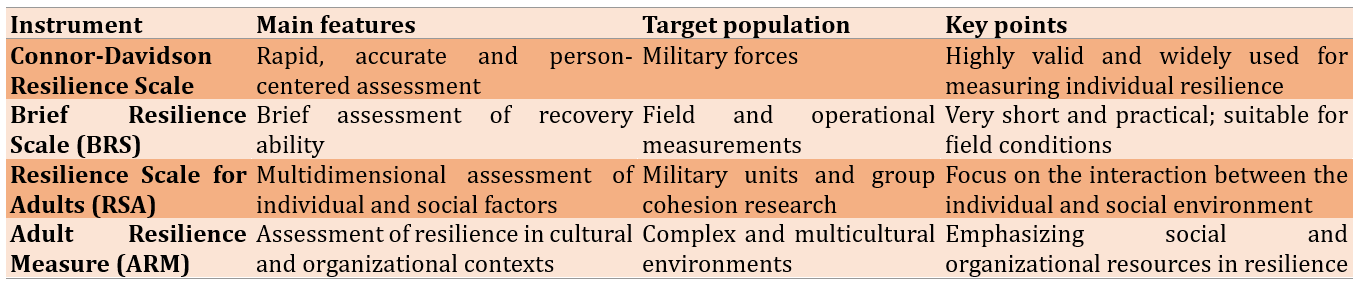
Various tools have been used to measure resilience; however, some scales have received more attention due to their high validity, applicability across different populations, and extensive use in military studies. Among these, four scales have been widely employed in resilience research: the Connor-Davidson Resilience Scale, the Brief Resilience Scale, the Adult Resilience Scale, and the Adult Resilience Assessment Scale (ARM) [14, 22-24]. Each scale takes a different approach to measuring resilience and emphasizes specific dimensions of this construct.
One of the most well-known tools for measuring resilience is the Connor-Davidson Resilience Scale (CD-RISC). This scale, widely used in psychological and psychiatric studies, measures an individual’s ability to adapt to stress, maintain hope, and effectively deal with challenges. The CD-RISC has become one of the most popular tools in resilience research due to its relatively simple structure, high validity, and applicability to diverse population groups. In military settings, this scale is also commonly used to assess individual resilience, identify psychological strengths, and evaluate the impact of training programs on resilience.
Another important tool is the Brief Resilience Scale (BRS), designed to measure the ability to quickly return to equilibrium after experiencing stress. Unlike some other scales that assess multiple dimensions of resilience, the BRS focuses primarily on psychological recovery. This focus has made the tool particularly useful in field research and operational environments where time and resources are limited. Its brevity and ease of administration have led to its widespread use in studies involving operational forces, rapid response teams, and high-stress environments.
In addition, the Resilience Scale for Adults (RSA) takes a more comprehensive approach to resilience by examining both individual and social dimensions of this construct simultaneously. This scale assesses factors such as personal resources, social support, family cohesion, and coping skills. For this reason, the RSA has been widely applied in research focusing on the interaction between the individual and the social environment. In military settings, this scale can be used to explore the role of group relationships, unit cohesion, and social support in enhancing resilience.
Another important tool in this area is the Adult Resilience Measure (ARM), designed to assess resilience across different cultural and social contexts. This scale emphasizes the role of environmental resources, social supports, growth opportunities, and cultural factors in shaping resilience. As a result, the ARM is widely used in studies conducted in multicultural environments or complex organizations. In the military context, this tool can be useful for examining the role of organizational structures, organizational culture, and supportive resources in strengthening the resilience of forces.
In summary, different resilience measurement tools each approach this construct from a unique angle, and the selection of the appropriate tool largely depends on the research objective, the characteristics of the population under study, and the conditions in which the study is conducted. In military research, the combined use of these tools can provide a more comprehensive picture of forces' resilience and help researchers more accurately identify factors affecting mental health and operational effectiveness.
Table 1. Comparison of the instrument
Practical implications of the research
Resilience, as a multidimensional construct, plays a crucial role in maintaining the mental health, operational performance, and social adaptation of military forces. It results from a complex interaction of individual, interpersonal, organizational, and even biological factors and cannot be reduced to a single personality trait or skill. Resilience should be understood as a dynamic system of psychological, social, and environmental capacities that enable individuals not only to avoid severe psychological harm when facing difficult circumstances but, in many cases, to experience positive growth and adaptation. Thus, resilience does not simply mean “withstanding stress,” but rather encompasses a set of cognitive, emotional, and behavioral processes that help an individual manage environmental pressures and remain on the path to effective performance.
We found resilience to be dynamic and capable of being strengthened [47]. In the past, many researchers considered resilience a relatively fixed trait within individuals’ personalities; however, more recently, resilience has been viewed as an active adaptive process that can be enhanced through training, experience, and social support [3, 5]. This theoretical shift has important implications for practical applications, especially within military organizations. If resilience is seen as a fixed trait, the potential for intervention and reinforcement is limited; however, if it is understood as a learnable process, training and support programs can be designed to purposefully enhance troops' psychological capacity. This perspective is particularly important in military environments, where troops are constantly exposed to stressful situations, and strengthening their psychological skills can significantly impact operational readiness, decision-making effectiveness, and mental health [48].
From a practical perspective, recognizing the developable nature of resilience means that military organizations can enhance their forces’ adaptability by investing in psychological training, preventive programs, and organizational support. This approach can be applied at various stages of military service, from initial training to operational deployments and even after returning from stressful missions. Thus, resilience is not only a theoretical concept in psychology but also a practical tool for improving the psychological readiness of forces.
Individual characteristics play a fundamental role in the development of resilience. Among these, psychological hardiness is considered one of the most important protective factors against severe stress. The components of commitment, control, and challenge help individuals perceive difficult situations as opportunities for growth and learning, rather than as uncontrollable threats [9, 18]. This mindset can help maintain effective performance in military environments characterized by uncertainty, operational pressure, and potential risks. Soldiers with higher levels of psychological hardiness typically demonstrate greater resilience in complex situations, better emotional regulation, and more effective decision-making in critical moments.
From an applied perspective, focusing on psychological hardiness can be valuable in the selection, training, and development of military personnel. For example, identifying individuals with strong capacities in commitment, control, and challenge can assist in assigning sensitive operational roles. Additionally, training cognitive and behavioral skills that strengthen these components can help increase the resilience of forces under operational conditions.
Another important factor emphasized in various studies is optimism and a positive explanatory style. Optimistic individuals tend to view negative events as temporary and changeable, which makes them more likely to regain balance when faced with failure or psychological stress [19, 20]. Such cognitive patterns play a significant role in how they interpret stressful events. People who perceive negative events as permanent and uncontrollable are more likely to feel helpless and hopeless, while an optimistic explanatory style helps individuals see difficult situations as temporary and motivates them to improve their circumstances.
In military environments, where forces may face operational failures, human casualties, or unpredictable circumstances, such an attitude can be crucial for maintaining motivation, hope, and collective morale. Therefore, training skills that foster realistic optimism and adaptive explanatory styles can be an effective strategy in resilience-enhancing programs.
In addition, self-efficacy is an important predictor of resilience. Soldiers with higher levels of self-efficacy make more effective decisions in operational situations and experience less psychological distress [49]. Self-efficacy refers to an individual’s belief in their ability to manage difficult situations. When individuals feel they have control over their circumstances, they are more likely to face problems with confidence and motivation.
In practical terms, self-efficacy can be enhanced through incremental successes, practical skills training, positive feedback from commanders, and observing successful performance by fellow soldiers. These processes help soldiers feel more in control and perform more effectively in stressful situations.
We also highlighted the role of emotion regulation in military resilience. The ability to manage negative emotions, such as fear, anger, and anxiety in critical situations, is essential for effective military performance. The use of strategies such as cognitive restructuring can reduce the intensity of stress reactions and improve psychological adjustment [21]. Emotion regulation helps individuals manage their emotional responses in ways that align with their performance goals.
This is especially important in operational environments where rapid and accurate decision-making is essential. If left unchecked, negative emotions can disrupt focus, reduce decision-making efficiency, and increase operational errors. Therefore, training in emotion regulation skills should be considered a key component of resilience programs within military forces.
In addition to individual factors, social and interpersonal factors also play a crucial role in strengthening resilience [17]. Social support is regarded as one of the most important resources for coping with stress and can mitigate the negative effects of traumatic events [6]. The presence of support networks helps individuals feel they are not alone in facing problems and enables them to draw on others' emotional and practical resources.
In military settings, this support can come from comrades, commanders, and family members. Positive relationships among members of a military unit foster feelings of trust and solidarity, thereby enhancing individuals’ ability to cope with difficult situations. Unit cohesion has also been identified as a key factor in military resilience. Group cohesion refers to the presence of trust, cooperation, and a sense of belonging among members of a military unit.
Troops serving in highly cohesive units tend to be more resilient to operational stress and less likely to experience psychological distress [12]. In such units, individuals feel part of a unified group, and this sense of belonging can increase their motivation to face challenges.
Family also plays an important role in the mental health of military personnel. Long periods of deployment in operational areas, separation from family, and concerns about family members' safety can cause significant psychological stress [50]. The presence of stable, supportive family relationships can help prevent the development of psychological problems among military personnel and facilitate their adaptation to difficult circumstances [11, 14]. Therefore, many military organizations have developed programs to support military families and reduce the psychological stress caused by extended missions.
At the organizational level, effective leadership and a supportive organizational culture can play a vital role in promoting troop resilience [51]. Military leaders can enhance troops’ feelings of psychological safety by fostering an environment of trust, respect, and support [13]. Troops are more likely to perform effectively under operational pressure when they feel that their commanders genuinely care about their well-being and mental health.
Organizations that prioritize the mental health of their personnel and provide accessible counseling and psychological services tend to have a more resilient workforce [30]. Access to such services can help identify mental health issues early and offer timely supportive interventions.
We also highlighted the role of training programs and psychological interventions in enhancing military resilience. In recent years, many militaries worldwide have developed programs to strengthen the resilience of their forces. For example, the Battlemind program is designed to help soldiers adapt to combat conditions and transition back to civilian life [1]. The program teaches skills such as stress management, emotion regulation, and cognitive adaptation.
The Master Resilience Training program is also one of the most important training initiatives in the United States military, designed based on the principles of positive psychology [11]. It aims to develop skills such as optimism, cognitive flexibility, and problem-solving, and to strengthen social relationships within military forces. Participation in these programs can increase troops’ resilience and reduce symptoms of anxiety and depression [27].
The results of Iranian studies are consistent with international research. Studies conducted among Iranian military personnel have shown that resilience-based training can reduce job stress, improve mental health, and enhance psychological adjustment [17, 33]. Resilience-based interventions can also be effective within Iran's cultural context.
Despite significant advances in research on military resilience, several gaps remain. For example, many existing studies are cross-sectional and rarely examine changes in resilience over time. Longitudinal studies could provide a better understanding of the processes involved in resilience formation and development. Additionally, exploring cultural differences in the experience and strengthening of resilience is an important topic for future research. Moreover, most studies have focused on psychological and social factors, while neurobiological research suggests that neural and hormonal systems also play a role in individuals’ responses to stress [15, 16]. Combining psychological approaches with neuroscience findings could lead to a more comprehensive understanding of resilience mechanisms [52, 53].
Conclusion
Due to the nature of their missions, military forces are constantly exposed to stressful and life-threatening situations, operational pressures, harsh environmental conditions, and prolonged separations from family. These circumstances can place significant psychological strain on individuals and, without appropriate coping mechanisms, may lead to anxiety, depression, burnout, and PTSD. Resilience plays a key role in mitigating the negative effects of stress, preventing mental disorders, and maintaining the operational effectiveness of military forces. It is a multidimensional construct influenced by numerous factors that can be examined at the individual, interpersonal, and organizational levels. The interaction between these factors shapes the degree of resilience in individuals. Contrary to earlier views that considered resilience merely an innate trait, recent research shows that this ability can be developed through training and experience.
Acknowledgments: The authors would like to acknowledge the academic environment that facilitated the preparation of this review article.
Ethical Permissions: Not needed.
Conflicts of Interest: The authors declare that they have no conflicts of interest regarding the publication of this article.
Authors' Contribution: Minooeifar AR (First Author), Text Writer/Methodologist/Main Researcher (60%); Rahnejat AM (Second Author), Text Writer/Methodologist/Main Researcher (40%)
Funding/Support: This research received no specific grant from any funding agency in the public, commercial, or not-for-profit sectors.
The military profession, due to its unique nature and operational sensitivities, is associated with high levels of psychological stress, life-threatening situations, uncertainty, and exposure to complex and critical circumstances. During their service, military personnel may participate in combat operations, encounter violent scenes, witness war casualties, lose comrades, face direct threats to their own lives and those of their comrades, be deployed in insecure areas, and endure harsh environmental conditions. Additionally, the long duration of missions, frequent and prolonged separations from family, heavy organizational demands, and the need to maintain constant operational readiness are other significant sources of psychological stress in this profession. Such conditions can lead to serious psychological consequences, including anxiety, depression, post-traumatic stress disorder (PTSD), burnout, adjustment difficulties, sleep disorders, and decreased professional performance [1, 2].
However, not all individuals exposed to these conditions develop psychological distress. Many military personnel are able to maintain optimal psychological functioning, perform assigned tasks effectively, and adapt successfully to challenging situations. This ability to adapt and recover psychologically from extreme stress is known in the psychological literature as psychological resilience [3]. Resilience is not simply resistance to harm but rather a dynamic set of processes that enable an individual to maintain effective functioning in the face of adversity and to return to psychological equilibrium after a crisis.
Resilience generally refers to an individual’s ability to successfully cope with severe problems and threats, manage traumatic events, and return to a desirable level of psychological functioning. Over the past few decades, this concept has become a central focus in various fields, including developmental psychology, health psychology, positive psychology, and especially military psychology [4]. Early approaches viewed resilience primarily as a relatively stable and innate personality trait—present in some individuals and less evident in others. However, more recent perspectives consider resilience to be a multifaceted, dynamic, and changeable process arising from the complex interaction among individual, interpersonal, social, cultural, and environmental factors [5]. Accordingly, resilience is not only regarded as an innate trait but also as a learnable and strengthenable skill that can be enhanced through training, experience, social support, and psychological interventions.
Resilience plays a crucial role in maintaining soldiers' mental health, operational readiness, and adaptive capacity. For example, research on soldiers who participated in the wars in Iraq and Afghanistan has shown that despite facing high levels of stress, many maintained favorable and relatively stable psychological functioning, with only a few suffering from severe conditions, such as PTSD or depression [2, 6]. Thus, protective factors such as resilience, social support, and coping skills play an important role in mitigating the negative effects of war and can help prevent the onset of mental disorders.
Moreover, researchers have identified resilience as one of the most important determinants of the psychological outcomes of war and military operations. Higher levels of resilience are associated with reduced symptoms of depression, anxiety, and PTSD in soldiers returning from combat missions [6]. Furthermore, resilience can enhance individuals’ ability to recover from traumatic events and even facilitate post-traumatic growth—a phenomenon in which individuals experience positive changes after a crisis, including an increased sense of meaning, personal growth, development of psychological competencies, and improved interpersonal relationships [7, 8].
The theoretical roots of resilience trace back to classical research in child development. Researchers first introduced the concept of resilience while studying children living in high-risk situations, such as poverty, domestic violence, or traumatic environments, who nonetheless maintained good mental health [9, 10]. These studies demonstrated that some individuals, despite exposure to serious risks, are able to adapt successfully due to protective resources such as social support, positive personality traits, and effective coping skills. Over time, this concept expanded beyond developmental psychology to other scientific fields, including organizational, sports, and military psychology.
In the military, resilience is recognized as a key component of psychological readiness. Many armed forces around the world have designed and implemented programs to develop resilience among their personnel. For example, the Comprehensive Resilience Training Program in the United States Army aims to increase troops’ capacity to manage stress, strengthen cognitive skills, foster positive emotions, and improve psychological adjustment [11]. These programs are based on the principles of positive psychology and focus on promoting skills, such as optimism, self-efficacy, emotion regulation, cognitive flexibility, and problem-solving.
Alongside individual factors, organizational factors also play a crucial role in shaping and strengthening the resilience of military personnel. Leadership quality, commanders’ management style, unit cohesion, peer support, organizational climate, administrative justice, and organizational culture are among the factors that influence the resilience of the forces [12]. Military leaders can enhance the resilience of their subordinates by creating a supportive environment, establishing effective communication, increasing trust, and strengthening group morale [13].
Furthermore, the role of family and support networks in military resilience is highly significant. Military families face considerable challenges due to long deployments, concerns about the safety of their family members, frequent relocations, and mission-related uncertainty. However, family support can play a crucial role in preventing the onset of psychological problems among military personnel and in helping them adapt better to service conditions [11, 14].
In recent years, many studies have examined the biological and neurological dimensions of resilience. These studies have shown that individual differences in neural, hormonal, and genetic systems can influence how people respond to stress [15, 16]. For example, the functioning of the neuroendocrine system, cortisol regulation, and the activity of the amygdala and prefrontal cortex play important roles in the stress response. Thus, resilience results from a complex interaction of biological, psychological, and social factors.
In addition to international research, Iranian studies have also highlighted the importance of resilience among Iranian military personnel. For example, resilience-based training can reduce occupational stress, risky behaviors, and emotional problems among soldiers, while improving their mental health [17]. Characteristics, such as positive emotion, personality strengths, self-efficacy, and emotional adjustment, can be important predictors of resilience in the armed forces [18].
Given the importance of resilience for the mental health, operational performance, and quality of life of military personnel, a comprehensive study of this concept and its influencing factors is essential. A deeper understanding of resilience mechanisms can help in designing effective training programs, psychological interventions, and organizational policies to promote the mental health of military personnel.
Accordingly, this study aims to assess the validity of psychological resilience in the military, identify the factors that affect it, and examine the interventions and measurement tools related to this construct. It seeks to present a comprehensive, multidimensional overview of the current state of research in this field by analyzing both theoretical and empirical studies, thereby providing the necessary foundation for the development of resilience-promotion programs within the military.
Conceptual Dimensions and Main Areas of Research in Military Resilience
Psychological resilience has become a key concept in studies of military mental health in recent years. The nature of military missions, repeated exposure to stressful and life-threatening situations, operational pressures, and ethical challenges have led researchers to extensively investigate factors that can enhance the ability of military personnel to adapt and recover psychologically. In this context, several studies have sought to explain different dimensions of resilience in military environments by presenting theoretical models, empirical findings, and intervention programs.
A review of these studies shows that resilience in this population is not only an individual characteristic but also a multidimensional phenomenon shaped by a combination of individual, social, organizational, and even biological factors. Individuals with higher levels of optimism are better able to maintain motivation and hope in the face of psychological stress and are less likely to experience burnout or discouragement [19, 20]. In military environments—where operational conditions are often fraught with uncertainty and risk—such an attitude can help sustain troops' psychological effectiveness.
Psychological hardiness has been emphasized in the resilience literature. Defined as a combination of commitment, control, and challenge, psychological hardiness refers to an individual’s ability to perceive difficult situations as opportunities for growth and learning. Psychological hardiness plays a significant protective role against the negative effects of stress and reduces the likelihood of developing psychological problems in challenging situations [9, 18]. Among military personnel, this trait helps individuals accept difficult mission conditions as part of their professional duty and adapt more flexibly to environmental challenges.
Another important individual factor in military resilience is the ability to regulate emotions. Emotion regulation refers to a set of cognitive and behavioral processes that help individuals identify, manage, and, when necessary, modify their emotions. In operational environments where individuals may encounter threatening or traumatic situations, the ability to manage emotions becomes particularly crucial. Soldiers with stronger emotion regulation skills respond more adaptively to stressful events and are less likely to develop psychological problems [21].
In addition to individual characteristics, social and interpersonal factors also play a significant role in the development of resilience. Social support is considered one of the most important of these factors. Support received from comrades, commanders, friends, and family members can serve as a vital source of coping and strengthen the sense of psychological security and social belonging. Soldiers with stronger support networks perform better when facing psychological stress and are less likely to develop psychological disorders [6]. In military environments, unit cohesion and trust-based relationships among group members play a key role in fostering solidarity and mutual support.
In recent years, there has been growing attention to the design and implementation of training programs aimed at enhancing resilience in military forces. One of the most well-known of these programs is Battlemind training, which is designed to prepare troops psychologically to face operational pressures. It seeks to strengthen skills such as stress management, psychological adjustment, and effective coping strategies among soldiers [1]. Additionally, the Master Resilience Training program, developed by the United States Army, is considered one of the most comprehensive resilience training programs. It focuses on training cognitive skills, fostering optimism, increasing self-efficacy, and improving communication skills [11]. Such programs can help improve the mental health of troops and increase their psychological readiness to face operational challenges.
Another important area of research in resilience is the development of tools and scales to measure this construct. Accurate measurement of resilience allows researchers to assess the level of this trait in different populations and evaluate the effectiveness of psychological interventions. Among these tools, the Connor-Davidson Resilience Scale (CD-RISC) is one of the most widely used resilience measurement instruments and has been employed in many military studies [14]. By assessing different dimensions of psychological adjustment, this scale provides a relatively comprehensive picture of an individual’s capacity to cope with psychological stress.
In addition, the Brief Resilience Scale (BRS) focuses on the ability to return to a state of equilibrium after experiencing stress and is recognized as a brief, efficient tool for measuring this dimension of resilience [22]. The Resilience Scale for Adults (RSA) is also designed with an emphasis on individual and social resilience resources and includes dimensions such as social support, personal competence, and family structure [23]. The Adult Resilience Measure (ARM/RRC ARM) examines resilience resources at the individual, social, and cultural levels using an ecological approach [24]. The use of these tools in military studies has helped researchers gain a more detailed understanding of the factors affecting resilience in operational environments.
In addition to international studies, Iranian research has also examined resilience among Iranian military personnel in recent years. These studies have sought to identify factors affecting the mental health and psychological adjustment of military personnel, taking into account the cultural and organizational context of the country’s armed forces. Research has also explored the role of resilience-based training in reducing stress and improving psychological adjustment among military personnel [17].
In resilience studies, self-efficacy, optimism, emotion regulation, post-traumatic growth, and moral injury have been recognized as key constructs. Self-efficacy refers to an individual’s belief in their ability to manage difficult situations and plays an important role in how they face environmental challenges [3, 5]. Post-traumatic growth describes the process through which individuals, after experiencing difficult events, achieve a higher level of psychological growth and gain a deeper understanding of the meaning of life [7, 20]. In contrast, moral injury refers to the psychological consequences resulting from ethical conflicts in wartime conditions, which can have a profound impact on the mental health of military personnel [25, 26].
Resilience in military environments can be analyzed at several different levels. At the individual level, psychological characteristics such as hardiness, optimism, self-efficacy, coping skills, and emotion regulation are important factors that enhance an individual’s capacity to adapt to stressful situations [18-21, 27, 28]. These factors help soldiers maintain their psychological balance in difficult circumstances and face environmental challenges more effectively.
At the interpersonal and familial level, the quality of social relationships and the amount of support received from others are particularly important. Stable family relationships, emotional support from spouses and family members, and cohesion among military unit members play a crucial role in reducing psychological stress and strengthening a sense of social belonging [6, 11, 12, 14, 29]. Such sources of support can act as a psychological shield against the negative effects of stress.
At the organizational level, factors such as leadership style, organizational culture, and supportive policies play an important role in shaping resilience. Effective leadership, grounded in trust, support, and clear communication with troops, can enhance soldiers’ sense of psychological security and intrinsic motivation. Additionally, training programs and organizational interventions aimed at improving psychological skills can increase troops' adaptive capacity [7, 9, 13, 30-32].
Beyond these factors, some studies have also examined the biological and neuropsychological dimensions of resilience. Individual differences in physiological responses to stress, the functioning of the nervous and hormonal systems, and emotion regulation mechanisms can all contribute to the development of resilience [15, 16]. This biological perspective suggests that resilience is not just a psychological phenomenon but rather the result of a complex interaction between biological, psychological, and social factors.
Finally, one of the most important areas of research in this field examines interventions and programs designed to enhance resilience. Programs such as Battlemind and resilience training in the United States Army are intended to enhance troops' mental preparedness and strengthen skills such as stress management, flexible thinking, problem-solving, and effective communication [1, 7, 11, 27]. Additionally, some interventions based on positive psychology and mindfulness approaches have gained attention in recent years; these interventions can help improve emotion regulation, increase a sense of meaning, and strengthen psychological adaptability among military personnel.
Iranian studies have also evaluated resilience-based training programs aimed at improving the mental health of military personnel. Such interventions have been found effective in reducing job stress, increasing psychological adjustment, and enhancing the psychological performance of military forces [17, 33, 34]. These findings further highlight the importance of focusing on psychological training and resilience-building programs within military structures.
Determinants of Psychological Resilience in Military Personnel
Psychological resilience in military personnel is a multilevel, interactive phenomenon that depends on various individual, social, and organizational factors [35]. Contrary to traditional views that considered resilience a stable trait, recent studies regard it as a dynamic, evolving process shaped by interactions among biological, cognitive, emotional, interpersonal, and environmental characteristics [4].
In the military environment—characterized by intense pressure, unpredictable missions, exposure to life-threatening threats, and difficult moral situations—resilience is considered not only a psychological construct but also a critical component for maintaining operational effectiveness. For this group, resilience does not only mean returning to normal after stress but also includes the ability to maintain a high level of performance amid stress; in other words, continuing to function effectively under pressure is considered one of the most important indicators of military resilience [7].
Military personnel exhibit different patterns of response when exposed to traumatic events; however, a significant proportion return to normal life and functioning without developing severe psychological disorders [7]. This fact highlights the critical role of individual, interpersonal, and environmental protective systems. According to new models, resilience is the product of the activity of a network of biological, cognitive, emotional, behavioral, and social mechanisms that operate as a complex, self-regulating system [4, 15].
This network approach has brought an important shift to the resilience literature by suggesting that no single factor, whether individual or organizational, can create or enhance resilience on its own. Rather, it is the interaction and synergy of multiple factors that shape adaptation pathways. For example, a system that is highly psychologically resilient but operates in an environment lacking command support or unit cohesion may still be vulnerable. Conversely, an individual with average emotion regulation skills but within a supportive organizational structure may demonstrate highly resilient performance.
Resilience has traditionally been defined in many psychological sources as an individual’s ability to return to a baseline level of functioning after experiencing trauma. However, more recent studies have expanded this concept to view it as a developmental process influenced by individual, environmental, and biological factors [3, 5]. This shift in perspective has transformed resilience from a fixed trait into a dynamic, multifactorial mechanism that varies in form, intensity, and quality at different stages of the military career cycle (training, operations, return, extended deployment, military retirement).
In the military environment, this concept becomes even more complex because troops face real and potential threats simultaneously, are forced to make difficult ethical and tactical decisions, must function effectively under conditions of extreme uncertainty and sustained stress, and are often separated from their families and sources of support for extended periods [7]. These characteristics make resilience in military personnel not only a psychological construct but also an operational, ethical, social, and even neurobiological one.
Another important factor in this area is the interaction between cognitive structures and emotional systems. Positive cognitive processing, cognitive restructuring, selective attention to threat cues, and the ability to modulate emotional responses are all vital components of the resilience mechanism [4, 15]. Understanding these mechanisms helps explain why some soldiers experience posttraumatic growth following exposure to traumatic events, while others are more prone to vulnerability.
Individual factors
In military psychology, individual factors are among the most fundamental dimensions of resilience in military forces. These factors include a set of personality traits, cognitive abilities, emotional skills, and self-regulatory beliefs that help an individual perform steadily and adaptively in the face of threatening situations. These factors not only function independently but also interact to create a complex structure of psychological protection and enhanced adaptation. The most important of these factors are explained below based on findings from reputable studies.
Psychological toughness is one of the most central traits that has attracted significant attention in military psychology in recent decades [18]. It refers to an individual’s ability to adhere to their values and commitments, feel in control of situations, and view challenges as opportunities for growth. In the military environment, which is often characterized by extreme uncertainty, difficult tactical decisions, and constant operational pressures, this trait can serve as a stable “psychological shield.” Troops with higher levels of toughness experience less psychological damage and perform more consistently under severe operational pressures, such as being in conflict zones, experiencing traumatic events, and handling the stresses of heavy responsibilities [29].
Along with hardiness, optimism has been identified as another key factor in resilience among military personnel [19, 20]. Optimism is a positive interpretive style that helps individuals view negative events as temporary, manageable, and limited to specific circumstances. In operational environments where the likelihood of encountering threats, failure, or difficult situations is high, optimistic individuals are less likely to experience psychological distress and have a greater capacity to continue mission activities. This cognitive style also enhances motivation, hope, and belief in problem-solving abilities, all of which are critical for effectively managing battlefield challenges.
Self-efficacy is another critical factor that makes soldiers more resilient to external pressures [36]. It refers to an individual’s belief in their ability to successfully perform tasks and manage difficult situations. Soldiers with higher self-efficacy not only experience less anxiety when faced with complex operational situations but also employ more active coping strategies [37]. These individuals approach problem-solving with greater confidence rather than avoiding threatening situations.
The ability to regulate emotions is also considered one of the most important dimensions of individual resilience and plays a direct role in preventing the escalation of emotional reactions. The ability to control emotions such as anger, fear, and anxiety in situations where the speed of action and the accuracy of decision-making are crucial is a key factor in maintaining the mental and physical functioning of troops. One of the most important strategies for regulating emotions is cognitive restructuring, which is particularly significant in the military environment [21]. This strategy helps individuals reduce the intensity of negative emotions by changing the way they interpret a threatening situation, allowing for greater flexibility in decision-making.
From a cognitive perspective, factors such as cognitive flexibility, situational analysis, problem-solving skills, selective attention capacity, and decision-making abilities play a significant role in enhancing resilience [38]. These skills help individuals avoid sudden, impulsive reactions when faced with complex, unpredictable situations, enabling them to respond to challenges in a logical, calculated manner. These abilities become especially valuable on the front lines of operations, where making the right decision can have critical consequences.
In summary, individual factors form the foundation of psychological resilience in military forces and serve as the first line of psychological defense against threats. However, these factors can only fulfill their full potential through interaction with other components, particularly interpersonal relationships and organizational support systems.
Interpersonal and social factors
Interpersonal and social factors are another critical foundation of resilience in military settings. Contrary to the popular belief that resilience is largely an individual trait, the quality of one’s relationships and the degree of perceived social support can play an even greater role in shaping adaptive responses than individual factors [39]. This importance stems from the social nature of militarism and the reliance of operations on group coordination.
One of the most important social factors is social support, recognized in the psychological literature as a key protective element. This support can come from family, friends, comrades, commanders, and even informal unit structures [6]. Social support serves multiple functions, such as reducing feelings of loneliness, increasing emotional comfort, lowering perceived threat, and enhancing a sense of control over the situation. In military settings, where many troops may be separated from their support networks due to long-term deployments, missions away from home, and mission-oriented structures, the importance of this factor is even greater.
Soldiers who feel supported by others tend to interpret operational stress as less threatening and are better able to return to normal functioning after experiencing psychological stress.
Unit cohesion is another important factor that plays a decisive role in the level of group resilience [40]. Cohesion develops when unit members share a sense of mutual trust, belonging, solidarity, and operational coordination. Beyond its psychological impact, this cohesion also influences mission effectiveness. Units with greater cohesion perform more consistently under severe stress, and their members are less likely to experience psychological breakdowns [12]. Such units are also better equipped to reduce internal conflicts and foster collective motivation.
The family also plays a fundamental role in the military's support structure. The presence of stable family relationships, a supportive spouse, a broad family network, and secure emotional connections can mitigate the effects of stress caused by distance, frequent relocation, dangerous missions, and prolonged absence from family [41-43]. Families that are more resilient and employ healthy communication strategies directly contribute to improved mental health, enhanced performance, and a greater sense of security for military personnel.
These social and interpersonal factors not only affect individuals but also create a structure of “collective resilience” at the group level. Collective resilience emerges when members of a military unit can jointly manage severe pressures by relying on supportive relationships, mutual trust, and operational cohesion.
Organizational factors
Organizational factors are another key pillar of psychological resilience among military personnel. These factors include management structures, organizational policies, leadership styles, organizational culture, and formal support measures that can directly or indirectly influence an individual’s ability to cope with operational stressors.
One of the most important organizational components in military environments is leadership style. Transformational leaders who focus on inspiring, building trust, providing psychological support, and enhancing motivation typically create an environment in which troops feel safe, valued, and supported [13]. This sense of psychological safety increases troops’ ability to withstand intense pressure and reduces the likelihood of negative reactions. In contrast, authoritarian or punitive leadership styles can increase anxiety and stress levels and undermine resilience.
Organizational culture also plays a critical role in mental health and resilience. Organizations that make mental health part of their mission and provide accessible psychological services, stress training, mental health monitoring, and informal support tend to produce more resilient troops [30]. In contrast, cultures that view mental health problems as a weakness, discourage referrals to mental health services, or take a punitive approach to employee issues increase the vulnerability of military personnel.
Other organizational elements include mission structure, deployment time regulations, the quality of training programs, the level of command support for troops’ family life, and access to welfare resources. These factors can either enhance resilience or, conversely, increase psychological strain if ineffective. The more transparent, supportive, and coherent the organizational structure, the more secure and empowered troops will feel in managing a crisis.
Resilience measurement methods
Resilience assessment is a fundamental aspect of psychological research and studies related to military mental health. Accurate assessment of this construct enables us to understand the extent to which individuals can cope with stress, adapt to difficult situations, and return to optimal performance [44]. In military environments, where individuals are constantly faced with operational pressures, high-risk missions, and unpredictable conditions, measuring resilience is especially important, as the results of these assessments can inform decisions on force selection, training programs, preventive interventions, and mental health promotion initiatives.
Given that resilience is a multidimensional concept, many tools have been developed to measure it. Some of these tools focus on individual characteristics, such as personality traits, self-efficacy, or emotion regulation, while others view resilience as a social process, considering the role of social relationships, environmental resources, and support structures [45]. In recent years, hybrid approaches have also been developed to assess the individual, social, and organizational dimensions of resilience simultaneously.
Among military personnel, resilience assessment is used not only as a research tool but also as a practical instrument for human resource management. Assessing resilience levels can play an important role in the initial screening of troops, identifying individuals who are more psychologically prepared to perform high-risk missions, designing training programs to enhance coping skills, and predicting the likelihood of developing problems such as post-traumatic stress disorder, depression, or operational burnout [9, 46]. For this reason, the use of standardized resilience assessment tools has become an integral part of mental health programs in many armies worldwide.
Various tools have been used to measure resilience; however, some scales have received more attention due to their high validity, applicability across different populations, and extensive use in military studies. Among these, four scales have been widely employed in resilience research: the Connor-Davidson Resilience Scale, the Brief Resilience Scale, the Adult Resilience Scale, and the Adult Resilience Assessment Scale (ARM) [14, 22-24]. Each scale takes a different approach to measuring resilience and emphasizes specific dimensions of this construct.
One of the most well-known tools for measuring resilience is the Connor-Davidson Resilience Scale (CD-RISC). This scale, widely used in psychological and psychiatric studies, measures an individual’s ability to adapt to stress, maintain hope, and effectively deal with challenges. The CD-RISC has become one of the most popular tools in resilience research due to its relatively simple structure, high validity, and applicability to diverse population groups. In military settings, this scale is also commonly used to assess individual resilience, identify psychological strengths, and evaluate the impact of training programs on resilience.
Another important tool is the Brief Resilience Scale (BRS), designed to measure the ability to quickly return to equilibrium after experiencing stress. Unlike some other scales that assess multiple dimensions of resilience, the BRS focuses primarily on psychological recovery. This focus has made the tool particularly useful in field research and operational environments where time and resources are limited. Its brevity and ease of administration have led to its widespread use in studies involving operational forces, rapid response teams, and high-stress environments.
In addition, the Resilience Scale for Adults (RSA) takes a more comprehensive approach to resilience by examining both individual and social dimensions of this construct simultaneously. This scale assesses factors such as personal resources, social support, family cohesion, and coping skills. For this reason, the RSA has been widely applied in research focusing on the interaction between the individual and the social environment. In military settings, this scale can be used to explore the role of group relationships, unit cohesion, and social support in enhancing resilience.
Another important tool in this area is the Adult Resilience Measure (ARM), designed to assess resilience across different cultural and social contexts. This scale emphasizes the role of environmental resources, social supports, growth opportunities, and cultural factors in shaping resilience. As a result, the ARM is widely used in studies conducted in multicultural environments or complex organizations. In the military context, this tool can be useful for examining the role of organizational structures, organizational culture, and supportive resources in strengthening the resilience of forces.
In summary, different resilience measurement tools each approach this construct from a unique angle, and the selection of the appropriate tool largely depends on the research objective, the characteristics of the population under study, and the conditions in which the study is conducted. In military research, the combined use of these tools can provide a more comprehensive picture of forces' resilience and help researchers more accurately identify factors affecting mental health and operational effectiveness.
Table 1. Comparison of the instrument
Practical implications of the research
Resilience, as a multidimensional construct, plays a crucial role in maintaining the mental health, operational performance, and social adaptation of military forces. It results from a complex interaction of individual, interpersonal, organizational, and even biological factors and cannot be reduced to a single personality trait or skill. Resilience should be understood as a dynamic system of psychological, social, and environmental capacities that enable individuals not only to avoid severe psychological harm when facing difficult circumstances but, in many cases, to experience positive growth and adaptation. Thus, resilience does not simply mean “withstanding stress,” but rather encompasses a set of cognitive, emotional, and behavioral processes that help an individual manage environmental pressures and remain on the path to effective performance.
We found resilience to be dynamic and capable of being strengthened [47]. In the past, many researchers considered resilience a relatively fixed trait within individuals’ personalities; however, more recently, resilience has been viewed as an active adaptive process that can be enhanced through training, experience, and social support [3, 5]. This theoretical shift has important implications for practical applications, especially within military organizations. If resilience is seen as a fixed trait, the potential for intervention and reinforcement is limited; however, if it is understood as a learnable process, training and support programs can be designed to purposefully enhance troops' psychological capacity. This perspective is particularly important in military environments, where troops are constantly exposed to stressful situations, and strengthening their psychological skills can significantly impact operational readiness, decision-making effectiveness, and mental health [48].
From a practical perspective, recognizing the developable nature of resilience means that military organizations can enhance their forces’ adaptability by investing in psychological training, preventive programs, and organizational support. This approach can be applied at various stages of military service, from initial training to operational deployments and even after returning from stressful missions. Thus, resilience is not only a theoretical concept in psychology but also a practical tool for improving the psychological readiness of forces.
Individual characteristics play a fundamental role in the development of resilience. Among these, psychological hardiness is considered one of the most important protective factors against severe stress. The components of commitment, control, and challenge help individuals perceive difficult situations as opportunities for growth and learning, rather than as uncontrollable threats [9, 18]. This mindset can help maintain effective performance in military environments characterized by uncertainty, operational pressure, and potential risks. Soldiers with higher levels of psychological hardiness typically demonstrate greater resilience in complex situations, better emotional regulation, and more effective decision-making in critical moments.
From an applied perspective, focusing on psychological hardiness can be valuable in the selection, training, and development of military personnel. For example, identifying individuals with strong capacities in commitment, control, and challenge can assist in assigning sensitive operational roles. Additionally, training cognitive and behavioral skills that strengthen these components can help increase the resilience of forces under operational conditions.
Another important factor emphasized in various studies is optimism and a positive explanatory style. Optimistic individuals tend to view negative events as temporary and changeable, which makes them more likely to regain balance when faced with failure or psychological stress [19, 20]. Such cognitive patterns play a significant role in how they interpret stressful events. People who perceive negative events as permanent and uncontrollable are more likely to feel helpless and hopeless, while an optimistic explanatory style helps individuals see difficult situations as temporary and motivates them to improve their circumstances.
In military environments, where forces may face operational failures, human casualties, or unpredictable circumstances, such an attitude can be crucial for maintaining motivation, hope, and collective morale. Therefore, training skills that foster realistic optimism and adaptive explanatory styles can be an effective strategy in resilience-enhancing programs.
In addition, self-efficacy is an important predictor of resilience. Soldiers with higher levels of self-efficacy make more effective decisions in operational situations and experience less psychological distress [49]. Self-efficacy refers to an individual’s belief in their ability to manage difficult situations. When individuals feel they have control over their circumstances, they are more likely to face problems with confidence and motivation.
In practical terms, self-efficacy can be enhanced through incremental successes, practical skills training, positive feedback from commanders, and observing successful performance by fellow soldiers. These processes help soldiers feel more in control and perform more effectively in stressful situations.
We also highlighted the role of emotion regulation in military resilience. The ability to manage negative emotions, such as fear, anger, and anxiety in critical situations, is essential for effective military performance. The use of strategies such as cognitive restructuring can reduce the intensity of stress reactions and improve psychological adjustment [21]. Emotion regulation helps individuals manage their emotional responses in ways that align with their performance goals.
This is especially important in operational environments where rapid and accurate decision-making is essential. If left unchecked, negative emotions can disrupt focus, reduce decision-making efficiency, and increase operational errors. Therefore, training in emotion regulation skills should be considered a key component of resilience programs within military forces.
In addition to individual factors, social and interpersonal factors also play a crucial role in strengthening resilience [17]. Social support is regarded as one of the most important resources for coping with stress and can mitigate the negative effects of traumatic events [6]. The presence of support networks helps individuals feel they are not alone in facing problems and enables them to draw on others' emotional and practical resources.
In military settings, this support can come from comrades, commanders, and family members. Positive relationships among members of a military unit foster feelings of trust and solidarity, thereby enhancing individuals’ ability to cope with difficult situations. Unit cohesion has also been identified as a key factor in military resilience. Group cohesion refers to the presence of trust, cooperation, and a sense of belonging among members of a military unit.
Troops serving in highly cohesive units tend to be more resilient to operational stress and less likely to experience psychological distress [12]. In such units, individuals feel part of a unified group, and this sense of belonging can increase their motivation to face challenges.
Family also plays an important role in the mental health of military personnel. Long periods of deployment in operational areas, separation from family, and concerns about family members' safety can cause significant psychological stress [50]. The presence of stable, supportive family relationships can help prevent the development of psychological problems among military personnel and facilitate their adaptation to difficult circumstances [11, 14]. Therefore, many military organizations have developed programs to support military families and reduce the psychological stress caused by extended missions.
At the organizational level, effective leadership and a supportive organizational culture can play a vital role in promoting troop resilience [51]. Military leaders can enhance troops’ feelings of psychological safety by fostering an environment of trust, respect, and support [13]. Troops are more likely to perform effectively under operational pressure when they feel that their commanders genuinely care about their well-being and mental health.
Organizations that prioritize the mental health of their personnel and provide accessible counseling and psychological services tend to have a more resilient workforce [30]. Access to such services can help identify mental health issues early and offer timely supportive interventions.
We also highlighted the role of training programs and psychological interventions in enhancing military resilience. In recent years, many militaries worldwide have developed programs to strengthen the resilience of their forces. For example, the Battlemind program is designed to help soldiers adapt to combat conditions and transition back to civilian life [1]. The program teaches skills such as stress management, emotion regulation, and cognitive adaptation.
The Master Resilience Training program is also one of the most important training initiatives in the United States military, designed based on the principles of positive psychology [11]. It aims to develop skills such as optimism, cognitive flexibility, and problem-solving, and to strengthen social relationships within military forces. Participation in these programs can increase troops’ resilience and reduce symptoms of anxiety and depression [27].
The results of Iranian studies are consistent with international research. Studies conducted among Iranian military personnel have shown that resilience-based training can reduce job stress, improve mental health, and enhance psychological adjustment [17, 33]. Resilience-based interventions can also be effective within Iran's cultural context.
Despite significant advances in research on military resilience, several gaps remain. For example, many existing studies are cross-sectional and rarely examine changes in resilience over time. Longitudinal studies could provide a better understanding of the processes involved in resilience formation and development. Additionally, exploring cultural differences in the experience and strengthening of resilience is an important topic for future research. Moreover, most studies have focused on psychological and social factors, while neurobiological research suggests that neural and hormonal systems also play a role in individuals’ responses to stress [15, 16]. Combining psychological approaches with neuroscience findings could lead to a more comprehensive understanding of resilience mechanisms [52, 53].
Conclusion
Due to the nature of their missions, military forces are constantly exposed to stressful and life-threatening situations, operational pressures, harsh environmental conditions, and prolonged separations from family. These circumstances can place significant psychological strain on individuals and, without appropriate coping mechanisms, may lead to anxiety, depression, burnout, and PTSD. Resilience plays a key role in mitigating the negative effects of stress, preventing mental disorders, and maintaining the operational effectiveness of military forces. It is a multidimensional construct influenced by numerous factors that can be examined at the individual, interpersonal, and organizational levels. The interaction between these factors shapes the degree of resilience in individuals. Contrary to earlier views that considered resilience merely an innate trait, recent research shows that this ability can be developed through training and experience.
Acknowledgments: The authors would like to acknowledge the academic environment that facilitated the preparation of this review article.
Ethical Permissions: Not needed.
Conflicts of Interest: The authors declare that they have no conflicts of interest regarding the publication of this article.
Authors' Contribution: Minooeifar AR (First Author), Text Writer/Methodologist/Main Researcher (60%); Rahnejat AM (Second Author), Text Writer/Methodologist/Main Researcher (40%)
Funding/Support: This research received no specific grant from any funding agency in the public, commercial, or not-for-profit sectors.
Keywords:
References
1. Adler AB, Bliese PD, McGurk D, Hoge CW, Castro CA. Battlemind debriefing and battlemind training as early interventions with soldiers returning from Iraq: Randomization by platoon. J Consult Clin Psychol. 2009;77(5):927-40. [Link] [DOI:10.1037/a0016877]
2. Hoge CW, Castro CA, Messer SC, McGurk D, Cotting DI, Koffman RL. Combat duty in Iraq and Afghanistan, mental health problems, and barriers to care. N Engl J Med. 2004;32(1):13-9. [Link] [DOI:10.1056/NEJMoa040603]
3. Masten AS. Ordinary magic: Resilience processes in development. Am Psychol. 2001;33(3):197-208. [Link] [DOI:10.1037/0003-066X.56.3.227]
4. Southwick SM, Bonanno GA, Masten AS, Panter Brick C, Yehuda R. Resilience definitions, theory, and challenges: Interdisciplinary perspectives. Eur J Psychotraumatol. 2014;5:25116. [Link] [DOI:10.3402/ejpt.v5.25338]
5. Luthar SS, Cicchetti D, Becker B. The construct of resilience: A critical evaluation and guidelines for future work. Child Dev. 2000;71(3):543-62. [Link] [DOI:10.1111/1467-8624.00164]
6. Milliken CS, Auchterlonie JL, Hoge CW. Longitudinal assessment of mental health problems among active and reserve component soldiers returning from the Iraq war. JAMA. 2007;298(18):2141-8. [Link] [DOI:10.1001/jama.298.18.2141]
7. Bonanno GA. Loss, trauma, and human resilience: Have we underestimated the human capacity to thrive after extremely aversive events?. Am Psychol. 2004;18(1):20-7. [Link] [DOI:10.1037/0003-066X.59.1.20]
8. Greenberg J, Tsai J, Southwick SM, Pietrzak RH. Can military trauma promote psychological growth in combat veterans? Results from the national health and resilience in veterans' study. J Affect Disord. 2021;282:732-9. [Link] [DOI:10.1016/j.jad.2020.12.077]
9. Anthony EJ. The syndrome of the psychologically invulnerable child. In: Anthony EJ, Koupernik C, editors. The child in his family: Children at psychiatric risk. New York: Wiley; 1974. p. 529-15. [Link]
10. Garmezy N. Stress‑resistant children: The search for protective factors. In: Stevenson JE, editor. Recent research in developmental psychopathology. Oxford: Pergamon Press; 1985. p. 213-4. [Link]
11. Reivich KJ, Seligman MEP, McBride S. Master resilience training in the U.S. Army. Am Psychol. 2011;66(1):25‑34. [Link] [DOI:10.1037/a0021897]
12. Griffith J. Multilevel analysis of cohesion's relation to stress, well‑being, identification, disintegration, and perceived combat readiness. Mil Psychol. 2002;14(3):217‑39. [Link] [DOI:10.1207/S15327876MP1403_3]
13. Harms PD, Credé M, Tynan M, Leon M, Jeung W. Leadership and stress. Leadersh Q. 2017;28(1):178‑94. [Link] [DOI:10.1016/j.leaqua.2016.10.006]
14. Skomorovsky A. Deployment stress and wellbeing among military spouses: The role of social support. Mil Psychol. 2014;26(1):44‑54. [Link] [DOI:10.1037/mil0000029]
15. Feder A, Nestler EJ, Charney DS. Psychobiology and molecular genetics of resilience. Nat Rev Neurosci. 2009;10(6):446‑57. [Link] [DOI:10.1038/nrn2649]
16. Yehuda R, Flory JD. Differentiating biological correlates of risk and resilience. Biol Psychiatry. 2007;62(6):610‑7. [Link]
17. Esfandiar Y, Rahnejat A, Mousavi M, Sabayan B. Effectiveness of resilience training in reducing stress and self-harm in soldiers. J Mil Med. 2020;22(1). [Persian] [Link]
18. Seydi Asl ST, Rahnejat A, Elikai MM, Khademi M, Shahed-Haghighdam H, Taghva A. The role of resilience, positive/negative emotions, and character strengths in predicting burnout of military personnel. EBNESINA. 2020;22(4):4-13. [Persian] [Link]
19. Carver CS, Scheier MF. Dispositional optimism. Trends Cogn Sci. 2014;18(6):293‑9. [Link] [DOI:10.1016/j.tics.2014.02.003]
20. Segerstrom SC. Optimism and resources: Effects on each other and on health over 10 years. J Res Pers. 2007;41(4):772‑86. [Link] [DOI:10.1016/j.jrp.2006.09.004]
21. Gross JJ. Emotion regulation: Current status and future prospects. Psychol Inq. 2015;26(1):1‑26. [Link] [DOI:10.1080/1047840X.2014.940781]
22. Smith BW, Dalen J, Wiggins K, Tooley E, Christopher P, Bernard J. The brief resilience scale: Assessing the ability to bounce back. Int J Behav Med. 2008;15(3):194-200. [Link] [DOI:10.1080/10705500802222972]
23. Friborg O, Hjemdal O, Rosenvinge JH, Martinussen M. A new rating scale for adult resilience: What are the central protective resources behind healthy adjustment?. Int J Methods Psychiatr Res. 2003;12(2):65-76. [Link] [DOI:10.1002/mpr.143]
24. Ungar M, Liebenberg L. Assessing resilience across cultures using mixed methods: Construction of the Child and Youth Resilience Measure (CYRM) and the Adult Resilience Measure (ARM). J Mix Methods Res. 2011;5(2):126. [Link] [DOI:10.1177/1558689811400607]
25. Nash WP, Litz BT. Moral injury: A mechanism for war‑related psychological trauma in military family members. Clin Child Fam Psychol Rev. 2013;16(4):365‑75. [Link] [DOI:10.1007/s10567-013-0146-y]
26. Litz BT, Stein N, Delaney E, Lebowitz L, Nash WP, Silva C, et al. Moral injury and moral repair in war veterans: A preliminary model and intervention strategy. Clin Psychol Rev. 2009;29(8):695-706. [Link] [DOI:10.1016/j.cpr.2009.07.003]
27. Jha AP, Stanley EA, Kiyonaga A, Wong L, Gelfand L. Examining the protective effects of mindfulness training on working memory capacity and affective experience. Emotion. 2010;10(1):54-64. [Link] [DOI:10.1037/a0018438]
28. Lester P, Peterson K, Reeves J, Knauss L, Glover D, Mogil C, Duan N, Saltzman W, Pynoos R, Wilt K, Beardslee W. The long war and parental combat deployment: effects on military children and at-home spouses. J Am Acad Child Adolesc Psychiatry. 2010;49(4):310-20. Erratum in: J Am Acad Child Adolesc Psychiatry. 2012;51(3):337. [Link] [DOI:10.1016/j.jaac.2010.01.003]
29. Bartone PT, Roland RR, Picano JJ, Williams TJ. Psychological hardiness predicts success in U.S. Army Special Forces candidates. Int J Sel Assess. 2008;10(1):78‑81. [Link] [DOI:10.1111/j.1468-2389.2008.00412.x]
30. Adler AB, Castro CA. An occupational mental health model for the military. Mil Behav Health. 2013;1(1):41‑5. [Link] [DOI:10.1080/21635781.2012.721063]
31. Adler AB, Saboe KN, Anderson J, Sipos ML, Thomas JL. Behavioral health leadership: new directions in occupational mental health. Curr Psychiatry Rep. 2014;16(10):484. [Link] [DOI:10.1007/s11920-014-0484-6]
32. Fikretoglu D, Liu A, Nazarov A, Blackler K. A group randomized control trial to test the efficacy of the Road to Mental Readiness (R2MR) program among Canadian military recruits. BMC Psychiatry. 2019;19(1):326. [Link] [DOI:10.1186/s12888-019-2287-0]
33. Rahnejat A, Daniavi V, Taghavi A, Akbari M, Shahmiri H. The role of combat stress reaction as a source of psychological injury. Nurse Phys War. 2015;3(9). [Persian] [Link]
34. Zueger R, Niederhauser M, Utzinger C, Annen H, Ehlert U. Effects of resilience training on mental, emotional, and physical stress outcomes in military officer cadets. Mil Psychol. 2023;35(6):566-76. [Link] [DOI:10.1080/08995605.2022.2139948]
35. Meredith LS, Sherbourne CD, Gaillot SJ, Hansell L, Ritschard HV, Parker AM, et al. Promoting psychological resilience in the U.S. military. Rand Health Q. 2011;1(2):2. [Link]
36. Schwarzer R, Warner LM. Perceived self-efficacy and its relationship to resilience. In: Prince Embury S, Saklofske DH, editors. Resilience in children, adolescents, and adults. New York: Springer; 2013. p. 139-50. [Link] [DOI:10.1007/978-1-4614-4939-3_10]
37. Jex SM, Bliese PD, Buzzell S, Primeau J. The impact of self-efficacy on stressor-strain relations: Coping style as an explanatory mechanism. J Appl Psychol. 2001;86(3):401-9. [Link] [DOI:10.1037/0021-9010.86.3.401]
38. Neenan M. Developing resilience: A cognitive-behavioural approach. Behav Cogn Psychother. 2009;37(2):241-3. [Link]
39. Pietrzak RH, Johnson DC, Goldstein MB, Malley JC, Southwick SM. Psychological resilience and postdeployment social support project against traumatic stress and depressive symptoms in soldiers returning from Operations Enduring Freedom and Iraqi Freedom. J Spec Oper Med. 2009;9(3):67-73. [Link] [DOI:10.55460/LANU-HRWC]
40. Brailey K, Vasterling JJ, Proctor SP, Constans JI, Friedman MJ. PTSD symptoms, life events, and unit cohesion in U.S. soldiers: baseline findings from the neurocognition deployment health study. J Trauma Stress. 2007;20(4):495-503. [Link] [DOI:10.1002/jts.20234]
41. Campbell‑Sills L, Stein MB. Psychometric analysis of the Connor-Davidson Resilience Scale. J Trauma Stress. 2007;20(6):1019‑28. [Link] [DOI:10.1002/jts.20271]
42. Salimi SH, Rahnejat A, Rabiei M, Fathi-Ashtiani A, Diaghi P, Daniavi V. A systematic review of metacognitive therapy for PTSD. Nurse Phys War. 2014;2(2). [Persian] [Link]
43. Rahnejat A, Salimi SH, Fathi-Ashtiani A, Sabayan B, Dabbaghi P, Rabiei M, et al. Comparison of metacognitive therapy and prolonged exposure for chronic PTSD in veterans. J Mil Med. 2020;22(12). [Persian] [Link]
44. Lester PB, McBride S, Bliese PD, Adler AB. Bringing science to bear: An empirical assessment of the comprehensive soldier fitness program. Am Psychol. 2011;66(1):77-81. [Link] [DOI:10.1037/a0022083]
45. Windle G, Bennett KM, Noyes J. A methodological review of resilience measurement scales. Health Qual Life Outcomes. 2011;9:8. [Link] [DOI:10.1186/1477-7525-9-8]
46. Wagnild GM, Young HM. Development and psychometric evaluation of the Resilience Scale. J Nurs Meas. 1993;1(2):165-78. [Link]
47. Rutter M. Resilience as a dynamic concept. Dev Psychopathol. 2012;24(2):335-44. [Link] [DOI:10.1017/S0954579412000028]
48. Hourani LL, Council CL, Hubal RC, Strange LB. Approaches to the primary prevention of posttraumatic stress disorder in the military: A review of the stress control literature. Mil Med. 2011;176(7):721-30. [Link] [DOI:10.7205/MILMED-D-09-00227]
49. Vogt DS, Rizvi SL, Shipherd JC, Resick PA. Longitudinal investigation of reciprocal relationship between stress reactions and hardiness. Pers Soc Psychol Bull. 2008;34(1):61-73. [Link] [DOI:10.1177/0146167207309197]
50. Padden DL, Connors RA, Agazio JG. Stress, coping, and well-being in military spouses during deployment separation. West J Nurs Res. 2011;33(2):247-67. [Link] [DOI:10.1177/0193945910371319]
51. Hannah ST, Uhl Bien M, Avolio BJ, Cavarretta F. A framework for examining leadership in extreme contexts. Leadersh Q. 2009;20(6):897-919. [Link] [DOI:10.1016/j.leaqua.2009.09.006]
52. Russo SJ, Murrough JW, Han MH, Charney DS, Nestler EJ. Neurobiology of resilience. Nat Neurosci. 2012;15(11):1475-84. [Link] [DOI:10.1038/nn.3234]
53. Feder A, Fred-Torres S, Southwick SM, Charney DS. The Biology of Human Resilience: Opportunities for Enhancing Resilience Across the Life Span. Biol Psychiatry. 2019;86(6):443-53. [Link] [DOI:10.1016/j.biopsych.2019.07.012]