

1.0
Cite Score 2025
SJR: 0.129 / SNIP: 0.140

JMERC
Owner
Janbazan Medical and Engineering Research Center (JMERC) is the owner of IJWPH.
Volume 18, Issue 2 (2026)
3 2026, 18(2): 109-114 |
Back to browse issues page
Request Type:




History
Received: 2026/07/1 | Accepted: 2026/06/20 | Published: 2026/06/20
Received: 2026/07/1 | Accepted: 2026/06/20 | Published: 2026/06/20
How to cite this article
Kadhim A, Abed A, Laftah S, Abadi N. Mediating Role of Perceived Autonomy between Environmental Accessibility and Activities of Daily Living among Paraplegic Patients. 3 2026; 18 (2) :109-114
URL: http://ijwph.daneshafarand.org/article-3-85687-en.html
URL: http://ijwph.daneshafarand.org/article-3-85687-en.html
Download citation:
BibTeX | RIS | EndNote | Medlars | ProCite | Reference Manager | RefWorks
Send citation to:


Rights and permissions
BibTeX | RIS | EndNote | Medlars | ProCite | Reference Manager | RefWorks
Send citation to:


1- Department of Adult Nursing, College of Nursing, University of Thi-Qar, Nasiriyah, Iraq, Department of Adult Nursing, College of Nursing, University of Thi-Qar, Nasiriyah, Iraq. (alaa-kadhim@utq.edu.iq)
2- Department of Adult Nursing, College of Nursing, University of Thi-Qar, Nasiriyah, Iraq
3- Department of Community Health Nursing, College of Nursing, University of Thi-Qar, Nasiriyah, Iraq
4- Department of Community Health Nursing, College of Nursing, Baghdad University, Baghdad, Iraq
2- Department of Adult Nursing, College of Nursing, University of Thi-Qar, Nasiriyah, Iraq
3- Department of Community Health Nursing, College of Nursing, University of Thi-Qar, Nasiriyah, Iraq
4- Department of Community Health Nursing, College of Nursing, Baghdad University, Baghdad, Iraq
Full-Text (HTML) (31 Views)
Introduction
Spinal cord injury (SCI)-induced paraplegia is a severe, lifelong limitation affecting daily living and organ function. In addition to the primary sensorimotor impairments, paraplegia influences interaction with the built and social environment and functioning in basic activities of daily living (ADLs), which serve as a roadmap for long-term independence, quality of life, and social integration [1]. Rehabilitation research now takes into account both the individual’s impairments and the environment in which he or she lives, recognizing that the environment may facilitate or hinder ADL performance [2-4].
Environmental accessibility is a complex concept that encompasses the physical structures of homes and public spaces (such as ramps, door widths, and bathroom modifications), access to assistive technologies, and the availability of laws and social services that facilitate participation [5]. Although timely home modifications, for example, can reduce difficulty in daily tasks and improve self-rated functional ability, environmental barriers markedly increase ADL dependence and limit community inclusion for individuals who use wheelchairs or have SCI [6]. These findings highlight environmental accessibility as a modifiable factor for paraplegic populations in performing ADLs [7].
Self-perceived independence, an important psychosocial outcome in rehabilitation, refers to the individual’s subjective sense of responsibility for and control over daily decisions, mobility, and role fulfillment. To date, relatively little attention has been paid to the relationship between environment and function [8]. From a biopsychosocial perspective, as stated in the International Classification of Functioning, Disability and Health (ICF), participation and autonomy are key outcomes shaped by context. The ICF explicitly defines disability as emerging from interactions among an individual, their environment, and health conditions [9]. There is a strong correlation between self-perceived autonomy and independence in ADLs among individuals living with SCI. This suggests that autonomy may be both a feature of affordances and a prerequisite for effective action. Not surprisingly, the current positive influence of perceived autonomy on ADLs in our sample suggests that it mediates the relationship between environmental accessibility and ADL functioning [10, 11].
On the one hand, it is theoretically plausible that perceived autonomy serves as a mediator for several reasons. Accessible spaces, the argument goes, increase opportunities for volitional action and decision-making—prerequisites of autonomy—by reducing physical barriers and the cognitive and emotional costs of navigating them. Second, greater autonomy could enhance self-efficacy and motivation to initiate or sustain ADL tasks, further enhancing the functional benefits of environmental modifications. Third, psychological states such as autonomy influence the uptake and successful use of compensatory techniques and assistive technology; if control is not restored, physical changes alone may not necessarily lead to improved ADL performance. Although some isolated findings have revealed links between environment, independence, and ADLs, a paucity of formal mediation analyses focusing on paraplegics exists in the literature. To date, these studies tend to be cross-sectional or based on small samples. Without evidence, it becomes difficult to draw conclusions about causality and whether autonomy is the mechanism by which accessibility influences day-to-day life [12-14].
Given these considerations, we examined patients’ perceptions of their autonomy as a mediator of the effect of environmental accessibility on daily living activities. If perceived autonomy is established as a mediating factor, rehabilitation theory would take an enormous step forward, and the development of multi-component programs targeting both intrapersonal and environmental factors predicting functioning would be supported by empirical data [15, 16]. This study aimed to quantify the direct effect of environmental access on ADL independence, estimate the indirect effect transmitted by perceived autonomy, and pinpoint rehabilitation practice and policy implications (e.g., coupling structural home repairs with autonomy-supporting psychosocial interventions) by combining validated measures of environmental barriers/accessibility, standardized ADL indices, and a psychometrically sound instrument for perceived autonomy.
Instrument and Methods
Design and sample
This cross-sectional study was conducted on 423 paraplegic individuals in Nasiriyah City, the capital of Thi Qar Governorate, Iraq, from September to October 2025. The data sources included major rehabilitation centers, the physical therapy departments at public hospitals, and community-based rehabilitation units. To maximize the variance in the degree of environmental access and autonomy, these environments were chosen because they were accessible to individuals with disabilities and had successfully discharged some paraplegic persons to rehabilitation services, while others had not.
The target population comprised adult paraplegic patients (18 years or older) who were receiving rehabilitation services, used wheelchairs, and had no mental or cognitive disabilities that could have influenced their ability to understand the questionnaire or respond reliably. In addition, they had been treated for three months or longer. Based on the daily patient attendance registers for each facility, systematic random sampling was used to recruit participants. Every third eligible patient was invited to participate until the desired sample size was reached. The sample size was calculated using the Cochran formula at a 5% significance level and a 95% confidence level. To obtain the most representative sample, a conservative probability (p=0.05) was used because no previous prevalence values were available for Iraq. The final target number was increased to 423 patients to account for an anticipated nonresponse rate of 10%, although the minimum required sample size was calculated to be 384 participants. Because mediation analysis using the PROCESS macro typically requires 200–400 cases to obtain stable and reliable estimates of the indirect effect, this sample size was considered sufficient.
Instrument
Data were collected using an interviewer-administered structured questionnaire with four main sections. The first section gathered demographic information, including age, gender, level of education, marital status, working condition, duration of paraplegia, and type of assistive device used. The second section assessed environmental access using the Craig Hospital Inventory of Environmental Factors-Short Form (CHIEF-SF), which measures the frequency and magnitude of perceived barriers across five domains: work/school environments, attitudes/support, services/assistance, policies, and physical/structural barriers [17]. Each item was scored on a 5-point Likert scale, with higher scores reflecting greater environmental barriers. The third section used the Perceived Autonomy Support Scale for People with Physical Disabilities (PASS-PD), a 12-item measure that assesses the extent to which individuals believe their environment or caregivers support their autonomy. Participants rated the items concerning the level of autonomy on a seven-point Likert scale from 1=strongly disagree to 7=strongly agree, with higher scores indicating a greater degree of autonomy [18]. ADLs were assessed in the fourth section using the Barthel Index of Activities of Daily Living, which measures independence across 10 essential activities, including eating, transferring, grooming, bathing, and toileting. Higher scores indicate greater functional independence, with scores ranging from 0 to 20 [19].
Five experts in physical medicine, rehabilitation nursing, and public health evaluated the content validity and cultural relevance of the instruments following translation into Arabic using a forward-backward process. Their feedback was used to enhance linguistic quality and clarify ambiguous parts. A pilot study was conducted with 40 paraplegics who met all inclusion criteria but were excluded from the final analysis. Internal consistency, response time, and clarity of the instruments were evaluated during the pilot test. Cronbach’s α coefficients for the CHIEF-SF, PASS-PD, and Barthel Index were 0.88, 0.91, and 0.9, respectively, indicating high internal consistency and excellent reliability of each measurement tool.
Data collection
Data were collected by trained rehabilitation nurses who had completed a 2-day training program that outlined the study aims, ethical considerations, and the administration of standardized instruments. Individual interviews were conducted with each participant, either at the rehabilitation center or, for those with limited mobility, at home. To ensure comfort and privacy, all interviews took place in secure locations and lasted between 30 and 40 minutes. All participants were informed that participation was voluntary and that they had the right to withdraw at any time without penalty. Written informed consent was obtained from all participants. All study procedures met the ethical guidelines set out in the Declaration of Helsinki
Statistical analysis
Data were analyzed using SPSS 28. Pearson correlation coefficients were used to examine the relationships between perceived autonomy, environmental accessibility, and ADL scores. Mediation was tested using Hayes’ PROCESS macro (Model 4), with perceived autonomy as the mediator, employing 5,000 bootstrapping samples and a 95% confidence interval to estimate indirect effects. Mediation was considered significant only if the 95% confidence interval for the indirect effect did not include zero. Collinearity was assessed using variance inflation factor (VIF) values.
Findings
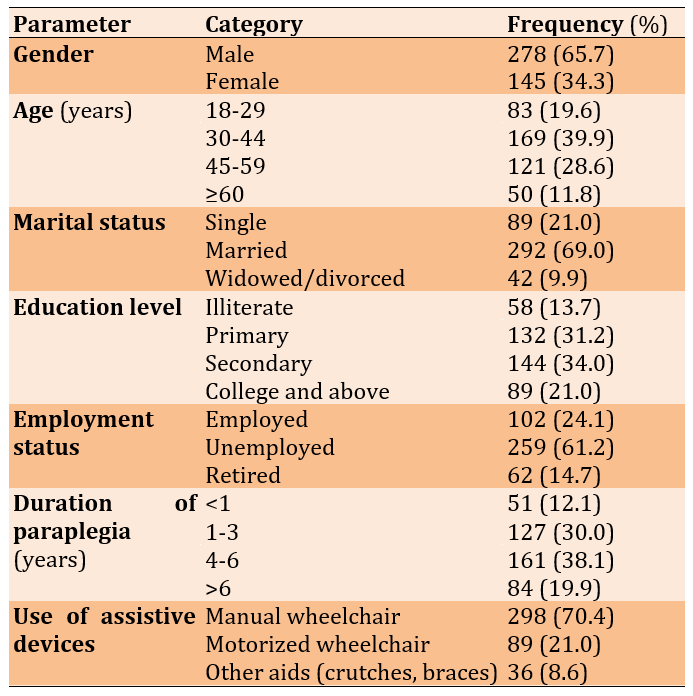
The mean age of the participants was 42.8±8.3 years, and most were male (65.7%), with the largest age group being 30-44 years (39.9%). Most were out of work (61.2%) and married (69%; Table 1).
Table 1. Participants' sociodemographic and clinical features (n=423)
Participants’ average perceived autonomy was moderate (61.38±10.52). Their environmental barriers were also moderate (58.47±13.61). Functional independence in ADLs, as measured by the Barthel Index, was moderate (16.41±15.28).
Environmental accessibility showed a negative relationship with both perceived autonomy and ADLs (r=-0.512 and r=-0.474, respectively), indicating that higher environmental barriers were associated with lower autonomy and reduced independence in ADLs. In contrast, perceived autonomy and ADLs were positively associated (r=0.623, p<0.001), indicating that greater functional capacity was linked to higher perceived autonomy.
The relationship between environmental access and ADLs was partly mediated by perceived autonomy. Greater autonomy improved ADL performance, whereas environmental barriers reduced both autonomy and ADL performance. The substantial indirect effect indicates that autonomy explains some of the association between environmental access and independence (Table 2).
Table 2. Mediating role of perceived autonomy between activities of daily living (ADLs) and environmental accessibility

Model 1 (perceived autonomy; a-path model) accounted for 22.9% of the variance in ADLs (R=0.478; R²=0.229). Model 2 (ADLs; b-path+c′-path model) accounted for 45.1% of the variance in ADLs (R=0.672; R²=0.451). Both models were statistically significant (Model 1: F=103.3, p<0.001; Model 2: F=173.8, p<0.001), indicating that perceived autonomy and environmental accessibility jointly explain paraplegic patients’ ADL outcomes.
Discussion
This investigation aimed to assess how paraplegic patients in Nasiriyah City, Iraq, experienced the relationship between environmental accessibility and daily living activities, with perceived autonomy as a mediator below the knee. Perceived autonomy partially mediated the association between environmental accessibility and functional independence, which underscores how psychological and physical stressors impact functional performance in individuals with SCI, and how autonomy can serve as an important psychological mediator linking environmental factors to day-to-day functional outcomes.
Regarding the participants’ sociodemographic profile, most were middle-aged men who had lived with paraplegia for several years. This aligns with previous reports indicating that men of working age comprise the majority of SCI cases, largely resulting from occupational and traffic-related factors [11]. The high unemployment rate observed in this study is consistent with worldwide evidence showing that paraplegic individuals have fewer employment opportunities due to physical limitations and limited workplace accessibility [20]. These sociocultural barriers can also restrict individuals’ freedom and participation in daily activities, underscoring the importance of inclusive policies and environmental modifications [21].
While participants’ autonomy and independence in daily activities were moderate, environmental constraints to independent living were evident. This intermediate pattern reflects ongoing impediments to full participation, despite the use of mobility aids and rehabilitation services, which enable partial independence. Similar findings have been reported in both developed and developing countries, where social stigma, transportation difficulties, and physical access remain significant barriers to independent living [22]. Enhancing access to services is a key factor in increasing participation and quality of life, as conceptualized by the World Health Organization’s International Classification of Functioning, Disability and Health (ICF), which defines disability as the result of an interaction between environmental factors and health conditions [23, 24].
The association between environmental accessibility and ADL performance was mediated by perceived autonomy. This finding is consistent with self-determination theory (SDT), which suggests that autonomy—a core need—may drive self-regulation, motivation, and healthy competence [25]. Individuals with physical disabilities are more willing to engage in rehabilitation and utilize adaptive coping strategies if they perceive a greater sense of control over their responses and behaviors. Autonomy-supportive settings have also been shown in previous studies to increase motivation and self-esteem among individuals with SCI, as well as adherence to treatment plans [26, 27]. The literature to date on participation suggests that autonomy is a key construct that mediates the relationship between the environment and everyday independence, and that it exerts direct effects on functional outcomes.
The strong inverse relationship between autonomy and environmental accessibility illustrates how external factors can undermine our sense of agency, or the ability to control events on some level. Studies of individuals with disabilities have shown that tools and support can help them maintain autonomy despite barriers such as social exclusion, physical inaccessibility, and lack of assistive technologies, while perceived loss of autonomy leads to poor adjustment and limited community accessibility [10–12]. Conversely, accessible environments foster participation and empowerment, which positively influence social reintegration and functional recovery [11]. Thus, the physical contextual environment should be considered an active influence that accommodates changing behaviors and psychological needs, rather than merely a backdrop for disability care.
The positive relationship between autonomy and ADLs validates autonomy as a predictor of independent performance. These results are supported by other findings indicating that greater independence in decision-making about mobility is associated with improved mobility, self-care, and overall life satisfaction among wheelchair users [10]. This association demonstrates that freedom allows individuals to apply adaptive strategies effectively despite ongoing physical limitations. As such, autonomy-enhancing interventions—such as peer mentoring, patient skill-based rehabilitation, and shared decision-making—will likely improve mental health and physical functioning.
In the mediation model, perceived autonomy and environmental accessibility jointly explained 45.1% of the variance in ADL performance, indicating a significant joint effect. Efforts to increase accessibility alone may be insufficient without psychological empowerment strategies. It is concluded that environmental facilitators and practices supporting autonomy must be addressed within a comprehensive biopsychosocial approach to rehabilitation. Interventions that focus on creating an enabling environment in public spaces and adaptive technology, combined with counseling aimed at encouraging autonomy, may interact synergistically to increase paraplegic patients’ independence and participation, in accordance with recommendations from international rehabilitation frameworks [28].
Several important limitations of this study must be noted. First, because this study is cross-sectional and correlational, it is difficult to establish causal relationships among perceived autonomy, environmental accessibility, and ADL performance. Second, self-report questionnaires were used for data collection, so response bias or social desirability effects may be present. Third, the study was confined to paraplegic individuals, limiting the generalizability of the results to patients with other disabilities (such as quadriplegics or hemiplegics). Lastly, contextual factors that were not fully controlled for (e.g., socioeconomic status differences, healthcare access, and cultural beliefs) might have influenced participants’ perceptions and functional outcomes.
Greater autonomy was associated with better ADL status, whereas more environmental barriers were associated with lower autonomy and diminished functional independence. These findings emphasize the importance of promoting environmental changes alongside obesity prevention and autonomy-supportive interventions. It is therefore recommended that policymakers and healthcare providers prioritize interventions that support patients in actively managing their daily lives, enhance access in public and healthcare settings, and incorporate autonomy-fostering approaches into patient care, enabling patients to become more independent and ultimately experience improved quality of life.
Conclusion
Perceived autonomy is a partial mediator of the effect of environmental access on ADL performance in paraplegic individuals.
Acknowledgments: The authors would like to thank all the participants who permitted them to conduct interviews and for their close cooperation and participation.
Ethical Permissions: Ethical approval was obtained from the Research Ethics Committee of the University of Thi-Qar (date: 07/09/2025, number: 211/4).
Conflicts of Interest: The authors declared no conflicts of interest.
Authors' Contribution: Kadhim AA (First Author), Introduction Writer/Main Researcher (25%); Abed AA (Second Author), Assistant Researcher/Discussion Writer (25%); Laftah SA (Third Author), Methodologist/Assistant Researcher (25%); Abadi NN (Fourth Author), Statistical Analyst (25%)
Funding/Support: The present study was not financially supported.
Spinal cord injury (SCI)-induced paraplegia is a severe, lifelong limitation affecting daily living and organ function. In addition to the primary sensorimotor impairments, paraplegia influences interaction with the built and social environment and functioning in basic activities of daily living (ADLs), which serve as a roadmap for long-term independence, quality of life, and social integration [1]. Rehabilitation research now takes into account both the individual’s impairments and the environment in which he or she lives, recognizing that the environment may facilitate or hinder ADL performance [2-4].
Environmental accessibility is a complex concept that encompasses the physical structures of homes and public spaces (such as ramps, door widths, and bathroom modifications), access to assistive technologies, and the availability of laws and social services that facilitate participation [5]. Although timely home modifications, for example, can reduce difficulty in daily tasks and improve self-rated functional ability, environmental barriers markedly increase ADL dependence and limit community inclusion for individuals who use wheelchairs or have SCI [6]. These findings highlight environmental accessibility as a modifiable factor for paraplegic populations in performing ADLs [7].
Self-perceived independence, an important psychosocial outcome in rehabilitation, refers to the individual’s subjective sense of responsibility for and control over daily decisions, mobility, and role fulfillment. To date, relatively little attention has been paid to the relationship between environment and function [8]. From a biopsychosocial perspective, as stated in the International Classification of Functioning, Disability and Health (ICF), participation and autonomy are key outcomes shaped by context. The ICF explicitly defines disability as emerging from interactions among an individual, their environment, and health conditions [9]. There is a strong correlation between self-perceived autonomy and independence in ADLs among individuals living with SCI. This suggests that autonomy may be both a feature of affordances and a prerequisite for effective action. Not surprisingly, the current positive influence of perceived autonomy on ADLs in our sample suggests that it mediates the relationship between environmental accessibility and ADL functioning [10, 11].
On the one hand, it is theoretically plausible that perceived autonomy serves as a mediator for several reasons. Accessible spaces, the argument goes, increase opportunities for volitional action and decision-making—prerequisites of autonomy—by reducing physical barriers and the cognitive and emotional costs of navigating them. Second, greater autonomy could enhance self-efficacy and motivation to initiate or sustain ADL tasks, further enhancing the functional benefits of environmental modifications. Third, psychological states such as autonomy influence the uptake and successful use of compensatory techniques and assistive technology; if control is not restored, physical changes alone may not necessarily lead to improved ADL performance. Although some isolated findings have revealed links between environment, independence, and ADLs, a paucity of formal mediation analyses focusing on paraplegics exists in the literature. To date, these studies tend to be cross-sectional or based on small samples. Without evidence, it becomes difficult to draw conclusions about causality and whether autonomy is the mechanism by which accessibility influences day-to-day life [12-14].
Given these considerations, we examined patients’ perceptions of their autonomy as a mediator of the effect of environmental accessibility on daily living activities. If perceived autonomy is established as a mediating factor, rehabilitation theory would take an enormous step forward, and the development of multi-component programs targeting both intrapersonal and environmental factors predicting functioning would be supported by empirical data [15, 16]. This study aimed to quantify the direct effect of environmental access on ADL independence, estimate the indirect effect transmitted by perceived autonomy, and pinpoint rehabilitation practice and policy implications (e.g., coupling structural home repairs with autonomy-supporting psychosocial interventions) by combining validated measures of environmental barriers/accessibility, standardized ADL indices, and a psychometrically sound instrument for perceived autonomy.
Instrument and Methods
Design and sample
This cross-sectional study was conducted on 423 paraplegic individuals in Nasiriyah City, the capital of Thi Qar Governorate, Iraq, from September to October 2025. The data sources included major rehabilitation centers, the physical therapy departments at public hospitals, and community-based rehabilitation units. To maximize the variance in the degree of environmental access and autonomy, these environments were chosen because they were accessible to individuals with disabilities and had successfully discharged some paraplegic persons to rehabilitation services, while others had not.
The target population comprised adult paraplegic patients (18 years or older) who were receiving rehabilitation services, used wheelchairs, and had no mental or cognitive disabilities that could have influenced their ability to understand the questionnaire or respond reliably. In addition, they had been treated for three months or longer. Based on the daily patient attendance registers for each facility, systematic random sampling was used to recruit participants. Every third eligible patient was invited to participate until the desired sample size was reached. The sample size was calculated using the Cochran formula at a 5% significance level and a 95% confidence level. To obtain the most representative sample, a conservative probability (p=0.05) was used because no previous prevalence values were available for Iraq. The final target number was increased to 423 patients to account for an anticipated nonresponse rate of 10%, although the minimum required sample size was calculated to be 384 participants. Because mediation analysis using the PROCESS macro typically requires 200–400 cases to obtain stable and reliable estimates of the indirect effect, this sample size was considered sufficient.
Instrument
Data were collected using an interviewer-administered structured questionnaire with four main sections. The first section gathered demographic information, including age, gender, level of education, marital status, working condition, duration of paraplegia, and type of assistive device used. The second section assessed environmental access using the Craig Hospital Inventory of Environmental Factors-Short Form (CHIEF-SF), which measures the frequency and magnitude of perceived barriers across five domains: work/school environments, attitudes/support, services/assistance, policies, and physical/structural barriers [17]. Each item was scored on a 5-point Likert scale, with higher scores reflecting greater environmental barriers. The third section used the Perceived Autonomy Support Scale for People with Physical Disabilities (PASS-PD), a 12-item measure that assesses the extent to which individuals believe their environment or caregivers support their autonomy. Participants rated the items concerning the level of autonomy on a seven-point Likert scale from 1=strongly disagree to 7=strongly agree, with higher scores indicating a greater degree of autonomy [18]. ADLs were assessed in the fourth section using the Barthel Index of Activities of Daily Living, which measures independence across 10 essential activities, including eating, transferring, grooming, bathing, and toileting. Higher scores indicate greater functional independence, with scores ranging from 0 to 20 [19].
Five experts in physical medicine, rehabilitation nursing, and public health evaluated the content validity and cultural relevance of the instruments following translation into Arabic using a forward-backward process. Their feedback was used to enhance linguistic quality and clarify ambiguous parts. A pilot study was conducted with 40 paraplegics who met all inclusion criteria but were excluded from the final analysis. Internal consistency, response time, and clarity of the instruments were evaluated during the pilot test. Cronbach’s α coefficients for the CHIEF-SF, PASS-PD, and Barthel Index were 0.88, 0.91, and 0.9, respectively, indicating high internal consistency and excellent reliability of each measurement tool.
Data collection
Data were collected by trained rehabilitation nurses who had completed a 2-day training program that outlined the study aims, ethical considerations, and the administration of standardized instruments. Individual interviews were conducted with each participant, either at the rehabilitation center or, for those with limited mobility, at home. To ensure comfort and privacy, all interviews took place in secure locations and lasted between 30 and 40 minutes. All participants were informed that participation was voluntary and that they had the right to withdraw at any time without penalty. Written informed consent was obtained from all participants. All study procedures met the ethical guidelines set out in the Declaration of Helsinki
Statistical analysis
Data were analyzed using SPSS 28. Pearson correlation coefficients were used to examine the relationships between perceived autonomy, environmental accessibility, and ADL scores. Mediation was tested using Hayes’ PROCESS macro (Model 4), with perceived autonomy as the mediator, employing 5,000 bootstrapping samples and a 95% confidence interval to estimate indirect effects. Mediation was considered significant only if the 95% confidence interval for the indirect effect did not include zero. Collinearity was assessed using variance inflation factor (VIF) values.
Findings
The mean age of the participants was 42.8±8.3 years, and most were male (65.7%), with the largest age group being 30-44 years (39.9%). Most were out of work (61.2%) and married (69%; Table 1).
Table 1. Participants' sociodemographic and clinical features (n=423)
Participants’ average perceived autonomy was moderate (61.38±10.52). Their environmental barriers were also moderate (58.47±13.61). Functional independence in ADLs, as measured by the Barthel Index, was moderate (16.41±15.28).
Environmental accessibility showed a negative relationship with both perceived autonomy and ADLs (r=-0.512 and r=-0.474, respectively), indicating that higher environmental barriers were associated with lower autonomy and reduced independence in ADLs. In contrast, perceived autonomy and ADLs were positively associated (r=0.623, p<0.001), indicating that greater functional capacity was linked to higher perceived autonomy.
The relationship between environmental access and ADLs was partly mediated by perceived autonomy. Greater autonomy improved ADL performance, whereas environmental barriers reduced both autonomy and ADL performance. The substantial indirect effect indicates that autonomy explains some of the association between environmental access and independence (Table 2).
Table 2. Mediating role of perceived autonomy between activities of daily living (ADLs) and environmental accessibility
Model 1 (perceived autonomy; a-path model) accounted for 22.9% of the variance in ADLs (R=0.478; R²=0.229). Model 2 (ADLs; b-path+c′-path model) accounted for 45.1% of the variance in ADLs (R=0.672; R²=0.451). Both models were statistically significant (Model 1: F=103.3, p<0.001; Model 2: F=173.8, p<0.001), indicating that perceived autonomy and environmental accessibility jointly explain paraplegic patients’ ADL outcomes.
Discussion
This investigation aimed to assess how paraplegic patients in Nasiriyah City, Iraq, experienced the relationship between environmental accessibility and daily living activities, with perceived autonomy as a mediator below the knee. Perceived autonomy partially mediated the association between environmental accessibility and functional independence, which underscores how psychological and physical stressors impact functional performance in individuals with SCI, and how autonomy can serve as an important psychological mediator linking environmental factors to day-to-day functional outcomes.
Regarding the participants’ sociodemographic profile, most were middle-aged men who had lived with paraplegia for several years. This aligns with previous reports indicating that men of working age comprise the majority of SCI cases, largely resulting from occupational and traffic-related factors [11]. The high unemployment rate observed in this study is consistent with worldwide evidence showing that paraplegic individuals have fewer employment opportunities due to physical limitations and limited workplace accessibility [20]. These sociocultural barriers can also restrict individuals’ freedom and participation in daily activities, underscoring the importance of inclusive policies and environmental modifications [21].
While participants’ autonomy and independence in daily activities were moderate, environmental constraints to independent living were evident. This intermediate pattern reflects ongoing impediments to full participation, despite the use of mobility aids and rehabilitation services, which enable partial independence. Similar findings have been reported in both developed and developing countries, where social stigma, transportation difficulties, and physical access remain significant barriers to independent living [22]. Enhancing access to services is a key factor in increasing participation and quality of life, as conceptualized by the World Health Organization’s International Classification of Functioning, Disability and Health (ICF), which defines disability as the result of an interaction between environmental factors and health conditions [23, 24].
The association between environmental accessibility and ADL performance was mediated by perceived autonomy. This finding is consistent with self-determination theory (SDT), which suggests that autonomy—a core need—may drive self-regulation, motivation, and healthy competence [25]. Individuals with physical disabilities are more willing to engage in rehabilitation and utilize adaptive coping strategies if they perceive a greater sense of control over their responses and behaviors. Autonomy-supportive settings have also been shown in previous studies to increase motivation and self-esteem among individuals with SCI, as well as adherence to treatment plans [26, 27]. The literature to date on participation suggests that autonomy is a key construct that mediates the relationship between the environment and everyday independence, and that it exerts direct effects on functional outcomes.
The strong inverse relationship between autonomy and environmental accessibility illustrates how external factors can undermine our sense of agency, or the ability to control events on some level. Studies of individuals with disabilities have shown that tools and support can help them maintain autonomy despite barriers such as social exclusion, physical inaccessibility, and lack of assistive technologies, while perceived loss of autonomy leads to poor adjustment and limited community accessibility [10–12]. Conversely, accessible environments foster participation and empowerment, which positively influence social reintegration and functional recovery [11]. Thus, the physical contextual environment should be considered an active influence that accommodates changing behaviors and psychological needs, rather than merely a backdrop for disability care.
The positive relationship between autonomy and ADLs validates autonomy as a predictor of independent performance. These results are supported by other findings indicating that greater independence in decision-making about mobility is associated with improved mobility, self-care, and overall life satisfaction among wheelchair users [10]. This association demonstrates that freedom allows individuals to apply adaptive strategies effectively despite ongoing physical limitations. As such, autonomy-enhancing interventions—such as peer mentoring, patient skill-based rehabilitation, and shared decision-making—will likely improve mental health and physical functioning.
In the mediation model, perceived autonomy and environmental accessibility jointly explained 45.1% of the variance in ADL performance, indicating a significant joint effect. Efforts to increase accessibility alone may be insufficient without psychological empowerment strategies. It is concluded that environmental facilitators and practices supporting autonomy must be addressed within a comprehensive biopsychosocial approach to rehabilitation. Interventions that focus on creating an enabling environment in public spaces and adaptive technology, combined with counseling aimed at encouraging autonomy, may interact synergistically to increase paraplegic patients’ independence and participation, in accordance with recommendations from international rehabilitation frameworks [28].
Several important limitations of this study must be noted. First, because this study is cross-sectional and correlational, it is difficult to establish causal relationships among perceived autonomy, environmental accessibility, and ADL performance. Second, self-report questionnaires were used for data collection, so response bias or social desirability effects may be present. Third, the study was confined to paraplegic individuals, limiting the generalizability of the results to patients with other disabilities (such as quadriplegics or hemiplegics). Lastly, contextual factors that were not fully controlled for (e.g., socioeconomic status differences, healthcare access, and cultural beliefs) might have influenced participants’ perceptions and functional outcomes.
Greater autonomy was associated with better ADL status, whereas more environmental barriers were associated with lower autonomy and diminished functional independence. These findings emphasize the importance of promoting environmental changes alongside obesity prevention and autonomy-supportive interventions. It is therefore recommended that policymakers and healthcare providers prioritize interventions that support patients in actively managing their daily lives, enhance access in public and healthcare settings, and incorporate autonomy-fostering approaches into patient care, enabling patients to become more independent and ultimately experience improved quality of life.
Conclusion
Perceived autonomy is a partial mediator of the effect of environmental access on ADL performance in paraplegic individuals.
Acknowledgments: The authors would like to thank all the participants who permitted them to conduct interviews and for their close cooperation and participation.
Ethical Permissions: Ethical approval was obtained from the Research Ethics Committee of the University of Thi-Qar (date: 07/09/2025, number: 211/4).
Conflicts of Interest: The authors declared no conflicts of interest.
Authors' Contribution: Kadhim AA (First Author), Introduction Writer/Main Researcher (25%); Abed AA (Second Author), Assistant Researcher/Discussion Writer (25%); Laftah SA (Third Author), Methodologist/Assistant Researcher (25%); Abadi NN (Fourth Author), Statistical Analyst (25%)
Funding/Support: The present study was not financially supported.
Keywords:
References
1. Widagdo MM, Robot MM, Pinzon RT. Independence in activities of daily living and quality of life of community-dwelling persons with paraplegia in Indonesia. Int J Disabil Hum Dev. 2021;20(3). [Link]
2. Rantanen T. Functional capacity, activities, and participation. In: Advancing research on active aging and participation: A public health approach. Cham: Springer; 2025. p. 51-72. [Link] [DOI:10.1007/978-3-031-94702-5_6]
3. Abed Laftah S, Kadhim Abdul-Hameed A, Zair Balat K, Malih Radhi M. Barriers and facilitators in rehabilitative nursing care for disabilities and mediating roles of nurse-related factors. Iran Rehabil J. 2025;23(2):165-74. [Link] [DOI:10.32598/irj.23.2.1989.4]
4. Al-Eqabi QA, Niazy SM, Radhi MM. Amputation-related factors influencing activities of daily living among amputees. Iran J War Public Health. 2024;16(2):123-9. [Link]
5. Da Silva MB, Moschen SD, Cecatto B, Larentis F. Perceived attributes and dimensions of accessibility in adapted bathrooms. Build Res Inf. 2022;50(1-2):60-73. [Link] [DOI:10.1080/09613218.2021.1943643]
6. Botticello AL, Tulsky D, Heinemann A, Charlifue S, Kalpakjian C, Slavin M, et al. Contextualizing disability: A cross-sectional analysis of the association between the built environment and functioning among people living with spinal cord injury in the United States. Spinal Cord. 2019;57(2):100-9. [Link] [DOI:10.1038/s41393-018-0186-8]
7. Gurung S, Jenkins HT, Chaudhury H, Ben Mortenson W. Modifiable sociostructural and environmental factors that impact the health and quality of life of people with spinal cord injury: A scoping review. Top Spinal Cord Inj Rehabil. 2023;29(1):42-53. [Link] [DOI:10.46292/sci21-00056]
8. Márquez L, Poveda JC, Vega LA. Factors affecting personal autonomy and perceived accessibility of people with mobility impairments in an urban transportation choice context. J Transp Health. 2019;14:100583. [Link] [DOI:10.1016/j.jth.2019.100583]
9. Radhi MM, Al-Eqabi QA, Hindi NK. Rehabilitation problems of people with motor disabilities at Babylon center for rehabilitation of the disabled. Med J Babylon. 2023;20(4):838-43. [Link] [DOI:10.4103/MJBL.MJBL_674_23]
10. Lili L, Sunnerhagen KS, Rekand T, Alt Murphy M. Participation and autonomy, independence in activities of daily living and upper extremity functioning in individuals with spinal cord injury. Sci Rep. 2024;14(1):9120. [Link] [DOI:10.1038/s41598-024-59862-2]
11. Juma Elywy G, Radhi MM, Khyoosh Al-Eqabi QA. Social support and its association with the quality of life (QoL) of amputees. Iran Rehabil J. 2022;20(2):253-60. [Link] [DOI:10.32598/irj.20.2.1784.1]
12. Friman M, Olsson LE. Are we leaving some people behind? Travel autonomy, perceived accessibility, and well-being among people experiencing mental and physical difficulties. Transp Res Part F Traffic Psychol Behav. 2023;98:243-53. [Link] [DOI:10.1016/j.trf.2023.08.009]
13. Malih Radhi M, Juma Elywy G, Abbas Khyoosh Al-Eqabi Q. Burdens among wives of disabled people in the light of some social variables. Iran Rehabil J. 2023;21(3):473-84. [Link] [DOI:10.32598/irj.21.3.1765.3]
14. Niazy SM, Abadi NN, Radhi MM, Al-Eqabi QA, AL-Thabhawee GD. Impact of digital health literacy on quality of life among people with physical disabilities. Iran J War Public Health. 2025;17(2):197-203. [Link] [DOI:10.58209/ijwph.17.1.83]
15. Blank R, Barnett AL, Cairney J, Green D, Kirby A, Polatajko H, et al. International clinical practice recommendations on the definition, diagnosis, assessment, intervention, and psychosocial aspects of developmental coordination disorder. Dev Med Child Neurol. 2019;61(3):242-85. [Link] [DOI:10.1111/dmcn.14132]
16. Philp KD, Babb KE. Understanding motivations for gang joining using self-determination theory: Implications for youth mentoring programs. Vict Offenders. 2025;1:1-31. [Link] [DOI:10.1080/15564886.2025.2509313]
17. Whiteneck GG, Harrison-Felix CL, Mellick DC, Brooks CA, Charlifue SB, Gerhart KA. Quantifying environmental factors: A measure of physical, attitudinal, service, productivity, and policy barriers. Arch Phys Med Rehabil. 2004;85(8):1324-35. [Link] [DOI:10.1016/j.apmr.2003.09.027]
18. Simon MA. The graduate thesis of Cherlou U. Valencia is approved [dissertation]. Madurai: American College; 2007. [Link]
19. Collin C, Wade DT, Davies S, Horne V. The Barthel ADL Index: A reliability study. Int Disabil Stud. 1988;10(2):61-3. [Link] [DOI:10.3109/09638288809164103]
20. Balat KZ, Laftah SA, Radhi M. The relationship between psychological distress and quality of life among women undergoing mastectomy in Iraq: A descriptive correlational study. Natl J Community Med. 2025;16(1):20-7. [Link] [DOI:10.55489/njcm.160120254716]
21. Yaqoub RH, Abdulwahid HS. Self-body image and its association to quality of life among women undergoing to mastectomy. Oncol Radiother. 2023;17(7):213-6. [Link]
22. Van Loon J, Luijkx K, Janssen M, De Rooij I, Janssen B. Facilitators and barriers to autonomy: A systematic literature review for older adults with physical impairments, living in residential care facilities. Ageing Soc. 2021;41(5):1021-50. [Link] [DOI:10.1017/S0144686X19001557]
23. Malih Radhi M, Zair Balat K. Health literacy and its association with medication adherence in patients with hypertension: A mediating role of social support. Iran Rehabil J. 2024;22(1):117-28. [Link] [DOI:10.32598/irj.22.1.1989.1]
24. Saketkoo LA, Escorpizo R, Varga J, Keen KJ, Fligelstone K, Birring SS, et al. World Health Organization (WHO) international classification of functioning, disability and health (ICF) core set development for interstitial lung disease. Front Pharmacol. 2022;13:979788. [Link] [DOI:10.3389/fphar.2022.979788]
25. Guay F. Applying self-determination theory to education: Regulations types, psychological needs, and autonomy supporting behaviors. Can J Sch Psychol. 2022;37(1):75-92. [Link] [DOI:10.1177/08295735211055355]
26. Cole S, Deci EL, Zhao H, Wang W. How environmental and psychological factors interact with travel participation after spinal cord injury. Rehabil Psychol. 2022;67(2):152-61. [Link] [DOI:10.1037/rep0000439]
27. Yasir AA, Qassim WJ, Radhi MM. Assessment the feeling of psychological loneliness among wives of martyrs in the light of some social variables in Babylon Governorate/Iraq. J Pharm Sci Res. 2018;10(1):40-4. [Link]
28. Zhang D, Bobis J, Wu X, Cui Y. The effects of an autonomy-supportive teaching intervention on Chinese physics students and their teacher. Res Sci Educ. 2020;50(2):645-71. [Link] [DOI:10.1007/s11165-018-9706-y]