

1.0
Cite Score 2025
SJR: 0.129 / SNIP: 0.140

JMERC
Owner
Janbazan Medical and Engineering Research Center (JMERC) is the owner of IJWPH.
Volume 17, Issue 4 (2025)
3 2025, 17(4): 391-397 |
Back to browse issues page
Request Type:




History
Received: 2025/12/14 | Accepted: 2025/12/23 | Published: 2025/11/19
Received: 2025/12/14 | Accepted: 2025/12/23 | Published: 2025/11/19
How to cite this article
Nemati P, Barzegari Marvast H, Mosayebi Z. Effects of Resistance Training with/without Vitamin D on Muscle Strength, Walking Speed, and Muscle Mass in Elderly Women with Sarcopenia. 3 2025; 17 (4) :391-397
URL: http://ijwph.daneshafarand.org/article-3-85663-en.html
URL: http://ijwph.daneshafarand.org/article-3-85663-en.html
Download citation:
BibTeX | RIS | EndNote | Medlars | ProCite | Reference Manager | RefWorks
Send citation to:


Rights and permissions
BibTeX | RIS | EndNote | Medlars | ProCite | Reference Manager | RefWorks
Send citation to:


Full-Text (HTML) (62 Views)
Introduction
Sarcopenia, derived from the Greek terms “sarx” (flesh) and “penia” (loss), is a progressive geriatric syndrome characterized by the age-related decline in skeletal muscle mass, strength, and physical performance [1]. It is now recognized as a distinct muscle disease with an ICD-10 code (M62.84), affecting functional independence, quality of life, and increasing the risk of falls, frailty, disability, hospitalization, and mortality [2]. Global prevalence estimates vary depending on diagnostic criteria, population, and setting, but systematic reviews and meta-analyses indicate that sarcopenia affects approximately 10-16% of community-dwelling older adults worldwide, with rates potentially higher (up to 20-30%) in institutionalized or frail populations [2, 3]. In elderly women, prevalence is often comparable or slightly higher than in men when using certain criteria, such as those from the European Working Group on Sarcopenia in Older People (EWGSOP), due to factors like hormonal changes post-menopause and lower baseline muscle mass [4].
The pathophysiology of sarcopenia is multifactorial, involving intrinsic aging processes and extrinsic influences such as physical inactivity and nutritional deficiencies [5]. At the cellular level, sarcopenia manifests as a reduction in both the number (hypoplasia) and size (atrophy) of muscle fibers, with a preferential loss of type II (fast-twitch) fibers, which are critical for explosive strength and power [6]. This is driven by age-related denervation, stemming from a decline in alpha-motor neurons in the spinal cord and degeneration of neuromuscular junctions [7]. Functional motor units decrease progressively, leading to denervation of muscle fibers, subsequent atrophy, and fiber death [7]. Additional contributors include mitochondrial dysfunction, increased oxidative stress, chronic low-grade inflammation (“inflammaging” with elevated cytokines, like IL-6 and TNF-α), hormonal imbalances (e.g., reduced growth hormone, IGF-1, testosterone, and estrogen), impaired satellite cell activation and muscle regeneration, and an imbalance between protein synthesis and degradation pathways (e.g., upregulated ubiquitin-proteasome system and autophagy) [8, 9].
Physical inactivity exacerbates these processes, accelerating muscle loss and contributing to a vicious cycle of reduced mobility and further decline [10]. Conversely, resistance training (RT) has emerged as the most effective non-pharmacological intervention for mitigating sarcopenia [11]. RT stimulates neuromuscular adaptations, including enhanced motor unit recruitment, improved neural drive, and increased protein synthesis via pathways such as the mammalian target of rapamycin (mTOR) [12]. Numerous randomized controlled trials and meta-analyses demonstrate that progressive RT (typically 2–3 sessions per week, moderate to high intensity) significantly increases muscle strength (e.g., grip and knee extension), muscle mass (hypertrophy, particularly in type II fibers), and physical performance (e.g., gait speed, Timed Up-and-Go test) [13]. For example, studies in elderly women have shown gains in lean mass and strength comparable to those of younger adults when training is supervised and progressive [14]. Functional exercises, such as sit-to-stand, also yield benefits, underscoring RT’s role in preserving or restoring muscle function [15].
Nutritional factors are equally pivotal, with vitamin D deficiency emerging as a key modifiable risk factor [16]. Vitamin D deficiency (<20ng/mL or <50nmol/L) is highly prevalent in older adults, affecting 20-60% globally, and up to 90% in certain populations (e.g., institutionalized elderly or those with limited sun exposure) [17]. Severe deficiency is linked to proximal muscle weakness, atrophy, pain, and impaired physical performance. Mechanistically, vitamin D acts via the vitamin D receptor (VDR), expressed in skeletal muscle, influencing both genomic (gene transcription for muscle proteins, growth factors) and non-genomic pathways (rapid calcium handling, mitochondrial function, oxidative stress reduction) [18]. Active 1,25-dihydroxyvitamin D promotes myoblast proliferation and differentiation, upregulates IGF-1, downregulates myostatin (a muscle growth inhibitor), enhances protein synthesis, and improves mitochondrial oxidative capacity [18]. Deficiency disrupts these processes, contributing to fiber atrophy and reduced strength [19].
Vitamin D supplementation alone has yielded mixed results in elderly women with sarcopenia, with some trials showing modest improvements in strength and performance, particularly in deficient individuals, while meta-analyses often find limited effects on muscle mass [20]. However, when combined with RT, synergistic benefits are observed: enhanced hypertrophy, greater strength gains, and improved functional outcomes. This combination may optimize anabolic signaling, reduce inflammation, and support satellite cell activity more effectively than either intervention alone [21].
Given the high prevalence of sarcopenia in elderly women—often compounded by vitamin D deficiency and sedentary lifestyles—interventions targeting both RT and nutritional correction are particularly relevant. While the individual effects of RT and vitamin D on muscle parameters are established, their combined impact, especially in women with diagnosed sarcopenia, requires further elucidation. This is critical amid rising musculoskeletal disorders in aging populations.
The present study investigated the effects of resistance training with and without vitamin D supplementation on muscle strength, walking speed, and muscle mass in elderly women with sarcopenia, aiming to clarify potential additive benefits and inform targeted therapeutic strategies.
Materials and Methods
This randomized, placebo-controlled, semi-experimental study employed a pre-test–post-test design with four parallel groups. The sample size was determined based on the feasibility and availability of eligible participants in the nursing homes of Aligoudarz County during the year 2024. A total of 40 elderly women with sarcopenia were recruited through convenience sampling after health screening. Participants were then randomly allocated into four equal groups (n=10 per group): resistance training+vitamin D supplementation (RT+VD), resistance training+placebo (RT+P), vitamin D supplementation only (VD), and control (CON).
Although no formal statistical power analysis was conducted, the chosen sample size was consistent with similar semi-experimental studies in geriatric populations, ensuring sufficient participants per group to allow meaningful comparisons using parametric tests (t-tests, ANOVA) at a significance level of α=0.05.
The trial was conducted in accordance with the Declaration of Helsinki [22]. Written informed consent was obtained from all participants prior to enrollment.
Sarcopenia was diagnosed according to the European Working Group on Sarcopenia in Older People 2 (EWGSOP2) criteria: Low muscle strength (handgrip strength <16kg for women) confirmed by low appendicular skeletal muscle mass and/or poor physical performance [23].
Eligibility criteria included handgrip strength between 15 and 26kg (as a proxy for low strength), no regular resistance training in the past 6 months, no contraindications to exercise or vitamin D supplementation (e.g., hypercalcemia, renal stones, or uncontrolled cardiovascular disease), and ability to walk independently. Exclusion criteria encompassed cognitive impairment (Mini-Mental State Examination score <24), acute illness, musculoskeletal injuries, or use of medications affecting muscle metabolism (e.g., corticosteroids).
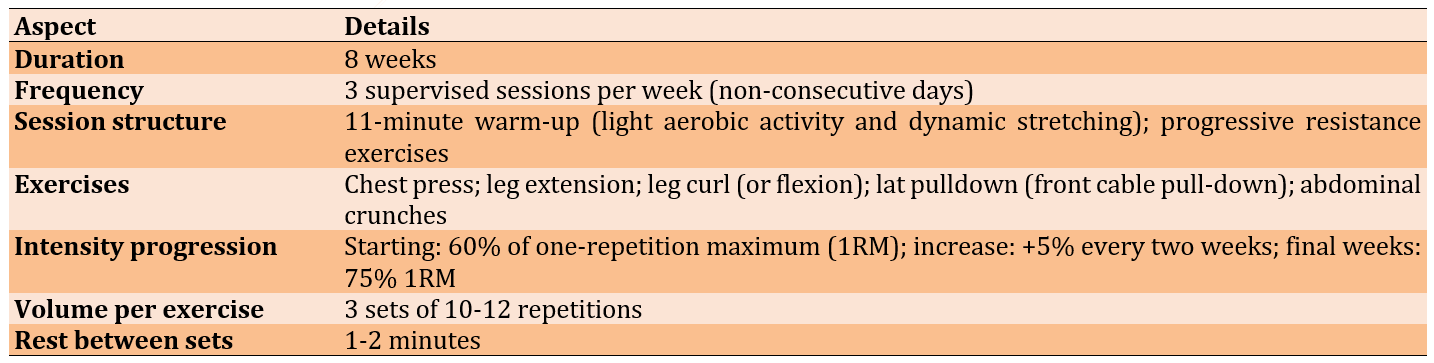
The resistance training protocol lasted 8 weeks, with three supervised sessions per week (on non-consecutive days). Each session began with an 11-minute warm-up, followed by progressive resistance exercises. One-repetition maximum (1RM) was assessed at baseline and re-evaluated every 4 weeks for progression. Sessions were supervised by certified trainers to ensure proper form and adherence (Table 1).
Table 1. Details of the resistance training protocol
Vitamin D supplementation consisted of (specify dose, e.g., 50,000IU weekly or equivalent daily dose, based on common trials) oral cholecalciferol (manufactured by Zahravi Pharmaceutical Company, Iran) for the duration following the resistance training period or concurrently, as per group. The placebo group received identical-appearing tablets containing inert substances. Supplementation was administered under direct observation or monitored for compliance. The control group maintained usual daily activities without structured exercise or supplementation. Assessments were conducted at baseline and post-intervention by blinded assessors.
Handgrip strength (primary measure) was assessed using a hydraulic dynamometer (preferred over quadriceps for EWGSOP2 alignment), with the dominant hand in a seated position and the elbow flexed at 90°. The maximum of three trials (1-minute rest) was recorded in kilograms (kg).
Quadriceps strength was measured isometrically using a handheld dynamometer in a seated position with the knee at 30° flexion. Each maximal effort lasted 3 seconds, repeated twice with a 2-minute rest. The best value was used.
Usual gait speed was measured over a 4-meter course (recommended for sarcopenia) from a static start. Time was recorded with a digital stopwatch, and speed was calculated in m/s (best of two trials) [24].
The 6-minute walk test (6MWT) was performed on a marked 30-meter corridor. Participants walked at a self-selected pace, and the total distance (meters) was recorded as a measure of functional endurance.
Appendicular skeletal muscle mass was estimated using the anthropometric prediction equation validated by Lee et al. [25], incorporating corrected arm, thigh, and calf circumferences (skin-fold adjusted), height, and sex. Additional anthropometric measures (height via stadiometer, body mass via LAICA scale, circumferences via tape measure, and skinfolds via caliper) were taken in triplicate by trained personnel.
Serum 25-hydroxyvitamin D levels were measured at baseline to confirm deficiency status (optional, if available).
Data were analyzed using SPSS version 25. Normality was assessed with the Shapiro-Wilk test, justifying the use of parametric statistics, and homogeneity of variances with Levene’s test. Within-group changes were evaluated using paired t-tests (or Wilcoxon signed-rank tests for non-normal data). Between-group differences were analyzed with one-way ANOVA (or Kruskal–Wallis test) followed by post hoc tests, or repeated-measures ANOVA for time×group interactions. Effect sizes (Cohen’s d) and an intention-to-treat analysis (last observation carried forward) were applied. Statistical significance was set at p <0.05.
Findings
Forty elderly women aged 60-65 years with sarcopenia participated in the study. Baseline demographic characteristics, including age, height, and body weight showed no significant differences among the groups (p>0.05; Table 2).
Table 2. Mean values of demographic characteristics of participant at baseline

Within-group comparisons (paired t-tests) revealed significant improvements in all outcomes for the resistance training groups (RT+VD and RT+P), but not for the VD-only or control groups (Table 3).
Table 3. Mean values and within-group changes by group for handgrip strength, quadriceps isometric strength, gait speed, and muscle mass
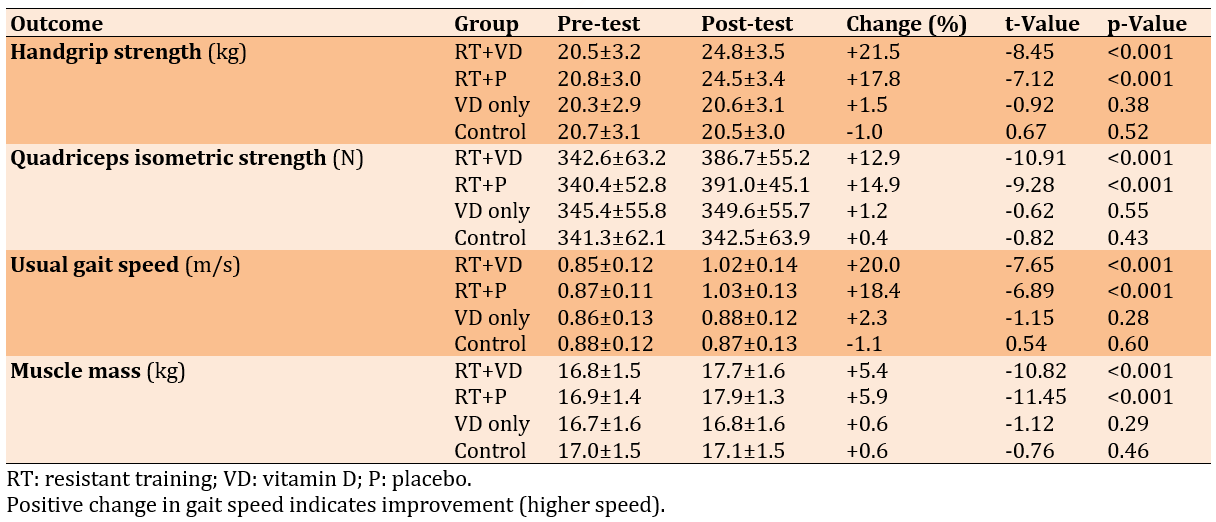
Repeated-measures ANOVA revealed significant time×group interactions for all outcomes (p<0.001). One-way ANOVA on post-intervention values (or delta changes) showed significant between-group differences.
Tukey’s post-hoc test indicated that both RT groups (RT+VD and RT+P) showed significantly greater improvements than VD-only and control groups (p<0.001). There were no significant differences between the two RT groups (p>0.05 for all outcomes), suggesting no additive effect of vitamin D supplementation beyond resistance training alone.
Discussion
This study examined the effects of resistance training with and without vitamin D supplementation on muscle strength, walking speed, and muscle mass in elderly women with sarcopenia. An 8-week progressive resistance training program significantly improved muscle strength (handgrip and quadriceps isometric), gait speed, and appendicular skeletal muscle mass in elderly women diagnosed with sarcopenia. Both RT groups (with vitamin D supplementation and placebo) exhibited substantial gains compared with the vitamin D-only and control groups, with no significant differences between the two RT groups. Thus, RT is the primary driver of these adaptations, while vitamin D supplementation alone conferred no benefits and did not augment the effects of RT.
Our findings are consistent with a large body of previous research, including those reported by Ezoji et al. [26], Clerton [1], and Muir & Montero-Odasso [27]. It appears that the training protocols used in this study contributed to the strengthening of the lower-extremity muscles, particularly the quadriceps and hamstrings—muscle groups that play a critical role in maintaining balance and enhancing motor performance. These muscles can improve postural stability and walking speed by reducing spasticity, alleviating sensory impairments, and minimizing muscular weakness.
The increase in muscle strength may be attributed to enhanced neural communication between motor neurons. These adaptations lead to greater synchronization and more efficient recruitment of motor units, thereby improving force production and its stability. During maximal voluntary contraction, increased neural drive toward alpha motor neurons can elevate the discharge frequency of motor units, resulting in peak force generation or tension within muscle fibers [28]. Evidence suggests that muscle atrophy in individuals with sarcopenia occurs both at the whole-muscle level and at the individual muscle fiber level [29]. Since force production begins in the motor cortex and culminates in the cross-bridge cycling between actin and myosin filaments, any disruption along this pathway can lead to reduced muscular strength and power. In particular, demyelination of neuronal axons—as observed in patients with multiple sclerosis—may prolong neural conduction time and impair motor performance [30].
Walking speed significantly improved in the resistance training group, with a 13.6% reduction in walking time, and in the group receiving resistance training combined with vitamin D supplementation, with a 12.9% reduction. In contrast, no significant changes were observed in the vitamin D-only group or the control group.
Duncan’s post hoc analysis identified two distinct subsets: the resistance training and combined intervention groups formed the first subset, while the vitamin D-only and control groups comprised the second. The significant difference between these subsets suggests that improvements in walking speed were primarily driven by resistance training. Vitamin D supplementation alone did not produce a meaningful effect in this regard.
These findings are consistent with previous studies by Cheng et al. [28] and Lin et al. [31]. Resistance training has been shown to enhance lower-limb muscle strength, while balance exercises contribute to improved postural stability. The combination of these two components in the intervention groups likely led to better movement quality and increased walking distance compared to non-exercising groups.
Individuals with sarcopenia often face multiple motor impairments, and attention to their functional mobility is essential for performing daily activities. There is a strong correlation between lower-limb muscle strength and walking distance; increased muscular strength is associated with greater walking capacity and improved gait performance. Conversely, reduced lower-limb strength is linked to shorter step length [32, 33]. Therefore, compensating for weakness in muscles involved in walking may lead to increased step length and, consequently, higher walking speed. Since walking speed depends on both step length and cadence, improvements in these two parameters play a decisive role in enhancing overall gait velocity [33].
The resistance training group experienced a significant increase of 5.97% in muscle mass, while the group receiving resistance training combined with vitamin D supplementation showed a 5.47% increase. In contrast, no significant changes were observed in the vitamin D-only group or the control group. Duncan’s post-hoc test identified two distinct subsets: the resistance training and combined intervention groups formed one subset, while the vitamin D-only and control groups comprised the other. The significant difference between these subsets indicates that the observed improvements in muscle mass were primarily driven by resistance training. Vitamin D supplementation alone did not produce a meaningful effect in this regard.
These findings reinforce the conclusion that resistance training is the key factor in enhancing muscle mass among elderly women with sarcopenia, while vitamin D supplementation may only be effective when combined with physical exercise.
These findings are consistent with previous studies conducted by Vakili et al. [34], Cheng et al. [28], and Lin et al. [31]. Resistance training has been associated with reduced levels of myostatin and increased muscle strength, volume, and cross-sectional area. Jacko et al. demonstrated that resistance training significantly enhances the phosphorylation of mTOR and p70s6k proteins, leading to muscle hypertrophy [35]. Furthermore, Wu et al., in a study on non-athletic male students, found that resistance training combined with nutritional education significantly improves muscle strength and body composition. Collectively, these findings underscore the pivotal role of resistance training in improving muscle mass among older adults [36].
Resistance training can be considered an effective strategy for improving muscle strength and mass in elderly individuals with sarcopenia. Future studies are recommended to investigate the long-term effects of such training programs, as well as other pharmacological supplements—such as vitamin E—on additional components of physical fitness. Targeted, multimodal interventions hold promise for optimizing outcomes in aging populations.
Conclusion
Resistance training significantly improves muscle strength, walking speed, and muscle mass in elderly women with sarcopenia, and vitamin D supplementation provides no additional benefit beyond resistance training alone.
Acknowledgments: The authors would like to express their sincere gratitude to all participants who took part in this study. This research is derived from a Master’s thesis conducted at Islamic Azad University, Aligoudarz Branch.
Ethical Permissions: This research has been approved by the Research Ethics Committee of Yazd University under the ID number IR.YAZD.REC.1405.016.
Conflicts of Interests: There are no conflicts of interests.
Authors' Contribution: Nemati P (First Author), Methodologist/Main Researcher (30%); Barzegari Marvast H (Second Author), Introduction Writer/Assistant Researcher (30%); Mosayebi Z (Third Author), Main Researcher/Discussion Writer/Statistical Analyst (40%)
Funding/Support: The present study was not financially supported.
Sarcopenia, derived from the Greek terms “sarx” (flesh) and “penia” (loss), is a progressive geriatric syndrome characterized by the age-related decline in skeletal muscle mass, strength, and physical performance [1]. It is now recognized as a distinct muscle disease with an ICD-10 code (M62.84), affecting functional independence, quality of life, and increasing the risk of falls, frailty, disability, hospitalization, and mortality [2]. Global prevalence estimates vary depending on diagnostic criteria, population, and setting, but systematic reviews and meta-analyses indicate that sarcopenia affects approximately 10-16% of community-dwelling older adults worldwide, with rates potentially higher (up to 20-30%) in institutionalized or frail populations [2, 3]. In elderly women, prevalence is often comparable or slightly higher than in men when using certain criteria, such as those from the European Working Group on Sarcopenia in Older People (EWGSOP), due to factors like hormonal changes post-menopause and lower baseline muscle mass [4].
The pathophysiology of sarcopenia is multifactorial, involving intrinsic aging processes and extrinsic influences such as physical inactivity and nutritional deficiencies [5]. At the cellular level, sarcopenia manifests as a reduction in both the number (hypoplasia) and size (atrophy) of muscle fibers, with a preferential loss of type II (fast-twitch) fibers, which are critical for explosive strength and power [6]. This is driven by age-related denervation, stemming from a decline in alpha-motor neurons in the spinal cord and degeneration of neuromuscular junctions [7]. Functional motor units decrease progressively, leading to denervation of muscle fibers, subsequent atrophy, and fiber death [7]. Additional contributors include mitochondrial dysfunction, increased oxidative stress, chronic low-grade inflammation (“inflammaging” with elevated cytokines, like IL-6 and TNF-α), hormonal imbalances (e.g., reduced growth hormone, IGF-1, testosterone, and estrogen), impaired satellite cell activation and muscle regeneration, and an imbalance between protein synthesis and degradation pathways (e.g., upregulated ubiquitin-proteasome system and autophagy) [8, 9].
Physical inactivity exacerbates these processes, accelerating muscle loss and contributing to a vicious cycle of reduced mobility and further decline [10]. Conversely, resistance training (RT) has emerged as the most effective non-pharmacological intervention for mitigating sarcopenia [11]. RT stimulates neuromuscular adaptations, including enhanced motor unit recruitment, improved neural drive, and increased protein synthesis via pathways such as the mammalian target of rapamycin (mTOR) [12]. Numerous randomized controlled trials and meta-analyses demonstrate that progressive RT (typically 2–3 sessions per week, moderate to high intensity) significantly increases muscle strength (e.g., grip and knee extension), muscle mass (hypertrophy, particularly in type II fibers), and physical performance (e.g., gait speed, Timed Up-and-Go test) [13]. For example, studies in elderly women have shown gains in lean mass and strength comparable to those of younger adults when training is supervised and progressive [14]. Functional exercises, such as sit-to-stand, also yield benefits, underscoring RT’s role in preserving or restoring muscle function [15].
Nutritional factors are equally pivotal, with vitamin D deficiency emerging as a key modifiable risk factor [16]. Vitamin D deficiency (<20ng/mL or <50nmol/L) is highly prevalent in older adults, affecting 20-60% globally, and up to 90% in certain populations (e.g., institutionalized elderly or those with limited sun exposure) [17]. Severe deficiency is linked to proximal muscle weakness, atrophy, pain, and impaired physical performance. Mechanistically, vitamin D acts via the vitamin D receptor (VDR), expressed in skeletal muscle, influencing both genomic (gene transcription for muscle proteins, growth factors) and non-genomic pathways (rapid calcium handling, mitochondrial function, oxidative stress reduction) [18]. Active 1,25-dihydroxyvitamin D promotes myoblast proliferation and differentiation, upregulates IGF-1, downregulates myostatin (a muscle growth inhibitor), enhances protein synthesis, and improves mitochondrial oxidative capacity [18]. Deficiency disrupts these processes, contributing to fiber atrophy and reduced strength [19].
Vitamin D supplementation alone has yielded mixed results in elderly women with sarcopenia, with some trials showing modest improvements in strength and performance, particularly in deficient individuals, while meta-analyses often find limited effects on muscle mass [20]. However, when combined with RT, synergistic benefits are observed: enhanced hypertrophy, greater strength gains, and improved functional outcomes. This combination may optimize anabolic signaling, reduce inflammation, and support satellite cell activity more effectively than either intervention alone [21].
Given the high prevalence of sarcopenia in elderly women—often compounded by vitamin D deficiency and sedentary lifestyles—interventions targeting both RT and nutritional correction are particularly relevant. While the individual effects of RT and vitamin D on muscle parameters are established, their combined impact, especially in women with diagnosed sarcopenia, requires further elucidation. This is critical amid rising musculoskeletal disorders in aging populations.
The present study investigated the effects of resistance training with and without vitamin D supplementation on muscle strength, walking speed, and muscle mass in elderly women with sarcopenia, aiming to clarify potential additive benefits and inform targeted therapeutic strategies.
Materials and Methods
This randomized, placebo-controlled, semi-experimental study employed a pre-test–post-test design with four parallel groups. The sample size was determined based on the feasibility and availability of eligible participants in the nursing homes of Aligoudarz County during the year 2024. A total of 40 elderly women with sarcopenia were recruited through convenience sampling after health screening. Participants were then randomly allocated into four equal groups (n=10 per group): resistance training+vitamin D supplementation (RT+VD), resistance training+placebo (RT+P), vitamin D supplementation only (VD), and control (CON).
Although no formal statistical power analysis was conducted, the chosen sample size was consistent with similar semi-experimental studies in geriatric populations, ensuring sufficient participants per group to allow meaningful comparisons using parametric tests (t-tests, ANOVA) at a significance level of α=0.05.
The trial was conducted in accordance with the Declaration of Helsinki [22]. Written informed consent was obtained from all participants prior to enrollment.
Sarcopenia was diagnosed according to the European Working Group on Sarcopenia in Older People 2 (EWGSOP2) criteria: Low muscle strength (handgrip strength <16kg for women) confirmed by low appendicular skeletal muscle mass and/or poor physical performance [23].
Eligibility criteria included handgrip strength between 15 and 26kg (as a proxy for low strength), no regular resistance training in the past 6 months, no contraindications to exercise or vitamin D supplementation (e.g., hypercalcemia, renal stones, or uncontrolled cardiovascular disease), and ability to walk independently. Exclusion criteria encompassed cognitive impairment (Mini-Mental State Examination score <24), acute illness, musculoskeletal injuries, or use of medications affecting muscle metabolism (e.g., corticosteroids).
The resistance training protocol lasted 8 weeks, with three supervised sessions per week (on non-consecutive days). Each session began with an 11-minute warm-up, followed by progressive resistance exercises. One-repetition maximum (1RM) was assessed at baseline and re-evaluated every 4 weeks for progression. Sessions were supervised by certified trainers to ensure proper form and adherence (Table 1).
Table 1. Details of the resistance training protocol
Vitamin D supplementation consisted of (specify dose, e.g., 50,000IU weekly or equivalent daily dose, based on common trials) oral cholecalciferol (manufactured by Zahravi Pharmaceutical Company, Iran) for the duration following the resistance training period or concurrently, as per group. The placebo group received identical-appearing tablets containing inert substances. Supplementation was administered under direct observation or monitored for compliance. The control group maintained usual daily activities without structured exercise or supplementation. Assessments were conducted at baseline and post-intervention by blinded assessors.
Handgrip strength (primary measure) was assessed using a hydraulic dynamometer (preferred over quadriceps for EWGSOP2 alignment), with the dominant hand in a seated position and the elbow flexed at 90°. The maximum of three trials (1-minute rest) was recorded in kilograms (kg).
Quadriceps strength was measured isometrically using a handheld dynamometer in a seated position with the knee at 30° flexion. Each maximal effort lasted 3 seconds, repeated twice with a 2-minute rest. The best value was used.
Usual gait speed was measured over a 4-meter course (recommended for sarcopenia) from a static start. Time was recorded with a digital stopwatch, and speed was calculated in m/s (best of two trials) [24].
The 6-minute walk test (6MWT) was performed on a marked 30-meter corridor. Participants walked at a self-selected pace, and the total distance (meters) was recorded as a measure of functional endurance.
Appendicular skeletal muscle mass was estimated using the anthropometric prediction equation validated by Lee et al. [25], incorporating corrected arm, thigh, and calf circumferences (skin-fold adjusted), height, and sex. Additional anthropometric measures (height via stadiometer, body mass via LAICA scale, circumferences via tape measure, and skinfolds via caliper) were taken in triplicate by trained personnel.
Serum 25-hydroxyvitamin D levels were measured at baseline to confirm deficiency status (optional, if available).
Data were analyzed using SPSS version 25. Normality was assessed with the Shapiro-Wilk test, justifying the use of parametric statistics, and homogeneity of variances with Levene’s test. Within-group changes were evaluated using paired t-tests (or Wilcoxon signed-rank tests for non-normal data). Between-group differences were analyzed with one-way ANOVA (or Kruskal–Wallis test) followed by post hoc tests, or repeated-measures ANOVA for time×group interactions. Effect sizes (Cohen’s d) and an intention-to-treat analysis (last observation carried forward) were applied. Statistical significance was set at p <0.05.
Findings
Forty elderly women aged 60-65 years with sarcopenia participated in the study. Baseline demographic characteristics, including age, height, and body weight showed no significant differences among the groups (p>0.05; Table 2).
Table 2. Mean values of demographic characteristics of participant at baseline
Within-group comparisons (paired t-tests) revealed significant improvements in all outcomes for the resistance training groups (RT+VD and RT+P), but not for the VD-only or control groups (Table 3).
Table 3. Mean values and within-group changes by group for handgrip strength, quadriceps isometric strength, gait speed, and muscle mass
Repeated-measures ANOVA revealed significant time×group interactions for all outcomes (p<0.001). One-way ANOVA on post-intervention values (or delta changes) showed significant between-group differences.
Tukey’s post-hoc test indicated that both RT groups (RT+VD and RT+P) showed significantly greater improvements than VD-only and control groups (p<0.001). There were no significant differences between the two RT groups (p>0.05 for all outcomes), suggesting no additive effect of vitamin D supplementation beyond resistance training alone.
Discussion
This study examined the effects of resistance training with and without vitamin D supplementation on muscle strength, walking speed, and muscle mass in elderly women with sarcopenia. An 8-week progressive resistance training program significantly improved muscle strength (handgrip and quadriceps isometric), gait speed, and appendicular skeletal muscle mass in elderly women diagnosed with sarcopenia. Both RT groups (with vitamin D supplementation and placebo) exhibited substantial gains compared with the vitamin D-only and control groups, with no significant differences between the two RT groups. Thus, RT is the primary driver of these adaptations, while vitamin D supplementation alone conferred no benefits and did not augment the effects of RT.
Our findings are consistent with a large body of previous research, including those reported by Ezoji et al. [26], Clerton [1], and Muir & Montero-Odasso [27]. It appears that the training protocols used in this study contributed to the strengthening of the lower-extremity muscles, particularly the quadriceps and hamstrings—muscle groups that play a critical role in maintaining balance and enhancing motor performance. These muscles can improve postural stability and walking speed by reducing spasticity, alleviating sensory impairments, and minimizing muscular weakness.
The increase in muscle strength may be attributed to enhanced neural communication between motor neurons. These adaptations lead to greater synchronization and more efficient recruitment of motor units, thereby improving force production and its stability. During maximal voluntary contraction, increased neural drive toward alpha motor neurons can elevate the discharge frequency of motor units, resulting in peak force generation or tension within muscle fibers [28]. Evidence suggests that muscle atrophy in individuals with sarcopenia occurs both at the whole-muscle level and at the individual muscle fiber level [29]. Since force production begins in the motor cortex and culminates in the cross-bridge cycling between actin and myosin filaments, any disruption along this pathway can lead to reduced muscular strength and power. In particular, demyelination of neuronal axons—as observed in patients with multiple sclerosis—may prolong neural conduction time and impair motor performance [30].
Walking speed significantly improved in the resistance training group, with a 13.6% reduction in walking time, and in the group receiving resistance training combined with vitamin D supplementation, with a 12.9% reduction. In contrast, no significant changes were observed in the vitamin D-only group or the control group.
Duncan’s post hoc analysis identified two distinct subsets: the resistance training and combined intervention groups formed the first subset, while the vitamin D-only and control groups comprised the second. The significant difference between these subsets suggests that improvements in walking speed were primarily driven by resistance training. Vitamin D supplementation alone did not produce a meaningful effect in this regard.
These findings are consistent with previous studies by Cheng et al. [28] and Lin et al. [31]. Resistance training has been shown to enhance lower-limb muscle strength, while balance exercises contribute to improved postural stability. The combination of these two components in the intervention groups likely led to better movement quality and increased walking distance compared to non-exercising groups.
Individuals with sarcopenia often face multiple motor impairments, and attention to their functional mobility is essential for performing daily activities. There is a strong correlation between lower-limb muscle strength and walking distance; increased muscular strength is associated with greater walking capacity and improved gait performance. Conversely, reduced lower-limb strength is linked to shorter step length [32, 33]. Therefore, compensating for weakness in muscles involved in walking may lead to increased step length and, consequently, higher walking speed. Since walking speed depends on both step length and cadence, improvements in these two parameters play a decisive role in enhancing overall gait velocity [33].
The resistance training group experienced a significant increase of 5.97% in muscle mass, while the group receiving resistance training combined with vitamin D supplementation showed a 5.47% increase. In contrast, no significant changes were observed in the vitamin D-only group or the control group. Duncan’s post-hoc test identified two distinct subsets: the resistance training and combined intervention groups formed one subset, while the vitamin D-only and control groups comprised the other. The significant difference between these subsets indicates that the observed improvements in muscle mass were primarily driven by resistance training. Vitamin D supplementation alone did not produce a meaningful effect in this regard.
These findings reinforce the conclusion that resistance training is the key factor in enhancing muscle mass among elderly women with sarcopenia, while vitamin D supplementation may only be effective when combined with physical exercise.
These findings are consistent with previous studies conducted by Vakili et al. [34], Cheng et al. [28], and Lin et al. [31]. Resistance training has been associated with reduced levels of myostatin and increased muscle strength, volume, and cross-sectional area. Jacko et al. demonstrated that resistance training significantly enhances the phosphorylation of mTOR and p70s6k proteins, leading to muscle hypertrophy [35]. Furthermore, Wu et al., in a study on non-athletic male students, found that resistance training combined with nutritional education significantly improves muscle strength and body composition. Collectively, these findings underscore the pivotal role of resistance training in improving muscle mass among older adults [36].
Resistance training can be considered an effective strategy for improving muscle strength and mass in elderly individuals with sarcopenia. Future studies are recommended to investigate the long-term effects of such training programs, as well as other pharmacological supplements—such as vitamin E—on additional components of physical fitness. Targeted, multimodal interventions hold promise for optimizing outcomes in aging populations.
Conclusion
Resistance training significantly improves muscle strength, walking speed, and muscle mass in elderly women with sarcopenia, and vitamin D supplementation provides no additional benefit beyond resistance training alone.
Acknowledgments: The authors would like to express their sincere gratitude to all participants who took part in this study. This research is derived from a Master’s thesis conducted at Islamic Azad University, Aligoudarz Branch.
Ethical Permissions: This research has been approved by the Research Ethics Committee of Yazd University under the ID number IR.YAZD.REC.1405.016.
Conflicts of Interests: There are no conflicts of interests.
Authors' Contribution: Nemati P (First Author), Methodologist/Main Researcher (30%); Barzegari Marvast H (Second Author), Introduction Writer/Assistant Researcher (30%); Mosayebi Z (Third Author), Main Researcher/Discussion Writer/Statistical Analyst (40%)
Funding/Support: The present study was not financially supported.
Keywords:
References
1. Clerton MG. Review of interventions to manage sarcopenia [dissertation]. Vilnius: Vilnius University; 2025. [Link]
2. Beaudart C, Demonceau C, Reginster JY, Locquet M, Cesari M, Cruz Jentoft AJ, et al. Sarcopenia and health‐related quality of life: A systematic review and meta‐analysis. J Cachexia Sarcopenia Muscle. 2023;14(3):1228-43. [Link] [DOI:10.1002/jcsm.13243]
3. Xu J, Wan CS, Ktoris K, Reijnierse EM, Maier AB. Sarcopenia is associated with mortality in adults: A systematic review and meta-analysis. Gerontology. 2022;68(4):361-76. [Link] [DOI:10.1159/000517099]
4. Jandová T. The effect of dance and martial arts on sarcopenia parameters in older females aged 65 years and over [dissertation]. Prague: Charles University; 2025. [Link]
5. Bilski J, Pierzchalski P, Szczepanik M, Bonior J, Zoladz JA. Multifactorial mechanism of sarcopenia and sarcopenic obesity. Role of physical exercise, microbiota and myokines. Cells. 2022;11(1):160. [Link] [DOI:10.3390/cells11010160]
6. Horwath O. Aging muscle and anabolic resistance: From whole muscle to the single fiber level. Stockholm: Swedish School of Sport and Health Sciences; 2024. [Link]
7. Castro RW, Lopes MC, Settlage RE, Valdez G. Aging alters mechanisms underlying voluntary movements in spinal motor neurons of mice, primates, and humans. JCI Insight. 2023;8(9):e168448. [Link] [DOI:10.1172/jci.insight.168448]
8. García-Domínguez M. Pathological and inflammatory consequences of aging. Biomolecules. 2025;15(3):404. [Link] [DOI:10.3390/biom15030404]
9. Prasad S, Giri A, Rathee A, Khattri V, Goel F. Inflammation: Chronic inflammation in aging. In: Neurobiology of aging. Cambridge: Academic Press; 2026. p. 89-110. [Link] [DOI:10.1016/B978-0-443-36295-8.00006-7]
10. Shur N, Creedon L, Skirrow S, Atherton P, MacDonald I, Lund J, et al. Age-related changes in muscle architecture and metabolism in humans: The likely contribution of physical inactivity to age-related functional decline. Ageing Res Rev. 2021;68:101344. [Link] [DOI:10.1016/j.arr.2021.101344]
11. Cho MR, Lee S, Song SK. A review of sarcopenia pathophysiology, diagnosis, treatment and future direction. J Korean Med Sci. 2022;37(18):e146. [Link] [DOI:10.3346/jkms.2022.37.e146]
12. Lecce E, Amoruso P, Felici F, Bazzucchi I. Resistance training-induced adaptations in the neuromuscular system: Physiological mechanisms and implications for human performance. J Physiol. 2026;604(1):81-115. [Link] [DOI:10.1113/JP289716]
13. Cheema BS, Chan D, Fahey P, Atlantis E. Effect of progressive resistance training on measures of skeletal muscle hypertrophy, muscular strength and health-related quality of life in patients with chronic kidney disease: A systematic review and meta-analysis. Sports Med. 2014;44(8):1125-38. [Link] [DOI:10.1007/s40279-014-0176-8]
14. Pisciottano MV, Pinto SS, Szejnfeld VL, Castro CH. The relationship between lean mass, muscle strength and physical ability in independent healthy elderly women from the community. J Nutr Health Aging. 2014;18(5):554-8. [Link] [DOI:10.1007/s12603-013-0414-z]
15. Woodbury RK. Investigating sit-to-stand velocity and power to assess functional capacity in older people [dissertation]. Murdoch: Murdoch University; 2022. [Link]
16. Zhang F, Li W. Vitamin D and sarcopenia in the senior people: A review of mechanisms and comprehensive prevention and treatment strategies. Ther Clin Risk Manag. 2024;20:577-95. [Link] [DOI:10.2147/TCRM.S471191]
17. Giustina A, Bouillon R, Dawson-Hughes B, Ebeling PR, Lazaretti-Castro M, Lips P, et al. Vitamin D in the older population: A consensus statement. Endocrine. 2023;79(1):31-44. [Link] [DOI:10.1007/s12020-022-03208-3]
18. Dzik KP, Kaczor JJ. Mechanisms of vitamin D on skeletal muscle function: Oxidative stress, energy metabolism and anabolic state. Eur J Appl Physiol. 2019;119(4):825-39. [Link] [DOI:10.1007/s00421-019-04104-x]
19. Garcia M, Seelaender M, Sotiropoulos A, Coletti D, Lancha AH Jr. Vitamin D, muscle recovery, sarcopenia, cachexia, and muscle atrophy. Nutrition. 2019;60:66-9. [Link] [DOI:10.1016/j.nut.2018.09.031]
20. Gkekas NK, Anagnostis P, Paraschou V, Stamiris D, Dellis S, Kenanidis E, et al. The effect of vitamin D plus protein supplementation on sarcopenia: A systematic review and meta-analysis of randomized controlled trials. Maturitas. 2021;145:56-63. [Link] [DOI:10.1016/j.maturitas.2021.01.002]
21. Chiang CM, Ismaeel A, Griffis RB, Weems S. Effects of Vitamin D supplementation on muscle strength in athletes: A systematic review. J Strength Cond Res. 2017;31(2):566-74. [Link] [DOI:10.1519/JSC.0000000000001518]
22. Shrestha B, Dunn L. The declaration of Helsinki on medical research involving human subjects: A review of seventh revision. J Nepal Health Res Counc. 2020;17(4):548-52. [Link] [DOI:10.33314/jnhrc.v17i4.1042]
23. Spexoto MCB, Ramírez PC, De Oliveira Máximo R, Steptoe A, De Oliveira C, Alexandre TdS. European working group on sarcopenia in older people 2010 (EWGSOP1) and 2019 (EWGSOP2) criteria or slowness: Which is the best predictor of mortality risk in older adults?. Age Ageing. 2022;51(7):afac164. [Link] [DOI:10.1093/ageing/afac164]
24. Mehmet H, Robinson SR, Yang AWH. Assessment of gait speed in older adults. J Geriatr Phys Ther. 2020;43(1):42-52. [Link] [DOI:10.1519/JPT.0000000000000224]
25. Lee RC, Wang Z, Heo M, Ross R, Janssen I, Heymsfield SB. Total-body skeletal muscle mass: development and cross-validation of anthropometric prediction models. Am J Clin Nutr. 2000;72(3):796-803. [Link] [DOI:10.1093/ajcn/72.3.796]
26. Ezoji K, Rasulzade Sheikh F, Hosseini SR, Bijani A, Meftah N, Latifi K, et al. Relationship between serum Vitamin D levels and muscle strength in older adults: Results of Amirkola elderly cohort. J Mazandaran Univ Med Sci. 2023;33(223):71-80. [Persian] [Link]
27. Muir SW, Montero-Odasso M. Effect of vitamin D supplementation on muscle strength, gait and balance in older adults: A systematic review and meta-analysis. J Am Geriatr Soc. 2011;59(12):2291-300. [Link] [DOI:10.1111/j.1532-5415.2011.03733.x]
28. Cheng SH, Chen KH, Chen C, Chu WC, Kang YN. The optimal strategy of vitamin D for sarcopenia: A network meta-analysis of randomized controlled trials. Nutrients. 2021;13(10):3589. [Link] [DOI:10.3390/nu13103589]
29. Talar K, Hernández-Belmonte A, Vetrovsky T, Steffl M, Kałamacka E, Courel-Ibáñez J. Benefits of resistance training in early and late stages of frailty and sarcopenia: A systematic review and meta-analysis of randomized controlled studies. J Clin Med. 2021;10(8):1630. [Link] [DOI:10.3390/jcm10081630]
30. Cheng DK, Nelson M, Brooks D, Salbach NM. Validation of stroke-specific protocols for the 10-meter walk test and 6-minute walk test conducted using 15-meter and 30-meter walkways. Top Stroke Rehabil. 2020;27(4):251-61. [Link] [DOI:10.1080/10749357.2019.1691815]
31. Lin CC, Shih MH, Chen CD, Yeh SL. Effects of adequate dietary protein with whey protein, leucine, and vitamin D supplementation on sarcopenia in older adults: An open-label, parallel-group study. Clin Nutr. 2021;40(3):1323-9. [Link] [DOI:10.1016/j.clnu.2020.08.017]
32. Callesen J, Cattaneo D, Brincks J, Kjeldgaard Jørgensen ML, Dalgas U. How do resistance training and balance and motor control training affect gait performance and fatigue impact in people with multiple sclerosis? A randomized controlled multi-center study. Mult Scler. 2020;26(11):1420-32. [Link] [DOI:10.1177/1352458519865740]
33. Correale L, Buzzachera CF, Liberali G, Codrons E, Mallucci G, Vandoni M, et al. Effects of combined endurance and resistance training in women with multiple sclerosis: A randomized controlled study. Front Neurol. 2021;12:698460. [Link] [DOI:10.3389/fneur.2021.698460]
34. Vakili J, Amirsasan R, Baturak K. The effect of eight weeks of high-intensity interval training (HIIT) and vitamin D supplementation on serum levels of IGF-1, myostatin and hypertrophy in older men. J Appl Health Stud Sport Physiol. 2025;12(1):1-12. [Persian] [Link]
35. Jacko D, Schaaf K, Masur L, Windoffer H, Aussieker T, Schiffer T, et al. Repeated and interrupted resistance exercise induces the desensitization and re-sensitization of mtor-related signaling in human skeletal muscle fibers. Int J Mol Sci. 2022;23(10):5431. [Link] [DOI:10.3390/ijms23105431]
36. Wu Z, Ma Y, Zhang X, Zhang Q. Body mass index and sport type as predictors of strength, power, and agility in adolescent athletes: A cross-sectional study. Eur J Sport Sci. 2025;4(4):15-24. [Link] [DOI:10.24018/ejsport.2025.4.4.244]
Send email to the article author