

1.0
Cite Score 2025
SJR: 0.129 / SNIP: 0.140

JMERC
Owner
Janbazan Medical and Engineering Research Center (JMERC) is the owner of IJWPH.
Volume 18, Issue 1 (2026)
3 2026, 18(1): 103-108 |
Back to browse issues page
Request Type:




History
Received: 2025/11/15 | Accepted: 2026/01/25 | Published: 2026/02/3
Received: 2025/11/15 | Accepted: 2026/01/25 | Published: 2026/02/3
How to cite this article
Aneed S, Abadi N, Mansi Q, Sharhan M. Mediating Role of Rehabilitation Nursing between Injury Severity and Functional Independence in Physically Disabled Children. 3 2026; 18 (1) :103-108
URL: http://ijwph.daneshafarand.org/article-3-85670-en.html
URL: http://ijwph.daneshafarand.org/article-3-85670-en.html
Download citation:
BibTeX | RIS | EndNote | Medlars | ProCite | Reference Manager | RefWorks
Send citation to:


Rights and permissions
BibTeX | RIS | EndNote | Medlars | ProCite | Reference Manager | RefWorks
Send citation to:


1- Department of Pediatric Nursing, College of Nursing, Thi-Qar University, Nasiriyah, Iraq, Department of Pediatric Nursing, College of Nursing, Thi-Qar University, Nasiriyah, Thi Qar, Iraq. (sururneizy10@gmail.com)
2- Department of Community Health Nursing, College of Nursing, Baghdad University, Baghdad, Iraq
3- Dialysis Techniques Department, AL-Nasiriya Technical Institute, Southern Technical University, Nasiriyah, Iraq
4- Nursing Department, Amara Technical Institute, Southern Technical University, Nasiriyah, Iraq
2- Department of Community Health Nursing, College of Nursing, Baghdad University, Baghdad, Iraq
3- Dialysis Techniques Department, AL-Nasiriya Technical Institute, Southern Technical University, Nasiriyah, Iraq
4- Nursing Department, Amara Technical Institute, Southern Technical University, Nasiriyah, Iraq
Full-Text (HTML) (25 Views)
Introduction
Childhood physical disabilities resulting from injuries are a major public health concern. Generally, they are associated with long-term functional limitations that can affect independence in daily activities and quality of life. Injury severity is one of the most significant determinants of physical rehabilitation outcomes. Mobility, self-care needs, and cognitive abilities are more likely to be adversely affected by more severe injuries [1, 2]. Children who sustain severe injuries frequently require a long recovery period and substantial effort to regain function [3].
Functional independence is an important goal in pediatric rehabilitation for children with physical disabilities, as it reflects the ability to live normal, independent lives. In practice, this means they can eat, dress, and groom themselves, and move about without assistance [4]. Previous research has found that children with lower injury severity tend to achieve greater functional independence. Severe injuries cause continued dependence and delayed developmental milestones [5, 6]. Nevertheless, injury severity alone does not fully explain variations in functional outcomes, indicating the presence of modifiable care-related factors [7].
Rehabilitation nursing care plays a key role in connecting injury-induced impairments with functional recovery. Rehabilitation nurses are well-suited to provide continuous, comprehensive care services that include physical rehabilitation, psychosocial support, family education, and the coordination of integrated services [8]. Evidence suggests that standard rehabilitation nursing improves treatment compliance, promotes self-care techniques, prevents side effects, and helps children with physical disabilities tolerate [9, 10]. In child populations, nursing care is particularly influential because children are in a developmental stage in which they must be taught and supported by others and also belong to a family unit [10].
Rehabilitation nursing care may act as a mediating parameter in the relationship between injury severity and functional independence. In children who have suffered a serious injury, constant and specialized nursing interventions help slow the deterioration of function and allow gradual independence to develop as individualized rehabilitation and family-unit objectives are established [8]. By contrast, inadequate or fragmented nursing care can increase the functional limitations associated with severe injuries and lead to poorer rehabilitation outcomes [11].
Few empirical studies have specifically examined the mediating role of rehabilitation nursing care in pediatric rehabilitation outcomes, despite its growing recognition. Most current research either addresses functional independence or injury severity separately, without examining how nursing care affects these relationships. Optimizing rehabilitation techniques, enhancing nursing practice, and developing policy guidelines to improve youth rehabilitation services all depend on understanding this mediating pathway.
This study aimed to examine the relationship between injury severity and functional independence among children with physical disabilities, with special attention to the mediating effects of rehabilitation nursing care.
Instrument and Methods
Design and sample
This cross-sectional correlational study was conducted on children with physical disabilities in the Departments of Rehabilitation Centers and New Research Sites across selected government hospitals in Thi-Qar Governorate, Iraq, as well as in pediatric rehabilitation centers and outpatient rehabilitation units, from April to July 2025. These sites were chosen because they offered pediatric rehabilitation services and provided uninterrupted care to children with physical disabilities. The subjects were children with physical disabilities resulting from injury who were currently receiving rehabilitation services at hospitals. Systematic random sampling was used to select subjects from all the records in hospitals and rehabilitation centers. The single population proportion formula was used to calculate the sample size. The estimated sample size was 384 cases, with a 95% confidence interval (CI) of ±5%. The final total of actual cases was 420, accounting for potential attrition. Eligible participants were children aged 6–18 years with physical disabilities resulting from injury who had been enrolled in a rehabilitation program for at least three months and had a primary caregiver present at the data-collection site. Children were included only if they did not have severe mental disabilities that prevented proper evaluation, were not born with injuries unrelated to parental work, and were willing and able to participate and provide data.
Instrument
A well-designed, interviewer-administered questionnaire with four primary sections was used to collect the data. Section I concerned medical and demographic information (age, sex, type of injury, etiology, duration of the injury, and rehabilitation period). Injury severity was assessed using the Pediatric Injury Severity Assessment Scale, a pediatric version of the standard Injury Severity Scale (a prognostic indicator). It involves classifying injury severity using anatomical and functional criteria. Higher scores indicate more serious injuries [12]. The Rehabilitation Complexity Scale (version 2) was used to measure the nursing care provided during rehabilitation. This set of 12 items addresses intervention activities, including mobility training, self-care training, disability treatment, and psychological support. Each item is rated according to a five-point Likert scale ranging from “never provided” to “always provided” [13]. Functional independence was assessed using WeeFIM (Functional Independence Measure for Children), a validated instrument for evaluating children’s functional status in terms of self-care, mobility, and communication abilities. Higher scores indicate greater functional independence [14].
Content validity was optimized through a review by a panel of five experts in pediatric, rehabilitation, and community health nursing. For reasons of clarity and cultural relevance, minor changes were made. A pilot study on feasibility and clarity was conducted with 42 children who met the study criteria. Internal consistency was also assessed. However, the pilot data were excluded from the final analysis to maintain data integrity. The reliability test showed satisfactory internal consistency. The Cronbach’s alpha coefficients were 0.86 for the injury severity scale, 0.89 for the rehabilitation nursing care scale, and 0.91 for the WeeFIM, respectively.
Data collection
Data were collected by pediatric and rehabilitation nurses trained for this purpose through face-to-face interviews with guardians and direct assessment of the children, based on their age or level of disability. The assessments took place in private consultation rooms at the rehabilitation centers or outpatient clinics. Each interview required approximately 30-45 minutes. Patients received a written explanation of the research, were informed that their answers would be kept confidential, and were given the option to opt out at any time without consequences. All patients' families had one parent sign formal consent forms, while the other parent provided verbal assent if the child was older than 6 years. Approval for the study was obtained from the University Nursing College Research Ethics Board in Thi-Qar and from the individual institutions.
Statistical analysis
Data were analyzed using SPSS 28. Pearson correlation analysis was conducted to explore associations among injury severity, rehabilitation nursing care, and children’s functional independence. The mediating role of rehabilitation care was then investigated using the PROCESS macro for SPSS (Model 4), with 5,000 bootstrap samples to estimate indirect effects and 95% confidence intervals.
Findings
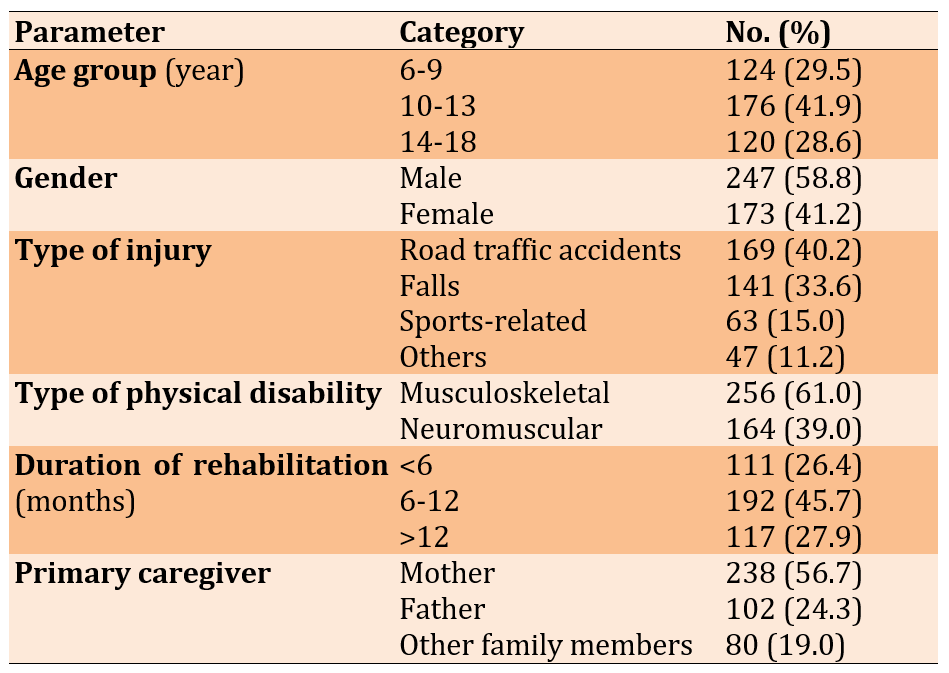
The average age was 10.9±3.4 years; almost half were between 10 and 13 years old (41.9%). Over half of the children were male (58.8%). Road traffic accidents accounted for the most injuries by cause (40.2%). The vast majority of the children had disabilities due to musculoskeletal disorders (61.0%) and had been undergoing rehabilitation for 6 to 12 months (45.7%). In over half of the cases (56.7%), mothers were the primary caregivers for their children (Table 1).
Table 1. Socio-demographic and clinical characteristics of participants (n=420)
Injury severity scores were at a moderate level, with a mean of 18.74±4.91 (range: 8-30; scale range: 5-30). Rehabilitation nursing care was rated at a moderate-to-high level from the nursing perspective, with a mean of 41.26±6.18 (range: 22-60; scale range: 12-60). Functional independence was also considerably good, with a mean of 87.42±13.05 (range: 35-126, scale range: 18-126). The skewness and kurtosis values for injury severity (0.38 and 0.67), rehabilitation nursing care (-0.41 and 0.74), and functional independence (-0.79 and 0.98) were all within acceptable ranges, indicating a normal distribution for these parameters. The degree of injury severity was strongly negatively correlated with both rehabilitation nursing care (r=-0.68, p<0.001) and functional independence (r=-0.72, p≤0.001). Rehabilitative nursing showed a strong positive correlation, indicating that stronger nursing care is associated with greater functional independence (r=0.79, p≤0.001).
The degree of injury was an important predictor of the need for rehabilitation nursing care. Rehabilitation nursing care was a key predictor of functional independence. Although the severity of injury still had a statistically significant direct effect on functional independence, this effect was halved relative to its initial magnitude and became non-significant due to the mediating effect (Table 2).
Table 2. Mediation analysis results using PROCESS Macro (Model 4)

Rehabilitation nursing care showed a significant mediating effect on the relationship between injury severity and functional independence. The indirect pathway from injury severity through rehabilitation nursing care to functional independence had an effect estimate of -1.01, with a bootstrapped standard error of 0.09. The 95% bootstrapped confidence interval ranged from -1.19 to -0.84, and the effect was statistically significant (p<0.001). The final regression model explained 69% of the variance in functional independence among children with physical disabilities. This model demonstrated strong predictive power, with both injury severity and rehabilitation nursing care emerging as significant predictors. The overall model fit was high, reflected by R=0.83, R²=0.69, adjusted R²=0.69, and an F value of 465.27 with degrees of freedom 2 and 417 (p<0.001).
Discussion
This research explored whether assisted-living rehabilitative nursing served as a mediator among children with physical disabilities in Thi-Qar Province, Iraq. All study parameters were significantly correlated, and injury severity had an inverse effect on functional independence. These results provide strong empirical support for the central role of nursing-led rehabilitation in pediatric disability outcomes, and they are consistent with current rehabilitation practice and nursing research [15, 16].
Most of the participants were school-aged children, and males were more frequently affected than females. This finding is consistent with international and national injury survey reports, which show that boys make up the majority of traumatic injuries due to factors such as greater freedom of movement outdoors, traffic exposure, and risk-taking behaviors [17]. Traffic collisions and falls ranked first by a wide margin in the causative injury category, consistent with similar surveys in the Middle East (including Arab states) and low- and middle-income countries, where there is less space to avoid sudden, unexpected moving vehicles [18].
Moderately high levels of injury severity were observed, with correspondingly but relatively higher functional independence scores. This pattern implies that some residual functional deficits caused by injury can be at least partially mitigated by effective rehabilitation. Similar conclusions can be drawn from research on pediatric rehabilitation, which has shown that even in children with moderate or severe injuries, immediate and ongoing rehabilitative therapy improves mobility, self-sufficiency skills, and participation outcomes [19]. Evidence of this pattern was difficult to find elsewhere in the literature, but correlation analysis revealed a substantial inverse relationship between functional independence and injury severity. Adolescents who suffer more severe injuries typically require longer hospital stays and recovery periods, and they may still be somewhat disadvantaged after they leave the hospital [20]. Nonetheless, the strong positive association between functional independence and rehabilitative nursing care clearly demonstrates the critical role that nursing intervention plays in promoting recovery. Improving pediatric outcomes requires individualized care planning, therapeutic training, prevention of potential secondary complications, and training for other providers [8, 21].
Rehabilitation nursing care significantly mediated the relationship between injury severity and functional independence, as confirmed by the statistically significant indirect effect and bootstrapped confidence intervals. It implies that although injury severity directly affects long-term functional outcomes, appropriate care can generally attenuate this relationship. Other studies have reported similar mediation effects in childhood injuries, where clinical severity influences recovery outcomes, and in trauma centers for children, where nursing care has also been implicated as a potential mediator [22, 23].
The persistence of a substantial direct effect of injury severity on functional independence explains the partial rather than full mediation. This is consistent with the multifaceted nature of childhood disability, in which biological factors influence functional outcomes through interactions with care parameters and the environment [24]. Nevertheless, the decrease in the direct effect size highlights how rehabilitation nursing can improve living conditions by altering the recovery trajectories of injury patients to a much greater extent than before.
At least some of the remaining 31% could not be explained. The robustness of the study’s structure and the crucial role of nursing in functional recovery are supported by the fact that this degree of explained variance in functional independence is either higher than or roughly comparable to that observed in other pediatric rehabilitation studies [25]. Additionally, it supports the International Classification of Functioning, Disability and Health paradigm, which posits that functional outcomes are determined by the interaction of contextual factors, such as health services and health conditions [26].
Our results have important ramifications for Iraq and other resource-limited environments. Healthcare workers, particularly nurses, bear greater responsibility for providing consistent, family-centered care when access to cutting-edge therapeutic technology is limited. Restoring functional autonomy for all can be largely achieved by significantly enhancing long-term outcomes and rehabilitative nursing competence in injured youth. This study offers empirical support for the idea that functional independence is influenced by rehabilitative nursing care, a relationship not mediated by injury severity. These findings further underscore the importance of nursing-led rehabilitation therapies in treating children with disabilities, highlighting the need for policies and strategies that uphold the role of rehabilitation nurses within multidisciplinary pediatric rehabilitation teams [27].
This study has limitations. First, the cross-sectional design precludes determining causal relationships among injury severity, nursing rehabilitation care, and the degree of functional independence. Furthermore, data were collected by caregivers, which may introduce recall or social desirability bias. In addition, the study was restricted to a single Iraqi governorate, making it difficult to generalize findings to other contexts or settings. Finally, certain potential confounding factors, such as socioeconomic status or psychological condition, were not investigated and could have impacted the rehabilitation results.
Rehabilitation nursing care played a significant role in mediating the impact of injury severity on functional independence among children with disabilities. Therefore, it helps to reduce potential damage from severe injuries and also enhances daily activities. Thus, it is suggested that healthcare providers focus on training nurses in functional care and integrate this training with family education and psychosocial support. Family involvement should also be integrated into rehabilitation plans. Policymakers need to establish universal protocols to ensure accurate, high-quality care. Finally, longitudinal or interventional research is recommended to both verify causal relationships and assess the long-term effects of nursing-led rehabilitation on functional outcomes.
Conclusion
Rehabilitation nursing care mediates the relationship between injury severity and functional independence among children with physical disabilities.
Acknowledgments: The authors would like to thank all the participants who permitted them to interview them for their close cooperation and participation.
Ethical Permissions: Ethical approval was obtained from the Research Ethics Committee of the University of Thi-Qar (Code: 412/3).
Conflicts of Interest: The authors declared no conflicts of interest.
Authors' Contribution: Aneed SH (First Author), Introduction Writer/Main Researcher (25%); Abadi NN (Second Author), Assistant Researcher/Discussion Writer (25%); Mansi QH (Third Author), Methodologist/Statistical Analyst (25%); Sharhan MA (Fourth Author), Statistical Analyst (25%)
Funding/Support: This study received no financial support.
Childhood physical disabilities resulting from injuries are a major public health concern. Generally, they are associated with long-term functional limitations that can affect independence in daily activities and quality of life. Injury severity is one of the most significant determinants of physical rehabilitation outcomes. Mobility, self-care needs, and cognitive abilities are more likely to be adversely affected by more severe injuries [1, 2]. Children who sustain severe injuries frequently require a long recovery period and substantial effort to regain function [3].
Functional independence is an important goal in pediatric rehabilitation for children with physical disabilities, as it reflects the ability to live normal, independent lives. In practice, this means they can eat, dress, and groom themselves, and move about without assistance [4]. Previous research has found that children with lower injury severity tend to achieve greater functional independence. Severe injuries cause continued dependence and delayed developmental milestones [5, 6]. Nevertheless, injury severity alone does not fully explain variations in functional outcomes, indicating the presence of modifiable care-related factors [7].
Rehabilitation nursing care plays a key role in connecting injury-induced impairments with functional recovery. Rehabilitation nurses are well-suited to provide continuous, comprehensive care services that include physical rehabilitation, psychosocial support, family education, and the coordination of integrated services [8]. Evidence suggests that standard rehabilitation nursing improves treatment compliance, promotes self-care techniques, prevents side effects, and helps children with physical disabilities tolerate [9, 10]. In child populations, nursing care is particularly influential because children are in a developmental stage in which they must be taught and supported by others and also belong to a family unit [10].
Rehabilitation nursing care may act as a mediating parameter in the relationship between injury severity and functional independence. In children who have suffered a serious injury, constant and specialized nursing interventions help slow the deterioration of function and allow gradual independence to develop as individualized rehabilitation and family-unit objectives are established [8]. By contrast, inadequate or fragmented nursing care can increase the functional limitations associated with severe injuries and lead to poorer rehabilitation outcomes [11].
Few empirical studies have specifically examined the mediating role of rehabilitation nursing care in pediatric rehabilitation outcomes, despite its growing recognition. Most current research either addresses functional independence or injury severity separately, without examining how nursing care affects these relationships. Optimizing rehabilitation techniques, enhancing nursing practice, and developing policy guidelines to improve youth rehabilitation services all depend on understanding this mediating pathway.
This study aimed to examine the relationship between injury severity and functional independence among children with physical disabilities, with special attention to the mediating effects of rehabilitation nursing care.
Instrument and Methods
Design and sample
This cross-sectional correlational study was conducted on children with physical disabilities in the Departments of Rehabilitation Centers and New Research Sites across selected government hospitals in Thi-Qar Governorate, Iraq, as well as in pediatric rehabilitation centers and outpatient rehabilitation units, from April to July 2025. These sites were chosen because they offered pediatric rehabilitation services and provided uninterrupted care to children with physical disabilities. The subjects were children with physical disabilities resulting from injury who were currently receiving rehabilitation services at hospitals. Systematic random sampling was used to select subjects from all the records in hospitals and rehabilitation centers. The single population proportion formula was used to calculate the sample size. The estimated sample size was 384 cases, with a 95% confidence interval (CI) of ±5%. The final total of actual cases was 420, accounting for potential attrition. Eligible participants were children aged 6–18 years with physical disabilities resulting from injury who had been enrolled in a rehabilitation program for at least three months and had a primary caregiver present at the data-collection site. Children were included only if they did not have severe mental disabilities that prevented proper evaluation, were not born with injuries unrelated to parental work, and were willing and able to participate and provide data.
Instrument
A well-designed, interviewer-administered questionnaire with four primary sections was used to collect the data. Section I concerned medical and demographic information (age, sex, type of injury, etiology, duration of the injury, and rehabilitation period). Injury severity was assessed using the Pediatric Injury Severity Assessment Scale, a pediatric version of the standard Injury Severity Scale (a prognostic indicator). It involves classifying injury severity using anatomical and functional criteria. Higher scores indicate more serious injuries [12]. The Rehabilitation Complexity Scale (version 2) was used to measure the nursing care provided during rehabilitation. This set of 12 items addresses intervention activities, including mobility training, self-care training, disability treatment, and psychological support. Each item is rated according to a five-point Likert scale ranging from “never provided” to “always provided” [13]. Functional independence was assessed using WeeFIM (Functional Independence Measure for Children), a validated instrument for evaluating children’s functional status in terms of self-care, mobility, and communication abilities. Higher scores indicate greater functional independence [14].
Content validity was optimized through a review by a panel of five experts in pediatric, rehabilitation, and community health nursing. For reasons of clarity and cultural relevance, minor changes were made. A pilot study on feasibility and clarity was conducted with 42 children who met the study criteria. Internal consistency was also assessed. However, the pilot data were excluded from the final analysis to maintain data integrity. The reliability test showed satisfactory internal consistency. The Cronbach’s alpha coefficients were 0.86 for the injury severity scale, 0.89 for the rehabilitation nursing care scale, and 0.91 for the WeeFIM, respectively.
Data collection
Data were collected by pediatric and rehabilitation nurses trained for this purpose through face-to-face interviews with guardians and direct assessment of the children, based on their age or level of disability. The assessments took place in private consultation rooms at the rehabilitation centers or outpatient clinics. Each interview required approximately 30-45 minutes. Patients received a written explanation of the research, were informed that their answers would be kept confidential, and were given the option to opt out at any time without consequences. All patients' families had one parent sign formal consent forms, while the other parent provided verbal assent if the child was older than 6 years. Approval for the study was obtained from the University Nursing College Research Ethics Board in Thi-Qar and from the individual institutions.
Statistical analysis
Data were analyzed using SPSS 28. Pearson correlation analysis was conducted to explore associations among injury severity, rehabilitation nursing care, and children’s functional independence. The mediating role of rehabilitation care was then investigated using the PROCESS macro for SPSS (Model 4), with 5,000 bootstrap samples to estimate indirect effects and 95% confidence intervals.
Findings
The average age was 10.9±3.4 years; almost half were between 10 and 13 years old (41.9%). Over half of the children were male (58.8%). Road traffic accidents accounted for the most injuries by cause (40.2%). The vast majority of the children had disabilities due to musculoskeletal disorders (61.0%) and had been undergoing rehabilitation for 6 to 12 months (45.7%). In over half of the cases (56.7%), mothers were the primary caregivers for their children (Table 1).
Table 1. Socio-demographic and clinical characteristics of participants (n=420)
Injury severity scores were at a moderate level, with a mean of 18.74±4.91 (range: 8-30; scale range: 5-30). Rehabilitation nursing care was rated at a moderate-to-high level from the nursing perspective, with a mean of 41.26±6.18 (range: 22-60; scale range: 12-60). Functional independence was also considerably good, with a mean of 87.42±13.05 (range: 35-126, scale range: 18-126). The skewness and kurtosis values for injury severity (0.38 and 0.67), rehabilitation nursing care (-0.41 and 0.74), and functional independence (-0.79 and 0.98) were all within acceptable ranges, indicating a normal distribution for these parameters. The degree of injury severity was strongly negatively correlated with both rehabilitation nursing care (r=-0.68, p<0.001) and functional independence (r=-0.72, p≤0.001). Rehabilitative nursing showed a strong positive correlation, indicating that stronger nursing care is associated with greater functional independence (r=0.79, p≤0.001).
The degree of injury was an important predictor of the need for rehabilitation nursing care. Rehabilitation nursing care was a key predictor of functional independence. Although the severity of injury still had a statistically significant direct effect on functional independence, this effect was halved relative to its initial magnitude and became non-significant due to the mediating effect (Table 2).
Table 2. Mediation analysis results using PROCESS Macro (Model 4)
Rehabilitation nursing care showed a significant mediating effect on the relationship between injury severity and functional independence. The indirect pathway from injury severity through rehabilitation nursing care to functional independence had an effect estimate of -1.01, with a bootstrapped standard error of 0.09. The 95% bootstrapped confidence interval ranged from -1.19 to -0.84, and the effect was statistically significant (p<0.001). The final regression model explained 69% of the variance in functional independence among children with physical disabilities. This model demonstrated strong predictive power, with both injury severity and rehabilitation nursing care emerging as significant predictors. The overall model fit was high, reflected by R=0.83, R²=0.69, adjusted R²=0.69, and an F value of 465.27 with degrees of freedom 2 and 417 (p<0.001).
Discussion
This research explored whether assisted-living rehabilitative nursing served as a mediator among children with physical disabilities in Thi-Qar Province, Iraq. All study parameters were significantly correlated, and injury severity had an inverse effect on functional independence. These results provide strong empirical support for the central role of nursing-led rehabilitation in pediatric disability outcomes, and they are consistent with current rehabilitation practice and nursing research [15, 16].
Most of the participants were school-aged children, and males were more frequently affected than females. This finding is consistent with international and national injury survey reports, which show that boys make up the majority of traumatic injuries due to factors such as greater freedom of movement outdoors, traffic exposure, and risk-taking behaviors [17]. Traffic collisions and falls ranked first by a wide margin in the causative injury category, consistent with similar surveys in the Middle East (including Arab states) and low- and middle-income countries, where there is less space to avoid sudden, unexpected moving vehicles [18].
Moderately high levels of injury severity were observed, with correspondingly but relatively higher functional independence scores. This pattern implies that some residual functional deficits caused by injury can be at least partially mitigated by effective rehabilitation. Similar conclusions can be drawn from research on pediatric rehabilitation, which has shown that even in children with moderate or severe injuries, immediate and ongoing rehabilitative therapy improves mobility, self-sufficiency skills, and participation outcomes [19]. Evidence of this pattern was difficult to find elsewhere in the literature, but correlation analysis revealed a substantial inverse relationship between functional independence and injury severity. Adolescents who suffer more severe injuries typically require longer hospital stays and recovery periods, and they may still be somewhat disadvantaged after they leave the hospital [20]. Nonetheless, the strong positive association between functional independence and rehabilitative nursing care clearly demonstrates the critical role that nursing intervention plays in promoting recovery. Improving pediatric outcomes requires individualized care planning, therapeutic training, prevention of potential secondary complications, and training for other providers [8, 21].
Rehabilitation nursing care significantly mediated the relationship between injury severity and functional independence, as confirmed by the statistically significant indirect effect and bootstrapped confidence intervals. It implies that although injury severity directly affects long-term functional outcomes, appropriate care can generally attenuate this relationship. Other studies have reported similar mediation effects in childhood injuries, where clinical severity influences recovery outcomes, and in trauma centers for children, where nursing care has also been implicated as a potential mediator [22, 23].
The persistence of a substantial direct effect of injury severity on functional independence explains the partial rather than full mediation. This is consistent with the multifaceted nature of childhood disability, in which biological factors influence functional outcomes through interactions with care parameters and the environment [24]. Nevertheless, the decrease in the direct effect size highlights how rehabilitation nursing can improve living conditions by altering the recovery trajectories of injury patients to a much greater extent than before.
At least some of the remaining 31% could not be explained. The robustness of the study’s structure and the crucial role of nursing in functional recovery are supported by the fact that this degree of explained variance in functional independence is either higher than or roughly comparable to that observed in other pediatric rehabilitation studies [25]. Additionally, it supports the International Classification of Functioning, Disability and Health paradigm, which posits that functional outcomes are determined by the interaction of contextual factors, such as health services and health conditions [26].
Our results have important ramifications for Iraq and other resource-limited environments. Healthcare workers, particularly nurses, bear greater responsibility for providing consistent, family-centered care when access to cutting-edge therapeutic technology is limited. Restoring functional autonomy for all can be largely achieved by significantly enhancing long-term outcomes and rehabilitative nursing competence in injured youth. This study offers empirical support for the idea that functional independence is influenced by rehabilitative nursing care, a relationship not mediated by injury severity. These findings further underscore the importance of nursing-led rehabilitation therapies in treating children with disabilities, highlighting the need for policies and strategies that uphold the role of rehabilitation nurses within multidisciplinary pediatric rehabilitation teams [27].
This study has limitations. First, the cross-sectional design precludes determining causal relationships among injury severity, nursing rehabilitation care, and the degree of functional independence. Furthermore, data were collected by caregivers, which may introduce recall or social desirability bias. In addition, the study was restricted to a single Iraqi governorate, making it difficult to generalize findings to other contexts or settings. Finally, certain potential confounding factors, such as socioeconomic status or psychological condition, were not investigated and could have impacted the rehabilitation results.
Rehabilitation nursing care played a significant role in mediating the impact of injury severity on functional independence among children with disabilities. Therefore, it helps to reduce potential damage from severe injuries and also enhances daily activities. Thus, it is suggested that healthcare providers focus on training nurses in functional care and integrate this training with family education and psychosocial support. Family involvement should also be integrated into rehabilitation plans. Policymakers need to establish universal protocols to ensure accurate, high-quality care. Finally, longitudinal or interventional research is recommended to both verify causal relationships and assess the long-term effects of nursing-led rehabilitation on functional outcomes.
Conclusion
Rehabilitation nursing care mediates the relationship between injury severity and functional independence among children with physical disabilities.
Acknowledgments: The authors would like to thank all the participants who permitted them to interview them for their close cooperation and participation.
Ethical Permissions: Ethical approval was obtained from the Research Ethics Committee of the University of Thi-Qar (Code: 412/3).
Conflicts of Interest: The authors declared no conflicts of interest.
Authors' Contribution: Aneed SH (First Author), Introduction Writer/Main Researcher (25%); Abadi NN (Second Author), Assistant Researcher/Discussion Writer (25%); Mansi QH (Third Author), Methodologist/Statistical Analyst (25%); Sharhan MA (Fourth Author), Statistical Analyst (25%)
Funding/Support: This study received no financial support.
Keywords:
References
1. Ryder C, Mackean T, Hunter K, Williams H, Clapham K, Holland AJ, et al. Equity in functional and health related quality of life outcomes following injury in children-a systematic review. Crit Public Health. 2020;30(3):352-66. [Link] [DOI:10.1080/09581596.2019.1581918]
2. Abed Laftah S, Kadhim Abdul-Hameed A, Zair Balat K, Malih Radhi M. Barriers and facilitators in rehabilitative nursing care for disabilities and mediating roles of nurse-related factors. Iran Rehabil J. 2025;23(2):165-74. [Link] [DOI:10.32598/irj.23.2.1989.4]
3. Al-Eqabi QA, Niazy SM, Radhi MM. Amputation-related factors influencing activities of daily living among amputees. Iran J War Public Health. 2024;16(2):123-9. [Link]
4. Himaid MA, Saleh SA, Ghanem NM. The impact of rehabilitation programs on the functional independence level of cerebral palsy children: A descriptive study. Proceedings of the 2020 International Conference on Assistive and Rehabilitation Technologies (iCareTech). New York: IEEE; 2020. p. 71-5. [Link] [DOI:10.1109/iCareTech49914.2020.00021]
5. Radhi MM, Al-Eqabi QA, Hindi NK. Rehabilitation problems of people with motor disabilities at Babylon center for rehabilitation of the disabled. Med J Babylon. 2023;20(4):838-43. [Link] [DOI:10.4103/MJBL.MJBL_674_23]
6. Elywy GJ, Radhi MM, Khyoosh Al-Eqabi QA. Social support and its association with the quality of life (QoL) of amputees. Iran Rehabil J. 2022;20(2):253-60. [Link] [DOI:10.32598/irj.20.2.1784.1]
7. James MT, Bhatt M, Pannu N, Tonelli M. Long-term outcomes of acute kidney injury and strategies for improved care. Nat Rev Nephrol. 2020;16(4):193-205. [Link] [DOI:10.1038/s41581-019-0247-z]
8. Aldosary BA, Aldosari SM, Hamad AM, Aldossari MM, Alotaibi TA, Al Aradi HS. The role of nurses in rehabilitation services: A holistic approach to enhancing recovery and promoting independence. J Int Crisis Risk Commun Res. 2024;7(S7):1114. [Link]
9. WHO. Implementation of self-care interventions for health and well-being: Guidance for health systems. Geneva: World Health Organization; 2024. [Link]
10. Pridham K, Limbo R, Schroeder M, editors. Guided participation in pediatric nursing practice: Relationship-based teaching and learning with parents, children, and adolescents. Cham: Springer Publishing Company; 2018. [Link] [DOI:10.1891/9780826140449]
11. Lenze EJ, Lenard E, Bland M, Barco P, Miller JP, Yingling M, et al. Effect of enhanced medical rehabilitation on functional recovery in older adults receiving skilled nursing care after acute rehabilitation: A randomized clinical trial. JAMA. 2019;2(7):e198199. [Link] [DOI:10.1001/jamanetworkopen.2019.8199]
12. Tepas III JJ, Mollitt DL, Talbert JL, Bryant M. The pediatric trauma score as a predictor of injury severity in the injured child. J Pediatr Surg. 1987;22(1):14-8. [Link] [DOI:10.1016/S0022-3468(87)80006-4]
13. Turner-Stokes L, Williams H, Siegert RJ. The rehabilitation complexity scale version 2: A clinimetric evaluation in patients with severe complex neurodisability. J Neurol Neurosurg Psychiatry. 2010;81(2):146-53. [Link] [DOI:10.1136/jnnp.2009.173716]
14. Msall ME, DiGaudio K, Rogers BT, LaForest S, Catanzaro NL, Campbell J, et al. The functional independence measure for children (WeeFIM) conceptual basis and pilot use in children with developmental disabilities. Clin Pediatr. 1994;33(7):421-30. [Link] [DOI:10.1177/000992289403300708]
15. Yasir AA, Qassim WJ, Radhi MM. Assessment the feeling of psychological loneliness among wives of martyrs in the light of some social variables in Babylon Governorate/Iraq. J Pharm Sci Res. 2018;10(1):40-4. [Link]
16. Elywy GJ, Radhi MM, Tuama AM. Determination the causes of neonatal mortality during the last 3 years ago in Al-Kut City. Prof.(Dr) RK Sharma. 2020;20(3):195. [Link]
17. Han L, You D, Gao X, Duan S, Hu G, Wang H, et al. Unintentional injuries and violence among adolescents aged 12-15 years in 68 low-income and middle-income countries: A secondary analysis of data from the Global School-Based Student Health Survey. Lancet Child Adolesc Health. 2019;3(9):616-26. [Link] [DOI:10.1016/S2352-4642(19)30195-6]
18. Hossain S, Maggi E, Vezzulli A. Factors influencing the road accidents in low and middle-income countries: A systematic literature review. Int J Inj Control Saf Promot. 2024;31(2):294-322. [Link] [DOI:10.1080/17457300.2024.2319618]
19. Janssen-Potten YJ, Roks L, Roijen R, Vermeulen RJ, Adelante Study Group, Rameckers EE. Effectiveness of functional intensive therapy on mobility and self-care activities in children and adolescents with cerebral palsy-a prospective clinical study. Disabil Rehabil. 2023;45(21):3529-38. [Link] [DOI:10.1080/09638288.2022.2130445]
20. Burd RS, Jensen AR, VanBuren JM, Richards R, Holubkov R, Pollack MM, et al. Factors associated with functional impairment after pediatric injury. JAMA Surg. 2021;156(8):e212058. [Link] [DOI:10.1001/jamasurg.2021.2058]
21. Radhi MM, Faris HI. Roles of nursing skills in improving quality of rehabilitative health services for patients with chronic conditions. Hist Med. 2023;9(1):831-7. [Link]
22. Liang H, Yuan P, Xu T, Jin C, Ji C. The impact of functional training based on clinical nursing pathways informed by evidence-based theory on functional recovery in patients with cerebral hemorrhage. Front Neurol. 2025;16:1558908. [Link] [DOI:10.3389/fneur.2025.1558908]
23. Niazy SM, Abadi NN, Radhi MM, Al-Eqabi QA, AL-Thabhawee GD. Impact of digital health literacy on quality of life among people with physical disabilities. Iran J War Public Health. 2025;17(2):197-203. [Link] [DOI:10.58209/ijwph.17.1.83]
24. Gugała B. Caregiver burden versus intensity of anxiety and depression symptoms in parents of children with cerebral palsy as well as factors potentially differentiating the level of burden: A cross-sectional study (Poland). BMJ Open. 2021;11(6):e036494. [Link] [DOI:10.1136/bmjopen-2019-036494]
25. Anaby D, Khetani M, Piskur B, Van Der Holst M, Bedell G, Schakel F, et al. Towards a paradigm shift in pediatric rehabilitation: Accelerating the uptake of evidence on participation into routine clinical practice. Disabil Rehabil. 2022;44(9):1746-57. [Link] [DOI:10.1080/09638288.2021.1903102]
26. Cozzi S, Martinuzzi A, Della Mea V. Ontological modeling of the International Classification of Functioning, Disabilities and Health (ICF): Activities & participation and environmental factors components. BMC Med Inform Decis Mak. 2021;21(1):367. [Link] [DOI:10.1186/s12911-021-01729-x]
27. Verga GI, Baltă AA, Ciortea DA, Petrea CL, Șerban M, Matei MN, et al. Healthcare interventions in the management of rheumatic diseases: A narrative analysis of effectiveness and emerging strategies. Healthcare. 2025;13(14):1691. [Link] [DOI:10.3390/healthcare13141691]