

1.0
Cite Score 2025
SJR: 0.129 / SNIP: 0.140

JMERC
Owner
Janbazan Medical and Engineering Research Center (JMERC) is the owner of IJWPH.
Volume 18, Issue 1 (2026)
3 2026, 18(1): 77-89 |
Back to browse issues page
Request Type:




History
Received: 2025/11/20 | Accepted: 2026/01/5 | Published: 2026/02/3
Received: 2025/11/20 | Accepted: 2026/01/5 | Published: 2026/02/3
How to cite this article
Mohammadebrahimi H, Zareiyan A, Sharififar S, Teymouri F, Zargar Balaye Jame S. Dimensions and Components of Pharmaceutical and Medical Equipment Supply Chain Preparedness in Disasters. 3 2026; 18 (1) :77-89
URL: http://ijwph.daneshafarand.org/article-3-85675-en.html
URL: http://ijwph.daneshafarand.org/article-3-85675-en.html
Download citation:
BibTeX | RIS | EndNote | Medlars | ProCite | Reference Manager | RefWorks
Send citation to:


Rights and permissions
BibTeX | RIS | EndNote | Medlars | ProCite | Reference Manager | RefWorks
Send citation to:

Authors
H. Mohammadebrahimi1 
 , A. Zareiyan2 , S. Sharififar1 , F. Teymouri1 , S. Zargar Balaye Jame *3
, A. Zareiyan2 , S. Sharififar1 , F. Teymouri1 , S. Zargar Balaye Jame *3
1- Department of Health in Disasters and Emergencies, Faculty of Nursing, AJA University of Medical Sciences, Tehran, Iran
2- “Department of Health in Disasters and Emergencies, Faculty of Nursing” and “Research Center for Cancer Screening Epidemiology”, Aja University of Medical Sciences, Tehran, Iran
3- Department of Health Management and Economics, Faculty of Medicine, AJA University of Medical Sciences, Tehran, Iran
2- “Department of Health in Disasters and Emergencies, Faculty of Nursing” and “Research Center for Cancer Screening Epidemiology”, Aja University of Medical Sciences, Tehran, Iran
3- Department of Health Management and Economics, Faculty of Medicine, AJA University of Medical Sciences, Tehran, Iran
Full-Text (HTML) (83 Views)
Introduction
In today’s world, the pharmaceutical and medical equipment supply chain is recognized as one of the fundamental pillars of health systems. The efficiency and effectiveness of this supply chain are profoundly affected during crises, including natural disasters, pandemics, and humanitarian emergencies. Under such circumstances, any deficiency or disruption in the procurement, storage, and distribution processes of medicines and medical equipment can lead to serious and irreversible consequences. Disasters create significant challenges in maintaining adequate pharmaceutical inventories and ensuring the availability of essential medical equipment, thereby reducing the capacity to respond to health and medical needs. This, in turn, may result in increased mortality and a decline in the quality of healthcare services [1].
The sustainable provision of medicines and medical equipment is a core component of health systems during disasters. Previous research has identified weaknesses in coordination and rapid response to shortages, insufficient preparedness, and the lack of appropriate infrastructure for supplying essential items as major challenges faced by health systems in disaster settings [2]. For instance, during the COVID-19 pandemic, many countries faced serious difficulties in procuring and distributing pharmaceuticals and medical supplies. This crisis revealed that, despite prior projections and planning efforts, numerous systems were unable to effectively meet healthcare demands [3].
Given these challenges, assessing and analyzing the preparedness of pharmaceutical and medical equipment supply chains—particularly during disasters—has become a primary concern for health researchers and managers. As disaster conditions directly influence the efficiency and resilience of health systems, preparedness of the pharmaceutical supply chain for disaster management is critical. Previous studies have predominantly focused on macro-level resilience assessments or quantitative analyses of supply systems; however, more detailed qualitative perspectives on the dimensions of supply chain preparedness—especially at the organizational and operational levels within the Islamic Republic of Iran Army—have not yet been comprehensively and systematically examined [2, 4].
Numerous studies have demonstrated that to enhance disaster response, the various components and dimensions of supply chain preparedness must be identified and conceptualized in the context of different types of disasters. These components broadly encompass stakeholder engagement, policymaking, preventive planning, information technology, and interorganizational coordination [5, 6]. Furthermore, evidence indicates that robust information systems, coordinated communication infrastructure, and effective resource management are critical to reducing procurement time and costs during crises. However, in many instances, these systems experience disruptions and performance declines, thereby underscoring the need for more precise and targeted management approaches in this domain [7, 8].
Given the critical importance of disaster management and the need to develop a comprehensive, practical framework for analyzing the preparedness of pharmaceutical and medical equipment supply chains [4], the present study aimed to examine the various dimensions of supply chain preparedness during disasters. Our objective was to identify and elucidate the key components of preparedness within pharmaceutical and medical equipment supply chains using a qualitative approach. In particular, this study sought to analyze the experiences of managers and experts within the health system of the Islamic Republic of Iran Army to identify and categorize the dimensions and factors influencing supply chain performance under crisis conditions. The findings may assist policymakers and planners within the Health Deputy of the Islamic Republic of Iran Army in recognizing existing strengths and weaknesses in supply chain preparedness and in formulating optimal disaster response strategies. As health hazards—particularly pandemics and natural disasters—increase in frequency and severity, a comprehensive understanding of the structure and components of preparedness in the pharmaceutical and medical equipment supply chain is of paramount importance. In light of global challenges posed by health hazards, the capacity of national armed forces to maintain a stable and resilient supply chain can play a vital role in mitigating adverse impacts and safeguarding public health. Accordingly, this study aimed to provide an in-depth and comprehensive analysis of the components and dimensions of supply chain preparedness in the face of disasters and to offer a new perspective in this field.
Participants and Methods
This qualitative study was conducted on 18 experts and employed conventional content analysis with an exploratory-descriptive approach, grounded in the constructivist paradigm. This approach was used because preparedness of the supply chain in disasters is not an objective, static phenomenon; rather, it is a multifaceted, dynamic reality constructed through complex interactions among stakeholders, organizational structures, and environmental conditions. The researchers’ approach was centered on qualitative conceptualization and causal explanation. Therefore, to enable an in-depth qualitative analysis of the interviews obtained and to examine, describe, explain, and interpret underlying causes, the framework synthesis method was applied to transform the content analysis findings into an operational model.
The sample consisted of senior managers and crisis management authorities involved at all levels of the procurement, storage, and distribution processes of pharmaceuticals and medical equipment within the health system of the Islamic Republic of Iran Army. This scope encompassed the headquarters and policy-making level, the operational and logistics level, and the service delivery level.
Purposive sampling with a maximum variation strategy was employed. The inclusion criteria comprised professional experience—a minimum of five years of managerial or executive experience related to the pharmaceutical supply chain, medical equipment supply, or crisis management, lived crisis experience—direct participation in or management of at least one major crisis (e.g., earthquakes, the COVID-19 pandemic, or war), organizational position—holding a command-level position within the health system of the Islamic Republic of Iran Army, and willingness to participate—providing informed consent and demonstrating the ability to articulate experiences and convey complex concepts. The exclusion criteria included withdrawal from participation—unwillingness to continue cooperation at any stage of the study (during or after the interview), incomplete data—inability to complete the interview due to reasons, such as time constraints, illness, or communication disruption, resulting in non-analyzable data, insufficient informational richness—the researcher’s determination that, despite relevant work history, the participant lacked adequate experience or knowledge regarding crisis and disaster conditions (i.e., data redundancy or “information saturation” at the individual level), and refusal of audio recording—lack of consent to audio-record the interview.
Interviews were conducted until data saturation was achieved. Although repetition in the data was observed by the fifteenth interview, the researchers conducted three additional interviews to ensure comprehensive coverage of all sub-dimensions. The data collection process was concluded after the eighteenth participant. A total of 18 face-to-face semi-structured interviews were conducted between February 2025 and September 2025. Each interview lasted approximately 45 to 60 minutes and was conducted in a quiet, private setting at the participants’ workplaces to ensure comfort and a sense of security when sharing their experiences.
In addition to audio recording, field notes were taken concurrently to document nonverbal cues, emotional reactions, and key points that required further probing in subsequent questions. The interview guide questions were developed based on a review of the literature and study objectives. Interviews began with broad, open-ended questions and were progressively directed toward more exploratory and focused inquiries.
Examples of interview questions included “Please describe your experience with the process of pharmaceutical procurement and distribution during the crises you have managed.” “You mentioned challenges in needs assessment; specifically, what structural or informational barriers led to discrepancies between your estimates and the actual needs?” “How is coordination between your organization and parallel institutions (e.g., the Red Crescent) established during the initial moments of a crisis?”
Data analysis was conducted concurrently with data collection. This iterative approach enabled the researchers to refine and deepen subsequent interview questions based on emerging concepts. Conventional content analysis was performed following the five-step method proposed by Hsieh and Shannon, incorporating the unit-of-analysis concepts described by Graneheim and Lundman. Categories and codes were derived directly from the raw data, and the researchers deliberately avoided imposing pre-existing theoretical frameworks onto the findings.
The analysis process began with immersion in the data. After each interview, the audio file was transcribed verbatim, and the resulting transcript was read twice by the researchers to achieve a comprehensive understanding. Initial coding was then performed by identifying meaning units (words, sentences, or paragraphs containing related messages). These units were condensed and subsequently labeled with open codes.
For example, the statement “We did not know how much IV fluid remained in our field hospital inventory because the system was down” was condensed into the meaning unit “Lack of real-time inventory awareness due to system failure” and assigned the initial code “Deficiency in inventory tracking systems”.
Data management and analysis were conducted using MAXQDA 2020 software.
Findings
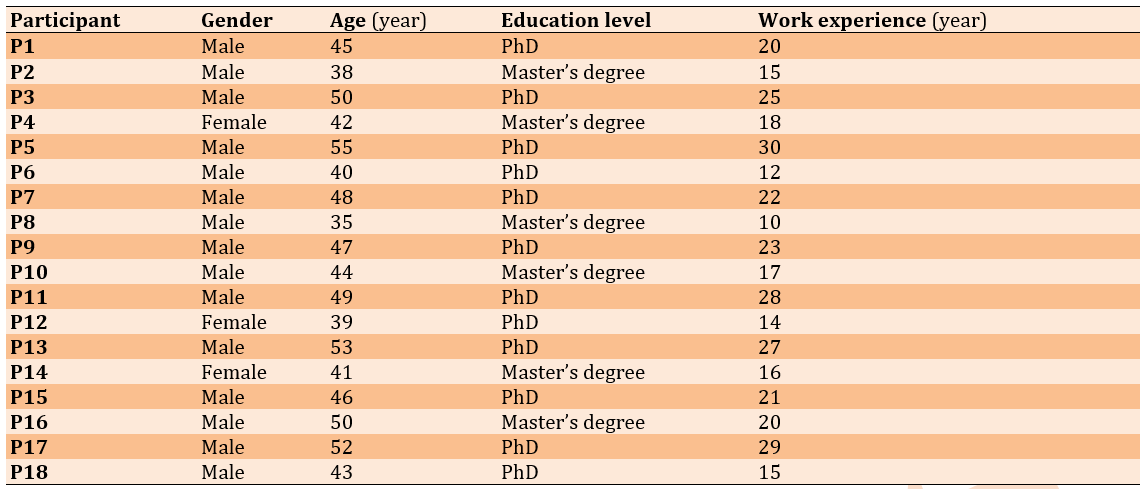
A total of 18 senior managers and crisis management authorities from the health system of the Islamic Republic of Iran Army participated (Table 1).
Table 1. Demographic characteristics of participants (n=18)
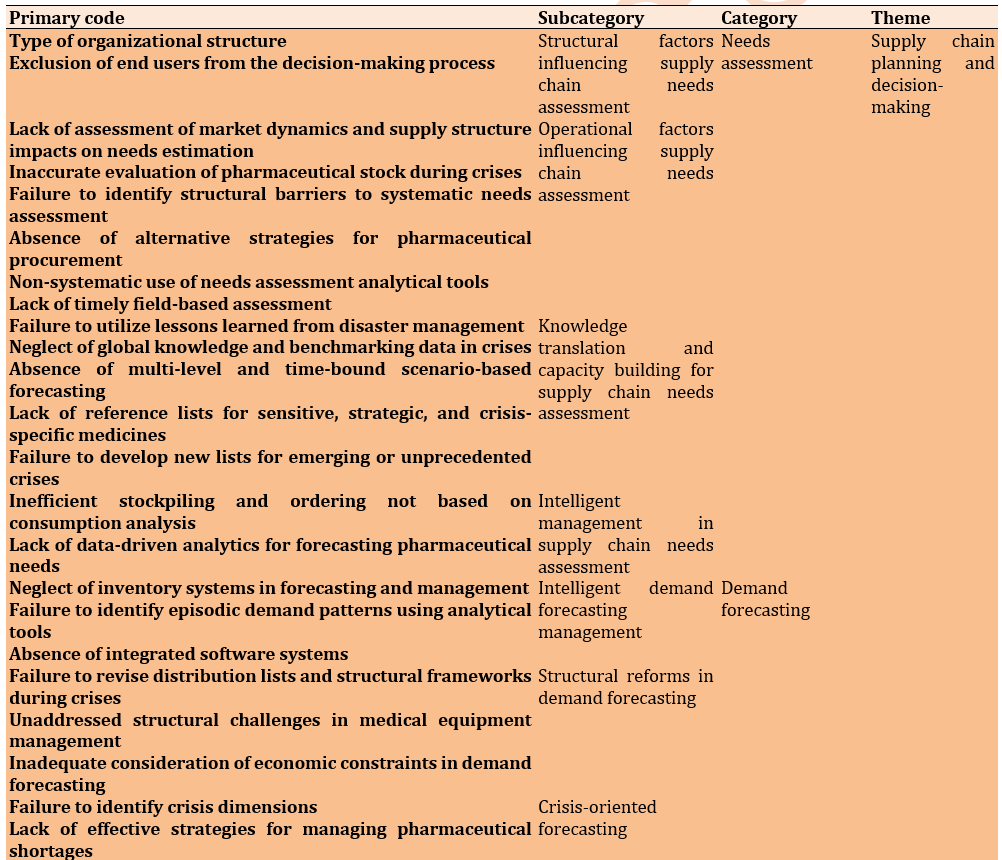
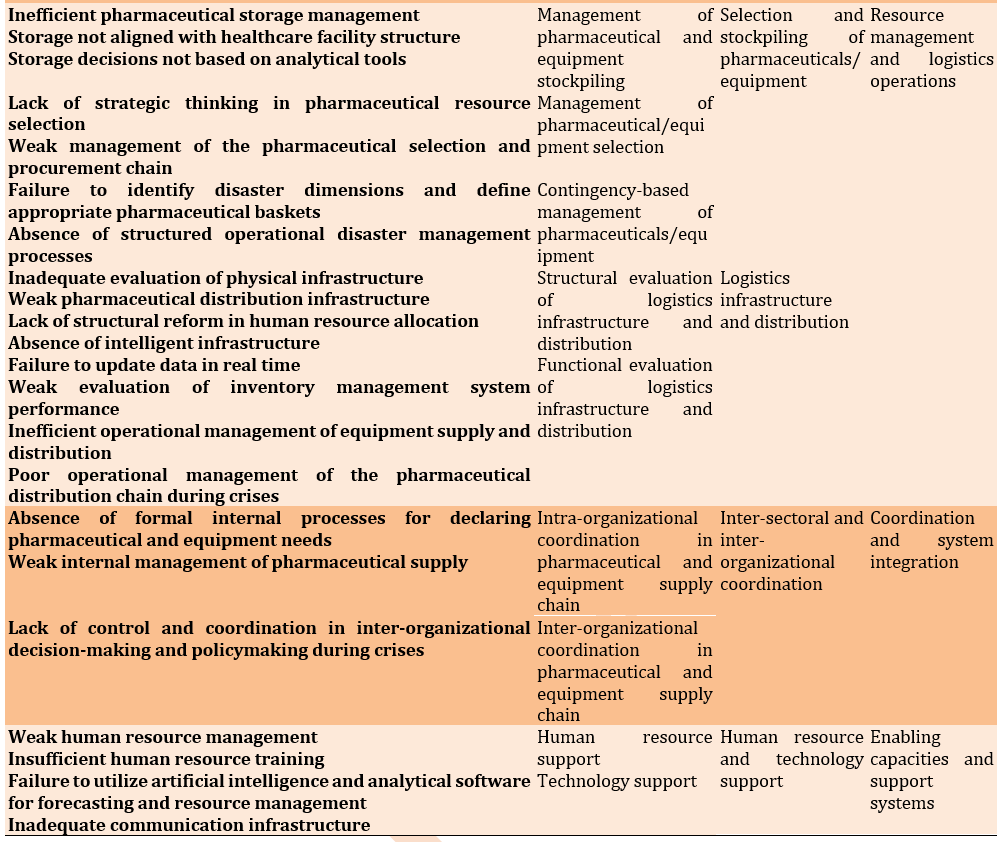
A total of 739 initial codes were extracted. Following iterative processes of reduction and abstraction, these codes were organized into 6 main themes, 16 categories, and 45 subcategories. These themes represented the key and critical dimensions of pharmaceutical and medical equipment supply chain preparedness in disaster settings (Table 2).
Table 2. Final analytical framework of supply chain preparedness dimensions in disasters
Category 1. Needs assessment
The cornerstone of any successful logistics operation is an accurate understanding of needs. In crisis situations, needs assessment was not a linear process; rather, it was shaped by a complex interplay among organizational structures, operational parameters, and managers' tacit knowledge. This construct comprised three primary subcategories.
1-1. Structural factors influencing needs assessment
Participants emphasized that the physical and organizational capacity of a healthcare facility significantly shapes its demand pattern. In particular, one participant (P4) stated: “We cannot apply the same ordering pattern used for a university hospital to a 50-bed field hospital; however, guidelines are sometimes communicated uniformly, which leads to either overstocking or shortages”.
In this regard, factors such as bed capacity, specialized service structure (e.g., burn or orthopedic units), and service utilization rate (Bed Occupancy Rate) were identified as key parameters in determining pharmaceutical needs.
Moreover, contrary to the common assumption that pharmacists are the sole decision-makers in medication supply, physicians’ decisions and those of the clinical staff—as the end users—were the primary drivers of demand. One interviewee (P8) noted: “If, during a crisis, physicians do not adhere to standard treatment protocols or, under psychological pressure, submit unnecessary requests, the supply chain becomes disrupted”.
Needs assessment was not merely a technical calculation based on inventory data, but rather a structurally embedded and behaviorally influenced process shaped by clinical practice patterns and organizational characteristics.
1-2. Operational factors influencing needs assessment
This subcategory refers to the operational dynamics that emerge during crises. One of the key findings was the impact of turbulence in the pharmaceutical market on needs assessment. Rumors of drug shortages during emergencies often prompted healthcare facilities to order quantities exceeding actual demand—a phenomenon commonly referred to as the bullwhip effect. As one participant (P14) stated: “Analyzing market conditions and assessing transparency in pharmaceutical stock levels are among the most critical needs”.
In addition, the absence of a strategic resource plan and weaknesses in financial resource allocation mechanisms may result in needs assessment being driven more by available budget than by patients’ actual clinical requirements.
During the initial moments of a crisis—the so-called Golden Time—software systems were found to be frequently inefficient or disrupted. Consequently, the capacity for field-based assessment and the physical presence of experts in affected areas to rapidly estimate needs (Rapid Assessment) were identified as vital factors. One participant (P6) remarked: “In the early hours of a crisis, systems are usually ineffective, and field assessment—especially in the initial stages—is essential”.
Thus, operational volatility, financial governance, and real-time situational awareness critically shaped the accuracy of needs estimation in disaster settings.
1-3. Knowledge translation and capacity building
The application of knowledge to enhance the precision of needs assessment emerged as a central theme. Many managers indicated that crises often represent a repetition of previous mistakes. In this context, managerial experience transfer and inter-organizational learning were identified as mechanisms to reduce estimation errors. As one interviewee (P9) noted: “Transferring the experience of managing the Golestan floods to Khuzestan could reduce estimation errors by up to 50%”.
Furthermore, the use of global data and World Health Organization (WHO) protocols to forecast required items for specific crises, including bioterrorism scenarios, was considered essential. One participant (P3) emphasized: “Using WHO protocols to forecast pharmaceutical needs in crises helps us take more timely and accurate actions”.
Moreover, needs forecasting should be scenario-based. In other words, for crises, such as earthquakes, war, or pandemics, predefined pharmaceutical packages should be developed to separately address the needs of chronic patients and those acutely affected by the disaster.
Collectively, effective needs assessment in disasters requires not only structural and operational readiness but also systematic knowledge translation, scenario planning, and the integration of institutional memory.
Category 2. Selection and stockpiling of pharmaceuticals and medical equipment
This construct addresses inventory strategies and stockpiling management. There was a major paradox in this domain: The legal obligation to maintain reserves versus operational constraints limiting implementation.
2-1. Management of pharmaceutical and equipment stockpiling
In managing pharmaceutical and medical equipment stockpiling, participants emphasized that infrastructural limitations—such as the lack of standard warehouses and insufficient cold storage capacity—pose significant barriers to achieving strategic reserves. One interviewee (P15) stated: “We are obligated to maintain reserves, yet we do not even have sufficient space for routine hospital medications—let alone emergency stockpiles”.
This statement highlights the impact of physical storage constraints within healthcare facilities.
Furthermore, stockpiling processes must be tailored to the structure and characteristics of each healthcare facility. One participant (P13) explained: “In some healthcare centers, stockpiling is mandatory due to the type of organization and their specific needs”.
These observations underscore the importance of aligning stockpiling policies with organizational structure, available infrastructure, and governmental regulations. In this context, ABC analysis was proposed as a strategic approach to identify the 20% of items that account for 80% of the critical value during crises.
2-2. Management of pharmaceutical and equipment selection
The selection of pharmaceuticals for stockpiling should not be arbitrary; rather, it must be guided by the Official National Drug List of Iran, continuous monitoring of the production market, and regular updating of the pharmaceutical needs profile. One participant (P12) stated: “A strategic approach to drug selection means considering expiration dates and the possibility of rotation of stockpiled medicines within the routine consumption system to prevent waste”.
This perspective highlights the necessity of a systematic and strategic selection process that simultaneously ensures preparedness and minimizes pharmaceutical wastage.
2-3. Contingency-based management
In disaster management, the first step is to determine the appropriate types of pharmaceuticals for the specific crisis. The nature of the crisis directly influences medication selection, particularly when the pattern of disease and injury shapes demand. One interviewee (P7) explained: “In earthquakes, there is a need for antibiotics, IV fluids, and orthopedic supplies, whereas in chemical attacks, antidotes are required”.
Thus, pharmaceutical selection must be crisis-specific and scenario-driven. In addition, the prioritization of medicines should be carefully aligned with the type and scale of the emergency to ensure optimal resource allocation. Accordingly, designing operational crisis management processes and establishing specialized response teams are crucial for rapid assessment and effective decision-making. As one participant (P10) noted: “Specialized teams must act quickly and effectively in crisis situations to ensure the timely provision of pharmaceutical needs”.
Moreover, zoning affected areas into six or seven operational blocks and continuously monitoring them through designated teams facilitates better crisis control. Systematic documentation of pharmaceutical needs and related challenges using structured reporting forms, followed by timely data processing to support prompt distribution, was also identified as an essential operational practice.
Category 3. Demand forecasting
The central message of this category is the transition from traditional forecasting—based on average historical consumption—to intelligent, crisis-responsive forecasting models.
3-1. Intelligent management of demand forecasting
The necessity of advanced analytical tools to differentiate episodic demand patterns and identify surge demand was found. One participant (P1) stated: “Traditional inventory systems are unable to distinguish routine consumption from crisis-related consumption and therefore generate misleading data”.
This observation highlights the need for intelligent software systems and predictive algorithms to improve demand forecasting during emergencies.
Moreover, participants underscored the importance of designing software platforms that operate in a predictive, rather than merely descriptive, manner, particularly for modeling budgetary allocation and supply capacity. As one interviewee (P6) explained: “We need a system that can model demands and supplies predictively—not just descriptively”.
Data-driven, algorithm-based forecasting systems were critical for enhancing responsiveness and minimizing distortion in crisis conditions.
3-2. Structural reforms in forecasting
One of the most significant issues identified was the need to restructure the pharmaceutical distribution network. The current distribution framework is designed for routine conditions; however, during crises—when demand surges in a specific geographic hotspot—structural flexibility becomes essential. As one participant (P2) noted: “During crises, the distribution network must have the capability for rapid flexibility and rerouting”.
Such reforms include the structural redesign of the distribution network and the revision of allocation lists, both of which can substantially reduce lead time for pharmaceutical supply during emergencies.
3-3. Crisis-oriented forecasting
Pharmaceutical demand forecasting in disaster settings must be based on the size and vulnerability of the affected population, the severity of the crisis, and probabilistic scenario modeling. Decisions must be updated in real time to ensure maximum responsiveness. One participant (P5) explained: “In crises, forecasting must be accurate and up-to-date so that we can respond quickly to actual needs”.
Maintaining multi-month pharmaceutical reserves was proposed as a strategy to mitigate uncertainty in forecasting. As another interviewee (P7) stated: “Long-term stockpiling is one way to cope with inaccurate forecasts and unpredictable conditions”.
Collectively, effective demand forecasting in disasters requires technological innovation, structural adaptability, real-time decision-making capacity, and strategic buffering against uncertainty.
Category 4. Logistics infrastructure and distribution
4-1. Structural evaluation of logistics infrastructure and pharmaceutical and equipment distribution
Logistics constitutes the backbone of relief operations. Without efficient distribution, even fully stocked warehouses become ineffective. The evaluation of logistics infrastructure and the distribution of pharmaceuticals and medical equipment was identified as a core pillar of crisis management.
One participant (P4) emphasized: “Establishing an appropriate structure for the distribution of medicines and equipment during crises is critically important, as even the smallest flaw can disrupt the entire procurement and distribution process”.
This evaluation assessed physical infrastructure, including the availability of standard warehouses and adequate cold storage facilities to safeguard vital medicines during emergencies. Additionally, pharmaceutical distribution challenges in certain rural areas and small cities—particularly during crises—were identified as a serious concern. One interviewee (P7) stated: “The slow distribution of medicines in these areas prevents the rapid fulfillment of pharmaceutical needs during crises”.
Accordingly, the need to revise the pharmaceutical distribution system and implement structural reforms in human resource allocation was strongly emphasized. Furthermore, the development of intelligent, real-time, and error-minimizing distribution management systems was proposed as a fundamental strategy for strengthening logistics performance in emergency settings.
4-2. Functional evaluation of logistics infrastructure and distribution systems
From a functional perspective, continuous data updating and access to accurate, real-time information were identified as essential requirements. One participant (P6) explained: “Access to accurate and up-to-date data—not only in crises but also in routine conditions—enables us to plan according to actual needs for medicines and equipment”.
Such data are vital for identifying urgent demands and ensuring optimal resource allocation during emergencies.
Performance evaluation of warehousing systems was also considered crucial. One interviewee (P10) stated: “Inventory systems must be capable of controlling stock levels during crises; Otherwise, we will face either overstocking or shortages”.
Thus, robust inventory control processes and periodic review of accounting and tracking systems in evaluating distribution performance are crucial.
Regarding operational management within the pharmaceutical distribution chain during crises, one participant (P2) remarked: “In crises, attention to the actual capacities of regions and effective financial support for the supply chain can significantly improve the distribution of medicines and medical equipment”.
This statement highlights the importance of resource governance and inter-sectoral coordination during emergencies.
Moreover, adherence to established crisis distribution guidelines and avoidance of arbitrary or uncoordinated distribution were identified as critical measures. As one participant (P10) emphasized: “In emergency situations, any arbitrary distribution can exacerbate the crisis; Therefore, strict adherence to guidelines is essential”.
Collectively, both structural robustness and functional efficiency of logistics systems are indispensable for ensuring equitable, timely, and controlled distribution of pharmaceuticals and medical equipment in disaster settings.
Category 5. Inter-sectoral and inter-organizational coordination
Lack of coordination was identified as the “Achilles’ heel” of crisis management in Iran. There were multiple managerial “silos” that undermined coherent, unified responses.
5-1. Intra-organizational coordination
Within hospitals and universities, informal networks and personal relationships sometimes replace formal needs-reporting procedures. One participant (P5) explained: “At times, formal processes are completely bypassed, and decisions are made based on personal relationships”.
Thus, formalizing operational processes, particularly regarding the declaration of needs and the allocation of scarce pharmaceuticals, is necessary. Another participant (P7) stated: “The design of a formal, protocol-based process for declaring needs and optimally allocating scarce medicines must be predefined so that, during crises, managerial deviations do not occur”.
Institutional resilience depends not only on resources but also on procedural clarity, governance integrity, and adherence to standardized protocols.
5-2. Inter-organizational coordination
A major challenge in inter-organizational coordination was managing conflicts and parallel operations. The multiplicity of actors—including the Ministry of Health, the Red Crescent, the Armed Forces, Civil Defense authorities, provincial administrations, and charitable organizations—often leads to duplication of efforts and inefficient use of resources. One interviewee (P4) stated: “The multiplicity of actors in crises leads to unclear division of responsibilities and ineffective distribution of available resources”.
Accordingly, clearly defining the scope of intervention and responsibilities of each organization was identified as a key solution. As one participant (P8) noted: “In the first phase of a crisis, it must be clearly defined who is responsible for procurement, and in subsequent phases, to whom this responsibility is transferred. Clarifying these roles, alongside reducing conflicts, can significantly improve inter-organizational coordination”.
Furthermore, inter-organizational engagement should shift from a competitive model toward a synergistic approach, in which each entity fulfills its role collaboratively and within a unified operational framework.
Collectively, effective pharmaceutical supply chain preparedness for disasters requires governance integration, clear delineation of roles, reduction of parallelism, and the institutionalization of cross-sector cooperative mechanisms.
Category 6. Support systems—Human resources and technology
This category highlights the enabling functions that sustain and reinforce the pharmaceutical supply chain during crises, particularly human resource capacity and technological infrastructure.
6-1. Human resource support
Human resource support was identified as a critical determinant of successful crisis management. One participant (P5) emphasized: “Support and pharmaceutical staff during crises must have a ‘military mindset’—disciplined, fast, and resilient”.
Such a mindset is essential in high-pressure environments where rapid response and operational readiness are indispensable.
Participants underscored the importance of pre-crisis planning for specialized skills training and for developing rapid-response personnel. As one interviewee (P7) explained: “During crises, burnout occurs quickly; Therefore, protocols for workforce compensation and shift replacement must be in place”.
Thus, workforce sustainability, psychological resilience, and structured contingency staffing plans are fundamental to maintaining continuity of pharmaceutical services in emergencies.
6-2. Technological support
The application of emerging technologies—such as Artificial Intelligence (AI) and big data analytics—was identified as a strategic tool for analyzing consumption patterns and forecasting shortages. One participant (P9) stated: “Using artificial intelligence to predict shortages before they occur can significantly improve crisis management”.
Additionally, data integration—including the use of electronic prescribing data—and the establishment of unified, formal information systems were recognized as key mechanisms for effective resource management. As one participant (P8) noted: “Technology can bridge the gap between ‘actual need’ and ‘available inventory’ by providing accurate data”.
Discussion
This study explored the dimensions and components of preparedness within the pharmaceutical and medical equipment supply chain in crisis settings. During emergencies, the performance of pharmaceutical and medical supply systems represents a fundamental pillar for effective disaster management and the protection of public health.
The preparedness of pharmaceutical and medical equipment supply chains for disasters was shaped by six interrelated dimensions: needs assessment; selection and stockpiling of medicines and equipment; demand forecasting; logistics infrastructure and distribution; inter-organizational coordination; and human resource and technological support. Importantly, these dimensions operate as an integrated system rather than as independent components; therefore, deficiencies in any single dimension may trigger cascading failures and secondary crises, such as critical shortages of medicines and medical supplies, particularly in large-scale and unexpected emergencies.
Our findings are consistent with prior research, including studies by Hamdi et al. and Bastani et al., which emphasize the critical importance of strengthening health system preparedness and enhancing resource supply mechanisms in crisis situations [9, 10]. However, this study extends the body of knowledge by demonstrating that structural and procedural challenges—particularly inter-organizational fragmentation and deficiencies in accurate demand forecasting—serve as central mechanisms undermining supply chain efficiency during emergencies. These findings highlight the pivotal role of structural coherence and data-driven planning in improving the performance of healthcare supply chains.
Existing literature highlights that the level of pre-crisis preparedness and the system’s adaptive capacity are fundamental to supply chain resilience in the face of disruptions. Ivanov et al. showed that the viability and survivability of supply networks under large-scale disruptions depend heavily on prior preparedness and the ability to dynamically respond to environmental changes [11]. Similarly, Paul et al., in their analysis of the COVID-19 pandemic, argue that the crisis exposed significant structural weaknesses in health systems—particularly in the supply and distribution of critical resources—and underscored the urgent need to reconsider system integration and preparedness strategies [12].
Furthermore, our findings regarding structural and procedural challenges align with recent empirical evidence. Chandra et al. demonstrate that the sudden surge in demand for medical equipment during the COVID-19 pandemic, combined with insufficient coordination among stakeholders, imposes substantial pressure on supply chains and disrupts access to essential resources. They further emphasize that adopting advanced technologies and Industry 4.0 tools can enhance healthcare supply chain performance by improving demand forecasting accuracy, increasing information transparency, and strengthening inter-organizational coordination [13]. Thus, preparedness is not solely a function of resource availability but rather depends on the systemic alignment of structures, processes, and information flows.
Needs assessment in crisis situations was a complex, dynamic, and non-linear process shaped by interactions among organizational structures, operational parameters, and the tacit knowledge of decision-makers. Needs assessment cannot be conducted solely on fixed, predefined indicators; instead, it must be contextualized to the actual capacities, operational conditions, and local characteristics of each healthcare facility. In this regard, variations in physical and organizational capacity across hospitals and healthcare centers necessitate differentiated approaches and tailored allocation strategies. This finding is consistent with Soltani et al. [14], who emphasize the importance of aligning resource allocation strategies with the specific characteristics of each healthcare facility.
These results are further supported by existing evidence in the literature. For instance, Bravata et al. [15] demonstrate that hospital capacity assessment during crises such as COVID-19 requires dynamic, multi-level models that capture variations in resources, infrastructure, and patient load across facilities. Similarly, Taccone et al. [16] argue that resource allocation decisions in emergency settings must be aligned with the actual capacities and operational constraints of individual healthcare centers, as uniform strategies may lead to inefficiencies and suboptimal outcomes.
Moreover, our findings highlight the significant role of behavioral and informational factors in shaping supply chain dynamics during crises. Specifically, rumors about drug shortages and pharmaceutical market fluctuations can lead to overordering, thereby exacerbating instability in the supply chain—a phenomenon known as the “bullwhip effect.” This issue has also been reported by Moreno et al. [17], who emphasize the importance of transparency in inventory management and strategic resource planning. In addition, Zheng et al. [18] show that a lack of information transparency and emotionally driven responses under uncertainty can amplify demand fluctuations, while Paul and Chowdhury [19] argue that panic-driven behaviors and incomplete information during pandemics can result in severe imbalances between supply and demand.
In contrast, some studies, such as Subramanian [20], emphasize the role of software-based systems and predictive models in managing demand and resource allocation. However, our findings suggest that, particularly in the early stages of a crisis, field-based assessment and situational awareness may be more effective than purely data-driven approaches, especially when initial data are incomplete or highly uncertain. This apparent tension highlights the need for a hybrid approach that integrates field-based assessment, data-driven analytics, and behavioral management strategies in order to enhance the accuracy of needs assessment and optimize resource allocation in crisis settings.
One of the primary challenges in selecting and stockpiling pharmaceuticals and medical equipment during crises was the tension between regulatory requirements to maintain reserves and practical operational constraints. Many healthcare centers faced infrastructural limitations, including a lack of standardized warehouses and adequate cold-chain storage, which significantly hinder effective stockpiling. These findings are consistent with Guo et al. [21], who report similar infrastructural barriers affecting pharmaceutical and medical supply reserves in disaster settings.
Moreover, the selection of pharmaceuticals for stockpiling should be continuously aligned with national essential medicines lists and with real-time monitoring of production and supply markets to prevent both overstocking and shortages. This finding is supported by Deressa et al. [22], who emphasize the importance of strategic pharmaceutical selection and the use of prioritization tools such as ABC analysis to ensure the availability of critical items during crises.
Importantly, pharmaceutical selection must be context- and crisis-specific. Different types of emergencies—such as natural disasters (e.g., earthquakes) versus human-made threats (e.g., chemical or nuclear incidents)—generate distinct pharmaceutical and medical needs. Therefore, stockpiling strategies should be tailored to the specific characteristics, risk profiles, and anticipated health consequences of each hazard. This perspective is consistent with Nocci et al. [23], who emphasized the need to maintain targeted pharmaceutical and medical countermeasure reserves for radiological and nuclear emergencies. They suggest that risk-based and threat-specific stockpiling strategies are essential, as reliance solely on general-purpose medicines is insufficient without incorporating specialized countermeasures for specific hazard scenarios.
Transitioning from traditional consumption-based forecasting approaches to intelligent, dynamic, and data-driven forecasting is a fundamental requirement for effective supply chain management in crisis settings. The use of advanced analytical tools—particularly for identifying intermittent demand patterns and predicting sudden surges in demand (surge demand)—can play a critical role in preventing major disruptions in the supply of pharmaceuticals and medical equipment. These findings are consistent with previous studies, including Yang et al. [24] and Subramanian [20], which emphasize the importance of employing advanced forecasting models under conditions of uncertainty.
Supporting this perspective, Ivanov and Dolgui [11] demonstrate that, in the context of large-scale disruptions, analytical and scenario-based models are essential for maintaining supply chain stability. Similarly, Choi [25] highlights that traditional forecasting methods become ineffective during crises such as COVID-19, increasing the need for real-time, data-driven approaches. Furthermore, Kumar et al. [26] show that adopting Industry 4.0 technologies and big data analytics can significantly enhance forecasting accuracy and improve responsiveness to demand fluctuations.
However, both our findings and prior research indicate that implementing such approaches is accompanied by several operational challenges. Bilal et al. [27] and Sharma et al. [28] report key barriers, including poor data quality, a shortage of skilled personnel, and infrastructural limitations, all of which can undermine forecasting accuracy. As a result, even when advanced analytical tools are available, supply planning may remain vulnerable to considerable errors.
Overall, while the transition toward intelligent and data-driven forecasting is an unavoidable necessity in crisis management, its effectiveness depends heavily on data quality, the maturity of digital infrastructure, and the analytical capabilities of organizations. Without addressing these underlying factors, achieving optimal performance in healthcare supply chains will remain a significant challenge.
Revising the design of distribution networks and implementing structural reforms during crises were essential for enhancing the resilience of pharmaceutical and medical equipment supply chains. Distribution networks designed for stable, predictable conditions often lacked the flexibility to respond rapidly to critical hotspots during emergencies and failed to adapt effectively to sudden shifts in demand and consumption patterns. In this context, our findings are consistent with Talaie [29], who identifies flexibility, agility, and information visibility as key characteristics of efficient distribution networks, particularly when supported by real-time data and advanced tracking technologies.
Existing literature highlights the importance of dynamic and adaptive network redesign. Ivanov and Dolgui [11] demonstrate that the dynamic reconfiguration of supply networks is crucial for maintaining system performance under large-scale disruptions. Similarly, Queiroz et al. [30] emphasize that crises, such as the COVID-19 pandemic, require greater agility and flexibility to respond to rapidly evolving demand patterns and emerging hotspots. In addition, Kumar et al. [26] argue that integrating digital technologies—such as real-time analytics and tracking systems—enhances supply chain visibility and supports faster, more informed decision-making. Chowdhury et al. [31] further show that supply chain resilience is strongly dependent on the ability to reconfigure distribution networks and adapt to continuously changing conditions.
Flexibility, agility, and access to real-time information were foundational components in the design of resilient distribution networks. These capabilities are particularly critical for enabling rapid, targeted responses to demand surges in high-risk, resource-constrained settings.
Demand forecasting in crisis settings must be dynamic, crisis-oriented, and grounded in up-to-date data, as the unique characteristics of each crisis can significantly alter demand patterns and render historical trend-based forecasts ineffective. These findings are consistent with Pang [32], who emphasizes that advanced forecasting systems can prevent disruptions in pharmaceutical supply and improve responsiveness to emergency needs. Similarly, Ivanov and Dolgui [11] show that forecasting models must be based on adaptive scenarios and real-time data to capture sudden fluctuations in demand. Arora et al. [33] further demonstrate that big data analytics and advanced forecasting systems play a critical role in enhancing the responsiveness of healthcare supply chains during emergencies.
In contrast, some studies propose complementary strategies. For example, Postma et al. [34] introduce long-term stockpiling as a mechanism to mitigate uncertainty, while Badreldin and Atallah [35] highlight the role of strategic stockpiling in improving preparedness. However, these approaches are not without limitations, as they may increase holding costs, raise the risk of pharmaceutical expiration, and contribute to resource wastage.
While stockpiling can serve as a complementary strategy, its effectiveness depends on integration with intelligent, data-driven forecasting systems. Therefore, hybrid approaches that combine advanced forecasting with strategic stockpiling offer a more balanced solution, enhancing resilience while maintaining cost-efficiency and operational performance.
Deficiencies in distribution system structures could directly disrupt access to essential medicines, particularly among vulnerable populations disproportionately affected by delays and shortages during crises. This finding is consistent with Emanuel et al. [36], who demonstrate that resilient distribution networks are a prerequisite for effective responses to sudden shocks, and that structural weaknesses can lead to delayed delivery and adverse patient outcomes.
Similarly, Guan et al. [37] show that disruptions in global distribution networks during the COVID-19 pandemic significantly affected access to critical goods and exacerbated inequalities. Ranney et al. [38] further highlight that inefficiencies in distribution and logistics systems contributed to critical shortages at the hospital level, while Iyengar et al. [39] report that supply chain disruptions—particularly in resource-limited settings—led to reduced access to essential medicines and serious public health consequences.
Hence, the efficiency and resilience of distribution networks were central to ensuring timely and equitable access to medicines during crises, and that structural weaknesses in this domain can have far-reaching implications for population health [40, 41].
Kwon et al. [42] demonstrate that real-time data and integrated information systems enhance supply chain visibility and support faster and more accurate decision-making. Queiroz et al. [30] further emphasize that digitalization and big data analytics improve flexibility and responsiveness, while Dubey et al. [43] show that data analytics capabilities and Industry 4.0 technologies enhance logistical performance by improving coordination and reducing uncertainty.
As highlighted by Al Nuaimi and Awofeso [7], the implementation of such approaches is constrained by challenges such as data integration issues, high implementation costs, and technological complexity. Similarly, Bag et al. [44] caution that these barriers may limit the full realization of data-driven supply chain capabilities.
The evaluation of logistics infrastructure and distribution systems must be grounded in accurate, up-to-date, and reliable data. Such data are essential for optimizing real-time decision-making, enabling timely resource allocation, and improving response efficiency in crisis situations. Our findings align with those of EO Alonge et al. [45], who show that strengthening data-driven systems—through improved inventory management, reduced lead times, and enhanced coordination—can significantly enhance system responsiveness.
Overall, while data-driven systems are key enablers of improved logistical performance, their effectiveness depends on the maturity of digital infrastructure, organizational readiness, and the ability to manage technological complexity.
The absence of formal, structured processes in supply chain management led to overreliance on informal relationships and unstructured decision-making, ultimately reducing crisis response efficiency. This finding is consistent with Bahadori et al. [46], who emphasize that systematic coordination and organizational collaboration are essential for improving information flow, optimizing resource allocation, and aligning operations.
In addition, Liu and Shi [47] show that strong network structures and inter-organizational collaboration—particularly through information integration and multi-sectoral partnerships—can significantly enhance response effectiveness. These findings are further supported by Kapucu [48], who demonstrates that inter-organizational networks improve coordination and collective decision-making when supported by flexible yet structured governance mechanisms. Similarly, Scholten and Schilder [49] and Pettit et al. [50] highlight that collaboration, transparency, and role clarity are critical determinants of supply chain resilience.
Finally, human resource capacity and technological capabilities were fundamental to strengthening health system responsiveness during crises. From a workforce perspective, specialized training, psychological preparedness, and effective management of occupational burnout among frontline staff were essential for sustaining system performance. As shown by Kaim et al. [51], preparedness and training significantly enhance the effectiveness of response teams, while Huang et al. [52] demonstrate that unmanaged stress and burnout can undermine system performance.
From a technological perspective, emerging tools, such as artificial intelligence and big data analytics, play a critical role in improving forecasting accuracy and supply chain responsiveness [53, 54]. However, the implementation of these technologies remains contingent upon overcoming challenges related to cost, infrastructure, and governance frameworks.
Adopting a holistic, integrated approach that addresses structural, technological, and human factors to enhance the preparedness and resilience of pharmaceutical and medical equipment supply chains in crisis settings is crucial.
Effective human resource management and technological capacity were decisive determinants of successful crisis response. Specialized training, psychological preparedness, and structured workforce management enhanced frontline resilience, while advanced technologies—such as predictive analytics and artificial intelligence—enabled accurate demand forecasting and optimal resource allocation. When integrated within a robust governance framework, these elements significantly strengthen supply chain performance during emergencies.
Furthermore, coordinated inter-organizational mechanisms and formalized resource allocation processes were essential to prevent duplication of efforts, role conflicts, and resource wastage. Weaknesses in logistics infrastructure or managerial processes can cause substantial disruptions to the availability of essential medicines and medical equipment, particularly under high-pressure crisis conditions.
Overall, there is a need for a comprehensive and integrated approach that combines workforce capacity building, technological innovation, structural reform, and collaborative governance to enhance resilience and efficiency in pharmaceutical supply chains during disasters. Future research is recommended to examine the impact of intelligent forecasting models and emerging technologies on distribution system performance, and to explore strategies for optimizing human resource management and strengthening inter-organizational collaboration in unexpected crises.
Conclusion
Strengthening supply chain preparedness for disasters requires a comprehensive approach, including workforce capacity building, data-driven forecasting systems, structural reforms to logistics networks, and enhanced inter-organizational coordination.
Acknowledgments: The authors would like to thank AJA University of Medical Sciences for supporting this research.
Ethical Permissions: This study was approved by the Research Ethics Committee of AJA University of Medical Sciences (Ethics Code: IR.AJAUMS.REC.1403.283).
Conflicts of Interest: The authors declared no conflicts of interest.
Authors' Contribution: Mohammadebrahimi H (First Author), Introduction Writer/Methodologist/Main Researcher/Statistical Analyst (35%); Zareiyan A (Second Author), Methodologist/Discussion Writer (20%); Sharififar S (Third Author), Assistant Researcher (10%); Teymouri F (Fourth Author), Assistant Researcher (10%); Zargar Balaye Jame S (Fifth Author), Introduction Writer/Statistical Analyst (25%)
Funding/Support: This research was funded and supported by AJA University of Medical Sciences.
In today’s world, the pharmaceutical and medical equipment supply chain is recognized as one of the fundamental pillars of health systems. The efficiency and effectiveness of this supply chain are profoundly affected during crises, including natural disasters, pandemics, and humanitarian emergencies. Under such circumstances, any deficiency or disruption in the procurement, storage, and distribution processes of medicines and medical equipment can lead to serious and irreversible consequences. Disasters create significant challenges in maintaining adequate pharmaceutical inventories and ensuring the availability of essential medical equipment, thereby reducing the capacity to respond to health and medical needs. This, in turn, may result in increased mortality and a decline in the quality of healthcare services [1].
The sustainable provision of medicines and medical equipment is a core component of health systems during disasters. Previous research has identified weaknesses in coordination and rapid response to shortages, insufficient preparedness, and the lack of appropriate infrastructure for supplying essential items as major challenges faced by health systems in disaster settings [2]. For instance, during the COVID-19 pandemic, many countries faced serious difficulties in procuring and distributing pharmaceuticals and medical supplies. This crisis revealed that, despite prior projections and planning efforts, numerous systems were unable to effectively meet healthcare demands [3].
Given these challenges, assessing and analyzing the preparedness of pharmaceutical and medical equipment supply chains—particularly during disasters—has become a primary concern for health researchers and managers. As disaster conditions directly influence the efficiency and resilience of health systems, preparedness of the pharmaceutical supply chain for disaster management is critical. Previous studies have predominantly focused on macro-level resilience assessments or quantitative analyses of supply systems; however, more detailed qualitative perspectives on the dimensions of supply chain preparedness—especially at the organizational and operational levels within the Islamic Republic of Iran Army—have not yet been comprehensively and systematically examined [2, 4].
Numerous studies have demonstrated that to enhance disaster response, the various components and dimensions of supply chain preparedness must be identified and conceptualized in the context of different types of disasters. These components broadly encompass stakeholder engagement, policymaking, preventive planning, information technology, and interorganizational coordination [5, 6]. Furthermore, evidence indicates that robust information systems, coordinated communication infrastructure, and effective resource management are critical to reducing procurement time and costs during crises. However, in many instances, these systems experience disruptions and performance declines, thereby underscoring the need for more precise and targeted management approaches in this domain [7, 8].
Given the critical importance of disaster management and the need to develop a comprehensive, practical framework for analyzing the preparedness of pharmaceutical and medical equipment supply chains [4], the present study aimed to examine the various dimensions of supply chain preparedness during disasters. Our objective was to identify and elucidate the key components of preparedness within pharmaceutical and medical equipment supply chains using a qualitative approach. In particular, this study sought to analyze the experiences of managers and experts within the health system of the Islamic Republic of Iran Army to identify and categorize the dimensions and factors influencing supply chain performance under crisis conditions. The findings may assist policymakers and planners within the Health Deputy of the Islamic Republic of Iran Army in recognizing existing strengths and weaknesses in supply chain preparedness and in formulating optimal disaster response strategies. As health hazards—particularly pandemics and natural disasters—increase in frequency and severity, a comprehensive understanding of the structure and components of preparedness in the pharmaceutical and medical equipment supply chain is of paramount importance. In light of global challenges posed by health hazards, the capacity of national armed forces to maintain a stable and resilient supply chain can play a vital role in mitigating adverse impacts and safeguarding public health. Accordingly, this study aimed to provide an in-depth and comprehensive analysis of the components and dimensions of supply chain preparedness in the face of disasters and to offer a new perspective in this field.
Participants and Methods
This qualitative study was conducted on 18 experts and employed conventional content analysis with an exploratory-descriptive approach, grounded in the constructivist paradigm. This approach was used because preparedness of the supply chain in disasters is not an objective, static phenomenon; rather, it is a multifaceted, dynamic reality constructed through complex interactions among stakeholders, organizational structures, and environmental conditions. The researchers’ approach was centered on qualitative conceptualization and causal explanation. Therefore, to enable an in-depth qualitative analysis of the interviews obtained and to examine, describe, explain, and interpret underlying causes, the framework synthesis method was applied to transform the content analysis findings into an operational model.
The sample consisted of senior managers and crisis management authorities involved at all levels of the procurement, storage, and distribution processes of pharmaceuticals and medical equipment within the health system of the Islamic Republic of Iran Army. This scope encompassed the headquarters and policy-making level, the operational and logistics level, and the service delivery level.
Purposive sampling with a maximum variation strategy was employed. The inclusion criteria comprised professional experience—a minimum of five years of managerial or executive experience related to the pharmaceutical supply chain, medical equipment supply, or crisis management, lived crisis experience—direct participation in or management of at least one major crisis (e.g., earthquakes, the COVID-19 pandemic, or war), organizational position—holding a command-level position within the health system of the Islamic Republic of Iran Army, and willingness to participate—providing informed consent and demonstrating the ability to articulate experiences and convey complex concepts. The exclusion criteria included withdrawal from participation—unwillingness to continue cooperation at any stage of the study (during or after the interview), incomplete data—inability to complete the interview due to reasons, such as time constraints, illness, or communication disruption, resulting in non-analyzable data, insufficient informational richness—the researcher’s determination that, despite relevant work history, the participant lacked adequate experience or knowledge regarding crisis and disaster conditions (i.e., data redundancy or “information saturation” at the individual level), and refusal of audio recording—lack of consent to audio-record the interview.
Interviews were conducted until data saturation was achieved. Although repetition in the data was observed by the fifteenth interview, the researchers conducted three additional interviews to ensure comprehensive coverage of all sub-dimensions. The data collection process was concluded after the eighteenth participant. A total of 18 face-to-face semi-structured interviews were conducted between February 2025 and September 2025. Each interview lasted approximately 45 to 60 minutes and was conducted in a quiet, private setting at the participants’ workplaces to ensure comfort and a sense of security when sharing their experiences.
In addition to audio recording, field notes were taken concurrently to document nonverbal cues, emotional reactions, and key points that required further probing in subsequent questions. The interview guide questions were developed based on a review of the literature and study objectives. Interviews began with broad, open-ended questions and were progressively directed toward more exploratory and focused inquiries.
Examples of interview questions included “Please describe your experience with the process of pharmaceutical procurement and distribution during the crises you have managed.” “You mentioned challenges in needs assessment; specifically, what structural or informational barriers led to discrepancies between your estimates and the actual needs?” “How is coordination between your organization and parallel institutions (e.g., the Red Crescent) established during the initial moments of a crisis?”
Data analysis was conducted concurrently with data collection. This iterative approach enabled the researchers to refine and deepen subsequent interview questions based on emerging concepts. Conventional content analysis was performed following the five-step method proposed by Hsieh and Shannon, incorporating the unit-of-analysis concepts described by Graneheim and Lundman. Categories and codes were derived directly from the raw data, and the researchers deliberately avoided imposing pre-existing theoretical frameworks onto the findings.
The analysis process began with immersion in the data. After each interview, the audio file was transcribed verbatim, and the resulting transcript was read twice by the researchers to achieve a comprehensive understanding. Initial coding was then performed by identifying meaning units (words, sentences, or paragraphs containing related messages). These units were condensed and subsequently labeled with open codes.
For example, the statement “We did not know how much IV fluid remained in our field hospital inventory because the system was down” was condensed into the meaning unit “Lack of real-time inventory awareness due to system failure” and assigned the initial code “Deficiency in inventory tracking systems”.
Data management and analysis were conducted using MAXQDA 2020 software.
Findings
A total of 18 senior managers and crisis management authorities from the health system of the Islamic Republic of Iran Army participated (Table 1).
Table 1. Demographic characteristics of participants (n=18)
A total of 739 initial codes were extracted. Following iterative processes of reduction and abstraction, these codes were organized into 6 main themes, 16 categories, and 45 subcategories. These themes represented the key and critical dimensions of pharmaceutical and medical equipment supply chain preparedness in disaster settings (Table 2).
Table 2. Final analytical framework of supply chain preparedness dimensions in disasters
Category 1. Needs assessment
The cornerstone of any successful logistics operation is an accurate understanding of needs. In crisis situations, needs assessment was not a linear process; rather, it was shaped by a complex interplay among organizational structures, operational parameters, and managers' tacit knowledge. This construct comprised three primary subcategories.
1-1. Structural factors influencing needs assessment
Participants emphasized that the physical and organizational capacity of a healthcare facility significantly shapes its demand pattern. In particular, one participant (P4) stated: “We cannot apply the same ordering pattern used for a university hospital to a 50-bed field hospital; however, guidelines are sometimes communicated uniformly, which leads to either overstocking or shortages”.
In this regard, factors such as bed capacity, specialized service structure (e.g., burn or orthopedic units), and service utilization rate (Bed Occupancy Rate) were identified as key parameters in determining pharmaceutical needs.
Moreover, contrary to the common assumption that pharmacists are the sole decision-makers in medication supply, physicians’ decisions and those of the clinical staff—as the end users—were the primary drivers of demand. One interviewee (P8) noted: “If, during a crisis, physicians do not adhere to standard treatment protocols or, under psychological pressure, submit unnecessary requests, the supply chain becomes disrupted”.
Needs assessment was not merely a technical calculation based on inventory data, but rather a structurally embedded and behaviorally influenced process shaped by clinical practice patterns and organizational characteristics.
1-2. Operational factors influencing needs assessment
This subcategory refers to the operational dynamics that emerge during crises. One of the key findings was the impact of turbulence in the pharmaceutical market on needs assessment. Rumors of drug shortages during emergencies often prompted healthcare facilities to order quantities exceeding actual demand—a phenomenon commonly referred to as the bullwhip effect. As one participant (P14) stated: “Analyzing market conditions and assessing transparency in pharmaceutical stock levels are among the most critical needs”.
In addition, the absence of a strategic resource plan and weaknesses in financial resource allocation mechanisms may result in needs assessment being driven more by available budget than by patients’ actual clinical requirements.
During the initial moments of a crisis—the so-called Golden Time—software systems were found to be frequently inefficient or disrupted. Consequently, the capacity for field-based assessment and the physical presence of experts in affected areas to rapidly estimate needs (Rapid Assessment) were identified as vital factors. One participant (P6) remarked: “In the early hours of a crisis, systems are usually ineffective, and field assessment—especially in the initial stages—is essential”.
Thus, operational volatility, financial governance, and real-time situational awareness critically shaped the accuracy of needs estimation in disaster settings.
1-3. Knowledge translation and capacity building
The application of knowledge to enhance the precision of needs assessment emerged as a central theme. Many managers indicated that crises often represent a repetition of previous mistakes. In this context, managerial experience transfer and inter-organizational learning were identified as mechanisms to reduce estimation errors. As one interviewee (P9) noted: “Transferring the experience of managing the Golestan floods to Khuzestan could reduce estimation errors by up to 50%”.
Furthermore, the use of global data and World Health Organization (WHO) protocols to forecast required items for specific crises, including bioterrorism scenarios, was considered essential. One participant (P3) emphasized: “Using WHO protocols to forecast pharmaceutical needs in crises helps us take more timely and accurate actions”.
Moreover, needs forecasting should be scenario-based. In other words, for crises, such as earthquakes, war, or pandemics, predefined pharmaceutical packages should be developed to separately address the needs of chronic patients and those acutely affected by the disaster.
Collectively, effective needs assessment in disasters requires not only structural and operational readiness but also systematic knowledge translation, scenario planning, and the integration of institutional memory.
Category 2. Selection and stockpiling of pharmaceuticals and medical equipment
This construct addresses inventory strategies and stockpiling management. There was a major paradox in this domain: The legal obligation to maintain reserves versus operational constraints limiting implementation.
2-1. Management of pharmaceutical and equipment stockpiling
In managing pharmaceutical and medical equipment stockpiling, participants emphasized that infrastructural limitations—such as the lack of standard warehouses and insufficient cold storage capacity—pose significant barriers to achieving strategic reserves. One interviewee (P15) stated: “We are obligated to maintain reserves, yet we do not even have sufficient space for routine hospital medications—let alone emergency stockpiles”.
This statement highlights the impact of physical storage constraints within healthcare facilities.
Furthermore, stockpiling processes must be tailored to the structure and characteristics of each healthcare facility. One participant (P13) explained: “In some healthcare centers, stockpiling is mandatory due to the type of organization and their specific needs”.
These observations underscore the importance of aligning stockpiling policies with organizational structure, available infrastructure, and governmental regulations. In this context, ABC analysis was proposed as a strategic approach to identify the 20% of items that account for 80% of the critical value during crises.
2-2. Management of pharmaceutical and equipment selection
The selection of pharmaceuticals for stockpiling should not be arbitrary; rather, it must be guided by the Official National Drug List of Iran, continuous monitoring of the production market, and regular updating of the pharmaceutical needs profile. One participant (P12) stated: “A strategic approach to drug selection means considering expiration dates and the possibility of rotation of stockpiled medicines within the routine consumption system to prevent waste”.
This perspective highlights the necessity of a systematic and strategic selection process that simultaneously ensures preparedness and minimizes pharmaceutical wastage.
2-3. Contingency-based management
In disaster management, the first step is to determine the appropriate types of pharmaceuticals for the specific crisis. The nature of the crisis directly influences medication selection, particularly when the pattern of disease and injury shapes demand. One interviewee (P7) explained: “In earthquakes, there is a need for antibiotics, IV fluids, and orthopedic supplies, whereas in chemical attacks, antidotes are required”.
Thus, pharmaceutical selection must be crisis-specific and scenario-driven. In addition, the prioritization of medicines should be carefully aligned with the type and scale of the emergency to ensure optimal resource allocation. Accordingly, designing operational crisis management processes and establishing specialized response teams are crucial for rapid assessment and effective decision-making. As one participant (P10) noted: “Specialized teams must act quickly and effectively in crisis situations to ensure the timely provision of pharmaceutical needs”.
Moreover, zoning affected areas into six or seven operational blocks and continuously monitoring them through designated teams facilitates better crisis control. Systematic documentation of pharmaceutical needs and related challenges using structured reporting forms, followed by timely data processing to support prompt distribution, was also identified as an essential operational practice.
Category 3. Demand forecasting
The central message of this category is the transition from traditional forecasting—based on average historical consumption—to intelligent, crisis-responsive forecasting models.
3-1. Intelligent management of demand forecasting
The necessity of advanced analytical tools to differentiate episodic demand patterns and identify surge demand was found. One participant (P1) stated: “Traditional inventory systems are unable to distinguish routine consumption from crisis-related consumption and therefore generate misleading data”.
This observation highlights the need for intelligent software systems and predictive algorithms to improve demand forecasting during emergencies.
Moreover, participants underscored the importance of designing software platforms that operate in a predictive, rather than merely descriptive, manner, particularly for modeling budgetary allocation and supply capacity. As one interviewee (P6) explained: “We need a system that can model demands and supplies predictively—not just descriptively”.
Data-driven, algorithm-based forecasting systems were critical for enhancing responsiveness and minimizing distortion in crisis conditions.
3-2. Structural reforms in forecasting
One of the most significant issues identified was the need to restructure the pharmaceutical distribution network. The current distribution framework is designed for routine conditions; however, during crises—when demand surges in a specific geographic hotspot—structural flexibility becomes essential. As one participant (P2) noted: “During crises, the distribution network must have the capability for rapid flexibility and rerouting”.
Such reforms include the structural redesign of the distribution network and the revision of allocation lists, both of which can substantially reduce lead time for pharmaceutical supply during emergencies.
3-3. Crisis-oriented forecasting
Pharmaceutical demand forecasting in disaster settings must be based on the size and vulnerability of the affected population, the severity of the crisis, and probabilistic scenario modeling. Decisions must be updated in real time to ensure maximum responsiveness. One participant (P5) explained: “In crises, forecasting must be accurate and up-to-date so that we can respond quickly to actual needs”.
Maintaining multi-month pharmaceutical reserves was proposed as a strategy to mitigate uncertainty in forecasting. As another interviewee (P7) stated: “Long-term stockpiling is one way to cope with inaccurate forecasts and unpredictable conditions”.
Collectively, effective demand forecasting in disasters requires technological innovation, structural adaptability, real-time decision-making capacity, and strategic buffering against uncertainty.
Category 4. Logistics infrastructure and distribution
4-1. Structural evaluation of logistics infrastructure and pharmaceutical and equipment distribution
Logistics constitutes the backbone of relief operations. Without efficient distribution, even fully stocked warehouses become ineffective. The evaluation of logistics infrastructure and the distribution of pharmaceuticals and medical equipment was identified as a core pillar of crisis management.
One participant (P4) emphasized: “Establishing an appropriate structure for the distribution of medicines and equipment during crises is critically important, as even the smallest flaw can disrupt the entire procurement and distribution process”.
This evaluation assessed physical infrastructure, including the availability of standard warehouses and adequate cold storage facilities to safeguard vital medicines during emergencies. Additionally, pharmaceutical distribution challenges in certain rural areas and small cities—particularly during crises—were identified as a serious concern. One interviewee (P7) stated: “The slow distribution of medicines in these areas prevents the rapid fulfillment of pharmaceutical needs during crises”.
Accordingly, the need to revise the pharmaceutical distribution system and implement structural reforms in human resource allocation was strongly emphasized. Furthermore, the development of intelligent, real-time, and error-minimizing distribution management systems was proposed as a fundamental strategy for strengthening logistics performance in emergency settings.
4-2. Functional evaluation of logistics infrastructure and distribution systems
From a functional perspective, continuous data updating and access to accurate, real-time information were identified as essential requirements. One participant (P6) explained: “Access to accurate and up-to-date data—not only in crises but also in routine conditions—enables us to plan according to actual needs for medicines and equipment”.
Such data are vital for identifying urgent demands and ensuring optimal resource allocation during emergencies.
Performance evaluation of warehousing systems was also considered crucial. One interviewee (P10) stated: “Inventory systems must be capable of controlling stock levels during crises; Otherwise, we will face either overstocking or shortages”.
Thus, robust inventory control processes and periodic review of accounting and tracking systems in evaluating distribution performance are crucial.
Regarding operational management within the pharmaceutical distribution chain during crises, one participant (P2) remarked: “In crises, attention to the actual capacities of regions and effective financial support for the supply chain can significantly improve the distribution of medicines and medical equipment”.
This statement highlights the importance of resource governance and inter-sectoral coordination during emergencies.
Moreover, adherence to established crisis distribution guidelines and avoidance of arbitrary or uncoordinated distribution were identified as critical measures. As one participant (P10) emphasized: “In emergency situations, any arbitrary distribution can exacerbate the crisis; Therefore, strict adherence to guidelines is essential”.
Collectively, both structural robustness and functional efficiency of logistics systems are indispensable for ensuring equitable, timely, and controlled distribution of pharmaceuticals and medical equipment in disaster settings.
Category 5. Inter-sectoral and inter-organizational coordination
Lack of coordination was identified as the “Achilles’ heel” of crisis management in Iran. There were multiple managerial “silos” that undermined coherent, unified responses.
5-1. Intra-organizational coordination
Within hospitals and universities, informal networks and personal relationships sometimes replace formal needs-reporting procedures. One participant (P5) explained: “At times, formal processes are completely bypassed, and decisions are made based on personal relationships”.
Thus, formalizing operational processes, particularly regarding the declaration of needs and the allocation of scarce pharmaceuticals, is necessary. Another participant (P7) stated: “The design of a formal, protocol-based process for declaring needs and optimally allocating scarce medicines must be predefined so that, during crises, managerial deviations do not occur”.
Institutional resilience depends not only on resources but also on procedural clarity, governance integrity, and adherence to standardized protocols.
5-2. Inter-organizational coordination
A major challenge in inter-organizational coordination was managing conflicts and parallel operations. The multiplicity of actors—including the Ministry of Health, the Red Crescent, the Armed Forces, Civil Defense authorities, provincial administrations, and charitable organizations—often leads to duplication of efforts and inefficient use of resources. One interviewee (P4) stated: “The multiplicity of actors in crises leads to unclear division of responsibilities and ineffective distribution of available resources”.
Accordingly, clearly defining the scope of intervention and responsibilities of each organization was identified as a key solution. As one participant (P8) noted: “In the first phase of a crisis, it must be clearly defined who is responsible for procurement, and in subsequent phases, to whom this responsibility is transferred. Clarifying these roles, alongside reducing conflicts, can significantly improve inter-organizational coordination”.
Furthermore, inter-organizational engagement should shift from a competitive model toward a synergistic approach, in which each entity fulfills its role collaboratively and within a unified operational framework.
Collectively, effective pharmaceutical supply chain preparedness for disasters requires governance integration, clear delineation of roles, reduction of parallelism, and the institutionalization of cross-sector cooperative mechanisms.
Category 6. Support systems—Human resources and technology
This category highlights the enabling functions that sustain and reinforce the pharmaceutical supply chain during crises, particularly human resource capacity and technological infrastructure.
6-1. Human resource support
Human resource support was identified as a critical determinant of successful crisis management. One participant (P5) emphasized: “Support and pharmaceutical staff during crises must have a ‘military mindset’—disciplined, fast, and resilient”.
Such a mindset is essential in high-pressure environments where rapid response and operational readiness are indispensable.
Participants underscored the importance of pre-crisis planning for specialized skills training and for developing rapid-response personnel. As one interviewee (P7) explained: “During crises, burnout occurs quickly; Therefore, protocols for workforce compensation and shift replacement must be in place”.
Thus, workforce sustainability, psychological resilience, and structured contingency staffing plans are fundamental to maintaining continuity of pharmaceutical services in emergencies.
6-2. Technological support
The application of emerging technologies—such as Artificial Intelligence (AI) and big data analytics—was identified as a strategic tool for analyzing consumption patterns and forecasting shortages. One participant (P9) stated: “Using artificial intelligence to predict shortages before they occur can significantly improve crisis management”.
Additionally, data integration—including the use of electronic prescribing data—and the establishment of unified, formal information systems were recognized as key mechanisms for effective resource management. As one participant (P8) noted: “Technology can bridge the gap between ‘actual need’ and ‘available inventory’ by providing accurate data”.
Discussion
This study explored the dimensions and components of preparedness within the pharmaceutical and medical equipment supply chain in crisis settings. During emergencies, the performance of pharmaceutical and medical supply systems represents a fundamental pillar for effective disaster management and the protection of public health.
The preparedness of pharmaceutical and medical equipment supply chains for disasters was shaped by six interrelated dimensions: needs assessment; selection and stockpiling of medicines and equipment; demand forecasting; logistics infrastructure and distribution; inter-organizational coordination; and human resource and technological support. Importantly, these dimensions operate as an integrated system rather than as independent components; therefore, deficiencies in any single dimension may trigger cascading failures and secondary crises, such as critical shortages of medicines and medical supplies, particularly in large-scale and unexpected emergencies.
Our findings are consistent with prior research, including studies by Hamdi et al. and Bastani et al., which emphasize the critical importance of strengthening health system preparedness and enhancing resource supply mechanisms in crisis situations [9, 10]. However, this study extends the body of knowledge by demonstrating that structural and procedural challenges—particularly inter-organizational fragmentation and deficiencies in accurate demand forecasting—serve as central mechanisms undermining supply chain efficiency during emergencies. These findings highlight the pivotal role of structural coherence and data-driven planning in improving the performance of healthcare supply chains.
Existing literature highlights that the level of pre-crisis preparedness and the system’s adaptive capacity are fundamental to supply chain resilience in the face of disruptions. Ivanov et al. showed that the viability and survivability of supply networks under large-scale disruptions depend heavily on prior preparedness and the ability to dynamically respond to environmental changes [11]. Similarly, Paul et al., in their analysis of the COVID-19 pandemic, argue that the crisis exposed significant structural weaknesses in health systems—particularly in the supply and distribution of critical resources—and underscored the urgent need to reconsider system integration and preparedness strategies [12].
Furthermore, our findings regarding structural and procedural challenges align with recent empirical evidence. Chandra et al. demonstrate that the sudden surge in demand for medical equipment during the COVID-19 pandemic, combined with insufficient coordination among stakeholders, imposes substantial pressure on supply chains and disrupts access to essential resources. They further emphasize that adopting advanced technologies and Industry 4.0 tools can enhance healthcare supply chain performance by improving demand forecasting accuracy, increasing information transparency, and strengthening inter-organizational coordination [13]. Thus, preparedness is not solely a function of resource availability but rather depends on the systemic alignment of structures, processes, and information flows.
Needs assessment in crisis situations was a complex, dynamic, and non-linear process shaped by interactions among organizational structures, operational parameters, and the tacit knowledge of decision-makers. Needs assessment cannot be conducted solely on fixed, predefined indicators; instead, it must be contextualized to the actual capacities, operational conditions, and local characteristics of each healthcare facility. In this regard, variations in physical and organizational capacity across hospitals and healthcare centers necessitate differentiated approaches and tailored allocation strategies. This finding is consistent with Soltani et al. [14], who emphasize the importance of aligning resource allocation strategies with the specific characteristics of each healthcare facility.
These results are further supported by existing evidence in the literature. For instance, Bravata et al. [15] demonstrate that hospital capacity assessment during crises such as COVID-19 requires dynamic, multi-level models that capture variations in resources, infrastructure, and patient load across facilities. Similarly, Taccone et al. [16] argue that resource allocation decisions in emergency settings must be aligned with the actual capacities and operational constraints of individual healthcare centers, as uniform strategies may lead to inefficiencies and suboptimal outcomes.
Moreover, our findings highlight the significant role of behavioral and informational factors in shaping supply chain dynamics during crises. Specifically, rumors about drug shortages and pharmaceutical market fluctuations can lead to overordering, thereby exacerbating instability in the supply chain—a phenomenon known as the “bullwhip effect.” This issue has also been reported by Moreno et al. [17], who emphasize the importance of transparency in inventory management and strategic resource planning. In addition, Zheng et al. [18] show that a lack of information transparency and emotionally driven responses under uncertainty can amplify demand fluctuations, while Paul and Chowdhury [19] argue that panic-driven behaviors and incomplete information during pandemics can result in severe imbalances between supply and demand.
In contrast, some studies, such as Subramanian [20], emphasize the role of software-based systems and predictive models in managing demand and resource allocation. However, our findings suggest that, particularly in the early stages of a crisis, field-based assessment and situational awareness may be more effective than purely data-driven approaches, especially when initial data are incomplete or highly uncertain. This apparent tension highlights the need for a hybrid approach that integrates field-based assessment, data-driven analytics, and behavioral management strategies in order to enhance the accuracy of needs assessment and optimize resource allocation in crisis settings.
One of the primary challenges in selecting and stockpiling pharmaceuticals and medical equipment during crises was the tension between regulatory requirements to maintain reserves and practical operational constraints. Many healthcare centers faced infrastructural limitations, including a lack of standardized warehouses and adequate cold-chain storage, which significantly hinder effective stockpiling. These findings are consistent with Guo et al. [21], who report similar infrastructural barriers affecting pharmaceutical and medical supply reserves in disaster settings.
Moreover, the selection of pharmaceuticals for stockpiling should be continuously aligned with national essential medicines lists and with real-time monitoring of production and supply markets to prevent both overstocking and shortages. This finding is supported by Deressa et al. [22], who emphasize the importance of strategic pharmaceutical selection and the use of prioritization tools such as ABC analysis to ensure the availability of critical items during crises.
Importantly, pharmaceutical selection must be context- and crisis-specific. Different types of emergencies—such as natural disasters (e.g., earthquakes) versus human-made threats (e.g., chemical or nuclear incidents)—generate distinct pharmaceutical and medical needs. Therefore, stockpiling strategies should be tailored to the specific characteristics, risk profiles, and anticipated health consequences of each hazard. This perspective is consistent with Nocci et al. [23], who emphasized the need to maintain targeted pharmaceutical and medical countermeasure reserves for radiological and nuclear emergencies. They suggest that risk-based and threat-specific stockpiling strategies are essential, as reliance solely on general-purpose medicines is insufficient without incorporating specialized countermeasures for specific hazard scenarios.
Transitioning from traditional consumption-based forecasting approaches to intelligent, dynamic, and data-driven forecasting is a fundamental requirement for effective supply chain management in crisis settings. The use of advanced analytical tools—particularly for identifying intermittent demand patterns and predicting sudden surges in demand (surge demand)—can play a critical role in preventing major disruptions in the supply of pharmaceuticals and medical equipment. These findings are consistent with previous studies, including Yang et al. [24] and Subramanian [20], which emphasize the importance of employing advanced forecasting models under conditions of uncertainty.
Supporting this perspective, Ivanov and Dolgui [11] demonstrate that, in the context of large-scale disruptions, analytical and scenario-based models are essential for maintaining supply chain stability. Similarly, Choi [25] highlights that traditional forecasting methods become ineffective during crises such as COVID-19, increasing the need for real-time, data-driven approaches. Furthermore, Kumar et al. [26] show that adopting Industry 4.0 technologies and big data analytics can significantly enhance forecasting accuracy and improve responsiveness to demand fluctuations.
However, both our findings and prior research indicate that implementing such approaches is accompanied by several operational challenges. Bilal et al. [27] and Sharma et al. [28] report key barriers, including poor data quality, a shortage of skilled personnel, and infrastructural limitations, all of which can undermine forecasting accuracy. As a result, even when advanced analytical tools are available, supply planning may remain vulnerable to considerable errors.
Overall, while the transition toward intelligent and data-driven forecasting is an unavoidable necessity in crisis management, its effectiveness depends heavily on data quality, the maturity of digital infrastructure, and the analytical capabilities of organizations. Without addressing these underlying factors, achieving optimal performance in healthcare supply chains will remain a significant challenge.
Revising the design of distribution networks and implementing structural reforms during crises were essential for enhancing the resilience of pharmaceutical and medical equipment supply chains. Distribution networks designed for stable, predictable conditions often lacked the flexibility to respond rapidly to critical hotspots during emergencies and failed to adapt effectively to sudden shifts in demand and consumption patterns. In this context, our findings are consistent with Talaie [29], who identifies flexibility, agility, and information visibility as key characteristics of efficient distribution networks, particularly when supported by real-time data and advanced tracking technologies.
Existing literature highlights the importance of dynamic and adaptive network redesign. Ivanov and Dolgui [11] demonstrate that the dynamic reconfiguration of supply networks is crucial for maintaining system performance under large-scale disruptions. Similarly, Queiroz et al. [30] emphasize that crises, such as the COVID-19 pandemic, require greater agility and flexibility to respond to rapidly evolving demand patterns and emerging hotspots. In addition, Kumar et al. [26] argue that integrating digital technologies—such as real-time analytics and tracking systems—enhances supply chain visibility and supports faster, more informed decision-making. Chowdhury et al. [31] further show that supply chain resilience is strongly dependent on the ability to reconfigure distribution networks and adapt to continuously changing conditions.
Flexibility, agility, and access to real-time information were foundational components in the design of resilient distribution networks. These capabilities are particularly critical for enabling rapid, targeted responses to demand surges in high-risk, resource-constrained settings.
Demand forecasting in crisis settings must be dynamic, crisis-oriented, and grounded in up-to-date data, as the unique characteristics of each crisis can significantly alter demand patterns and render historical trend-based forecasts ineffective. These findings are consistent with Pang [32], who emphasizes that advanced forecasting systems can prevent disruptions in pharmaceutical supply and improve responsiveness to emergency needs. Similarly, Ivanov and Dolgui [11] show that forecasting models must be based on adaptive scenarios and real-time data to capture sudden fluctuations in demand. Arora et al. [33] further demonstrate that big data analytics and advanced forecasting systems play a critical role in enhancing the responsiveness of healthcare supply chains during emergencies.
In contrast, some studies propose complementary strategies. For example, Postma et al. [34] introduce long-term stockpiling as a mechanism to mitigate uncertainty, while Badreldin and Atallah [35] highlight the role of strategic stockpiling in improving preparedness. However, these approaches are not without limitations, as they may increase holding costs, raise the risk of pharmaceutical expiration, and contribute to resource wastage.
While stockpiling can serve as a complementary strategy, its effectiveness depends on integration with intelligent, data-driven forecasting systems. Therefore, hybrid approaches that combine advanced forecasting with strategic stockpiling offer a more balanced solution, enhancing resilience while maintaining cost-efficiency and operational performance.
Deficiencies in distribution system structures could directly disrupt access to essential medicines, particularly among vulnerable populations disproportionately affected by delays and shortages during crises. This finding is consistent with Emanuel et al. [36], who demonstrate that resilient distribution networks are a prerequisite for effective responses to sudden shocks, and that structural weaknesses can lead to delayed delivery and adverse patient outcomes.
Similarly, Guan et al. [37] show that disruptions in global distribution networks during the COVID-19 pandemic significantly affected access to critical goods and exacerbated inequalities. Ranney et al. [38] further highlight that inefficiencies in distribution and logistics systems contributed to critical shortages at the hospital level, while Iyengar et al. [39] report that supply chain disruptions—particularly in resource-limited settings—led to reduced access to essential medicines and serious public health consequences.
Hence, the efficiency and resilience of distribution networks were central to ensuring timely and equitable access to medicines during crises, and that structural weaknesses in this domain can have far-reaching implications for population health [40, 41].
Kwon et al. [42] demonstrate that real-time data and integrated information systems enhance supply chain visibility and support faster and more accurate decision-making. Queiroz et al. [30] further emphasize that digitalization and big data analytics improve flexibility and responsiveness, while Dubey et al. [43] show that data analytics capabilities and Industry 4.0 technologies enhance logistical performance by improving coordination and reducing uncertainty.
As highlighted by Al Nuaimi and Awofeso [7], the implementation of such approaches is constrained by challenges such as data integration issues, high implementation costs, and technological complexity. Similarly, Bag et al. [44] caution that these barriers may limit the full realization of data-driven supply chain capabilities.
The evaluation of logistics infrastructure and distribution systems must be grounded in accurate, up-to-date, and reliable data. Such data are essential for optimizing real-time decision-making, enabling timely resource allocation, and improving response efficiency in crisis situations. Our findings align with those of EO Alonge et al. [45], who show that strengthening data-driven systems—through improved inventory management, reduced lead times, and enhanced coordination—can significantly enhance system responsiveness.
Overall, while data-driven systems are key enablers of improved logistical performance, their effectiveness depends on the maturity of digital infrastructure, organizational readiness, and the ability to manage technological complexity.
The absence of formal, structured processes in supply chain management led to overreliance on informal relationships and unstructured decision-making, ultimately reducing crisis response efficiency. This finding is consistent with Bahadori et al. [46], who emphasize that systematic coordination and organizational collaboration are essential for improving information flow, optimizing resource allocation, and aligning operations.
In addition, Liu and Shi [47] show that strong network structures and inter-organizational collaboration—particularly through information integration and multi-sectoral partnerships—can significantly enhance response effectiveness. These findings are further supported by Kapucu [48], who demonstrates that inter-organizational networks improve coordination and collective decision-making when supported by flexible yet structured governance mechanisms. Similarly, Scholten and Schilder [49] and Pettit et al. [50] highlight that collaboration, transparency, and role clarity are critical determinants of supply chain resilience.
Finally, human resource capacity and technological capabilities were fundamental to strengthening health system responsiveness during crises. From a workforce perspective, specialized training, psychological preparedness, and effective management of occupational burnout among frontline staff were essential for sustaining system performance. As shown by Kaim et al. [51], preparedness and training significantly enhance the effectiveness of response teams, while Huang et al. [52] demonstrate that unmanaged stress and burnout can undermine system performance.
From a technological perspective, emerging tools, such as artificial intelligence and big data analytics, play a critical role in improving forecasting accuracy and supply chain responsiveness [53, 54]. However, the implementation of these technologies remains contingent upon overcoming challenges related to cost, infrastructure, and governance frameworks.
Adopting a holistic, integrated approach that addresses structural, technological, and human factors to enhance the preparedness and resilience of pharmaceutical and medical equipment supply chains in crisis settings is crucial.
Effective human resource management and technological capacity were decisive determinants of successful crisis response. Specialized training, psychological preparedness, and structured workforce management enhanced frontline resilience, while advanced technologies—such as predictive analytics and artificial intelligence—enabled accurate demand forecasting and optimal resource allocation. When integrated within a robust governance framework, these elements significantly strengthen supply chain performance during emergencies.
Furthermore, coordinated inter-organizational mechanisms and formalized resource allocation processes were essential to prevent duplication of efforts, role conflicts, and resource wastage. Weaknesses in logistics infrastructure or managerial processes can cause substantial disruptions to the availability of essential medicines and medical equipment, particularly under high-pressure crisis conditions.
Overall, there is a need for a comprehensive and integrated approach that combines workforce capacity building, technological innovation, structural reform, and collaborative governance to enhance resilience and efficiency in pharmaceutical supply chains during disasters. Future research is recommended to examine the impact of intelligent forecasting models and emerging technologies on distribution system performance, and to explore strategies for optimizing human resource management and strengthening inter-organizational collaboration in unexpected crises.
Conclusion
Strengthening supply chain preparedness for disasters requires a comprehensive approach, including workforce capacity building, data-driven forecasting systems, structural reforms to logistics networks, and enhanced inter-organizational coordination.
Acknowledgments: The authors would like to thank AJA University of Medical Sciences for supporting this research.
Ethical Permissions: This study was approved by the Research Ethics Committee of AJA University of Medical Sciences (Ethics Code: IR.AJAUMS.REC.1403.283).
Conflicts of Interest: The authors declared no conflicts of interest.
Authors' Contribution: Mohammadebrahimi H (First Author), Introduction Writer/Methodologist/Main Researcher/Statistical Analyst (35%); Zareiyan A (Second Author), Methodologist/Discussion Writer (20%); Sharififar S (Third Author), Assistant Researcher (10%); Teymouri F (Fourth Author), Assistant Researcher (10%); Zargar Balaye Jame S (Fifth Author), Introduction Writer/Statistical Analyst (25%)
Funding/Support: This research was funded and supported by AJA University of Medical Sciences.
Keywords:
References
1. Valiki D. Supply chain vulnerabilities in healthcare systems exposed by global health crises. IJARCCE. 2022;11(12). [Link] [DOI:10.17148/IJARCCE.2022.111259]
2. Yuliwulandari R, El Mahroos R, Febriawan Z, Wibowo A, Devi DK, Paripurno ET, et al. Natural disaster and medication preparedness among elderly: A scoping review. F1000Res. 2025;13:1510. [Link] [DOI:10.12688/f1000research.157483.2]
3. Miller FA, Young SB, Dobrow M, Shojania KG. Vulnerability of the medical product supply chain: The wake-up call of COVID-19. BMJ Qual Saf. 2021;30(4):331-5. [Link] [DOI:10.1136/bmjqs-2020-012133]
4. Wright AM, Snowdon A, Saunders M, Trampas D. The necessity of healthcare supply chain resilience for crisis preparedness. Healthc Manag Forum. 2024;37(2):95-100. [Link] [DOI:10.1177/08404704231207386]
5. Ravangard R, Mohtashami AR, Bouzanjani AA, Siadat NK, Marzaleh MA. Assessing the resilience of the supply chain of medicines and consumables during disasters based on the world economic forum framework: A case of Iran. Disaster Med Public Health Prep. 2025;19:e266. [Link] [DOI:10.1017/dmp.2025.10192]
6. Ojo B. Enhancing the resilience of the healthcare supply chain against pandemics and bioterrorism. Int J Eng Adv Res Technol. 2024;15:13-33. [Link]
7. Al Nuaimi D, Awofeso N. The value of applying big data analytics in health supply chain management. F1000Res. 2025;13:1237. [Link] [DOI:10.12688/f1000research.156525.4]
8. Durugbo CM, Al-Balushi Z. Supply chain management in times of crisis: A systematic review. Manag Rev Q. 2023;73(3):1179-235. [Link] [DOI:10.1007/s11301-022-00272-x]
9. Hamdi AHA, Hatah E, Bakry MM, Basari AH, Hamdi NA. Operations management of pharmaceutical supply during preparedness and disaster response: A scoping review. Int J Disaster Risk Reduct. 2024;103:104296. [Link] [DOI:10.1016/j.ijdrr.2024.104296]
10. Bastani P, Sadeghkhani O, Bikine P, Mehralian G, Samadbeik M, Ravangard R. Medication supply chain resilience during disasters: Exploration of causes, strategies, and consequences applying Strauss and Corbin's approach to the grounded theory. J Pharm Policy Pract. 2023;16(1):99. [Link] [DOI:10.1186/s40545-023-00604-6]
11. Ivanov D, Dolgui A. Viability of intertwined supply networks: Extending the supply chain resilience angles towards survivability. A position paper motivated by COVID-19 outbreak. Int J Product Res. 2020;58(10):2904-15. [Link] [DOI:10.1080/00207543.2020.1750727]
12. Paul E, Brown GW, Ridde V. COVID-19: Time for paradigm shift in the nexus between local, national and global health. BMJ Glob Health. 2020;5(4). [Link] [DOI:10.1136/bmjgh-2020-002622]
13. Chandra M, Kumar K, Thakur P, Chattopadhyaya S, Alam F, Kumar S. Digital technologies, healthcare and Covid-19: Insights from developing and emerging nations. Health Technol. 2022;12(2):547-68. [Link] [DOI:10.1007/s12553-022-00650-1]
14. Soltani A, Aram M, Alaeddini F. Challenges of health services during Arbaeen Pilgrimage in 2019. Iran Red Crescent Med J. 2021. [Link]
15. Bravata DM, Perkins AJ, Myers LJ, Arling G, Zhang Y, Zillich AJ, et al. Association of intensive care unit patient load and demand with mortality rates in US Department of Veterans Affairs hospitals during the COVID-19 pandemic. JAMA Netw Open. 2021;4(1):e2034266. [Link] [DOI:10.1001/jamanetworkopen.2020.34266]
16. Taccone FS, Van Goethem N, De Pauw R, Wittebole X, Blot K, Van Oyen H, et al. The role of organizational characteristics on the outcome of COVID-19 patients admitted to the ICU in Belgium. Lancet Reg Health Eur. 2021;2. [Link] [DOI:10.1016/j.lanepe.2020.100019]
17. Moreno-Baca F, Cano-Olivos P, Sánchez-Partida D, Martínez-Flores JL. The bullwhip effect and ripple effect with respect to supply chain resilience: Challenges and opportunities. Logistics. 2025;9(2):62. [Link] [DOI:10.3390/logistics9020062]
18. Zheng R, Gu B, Yin S, Lai KK. Supply chain management in times of supply disruption risk and consumer panic buying: A systematic review. Mathematics. 2025;13(21):3449. [Link] [DOI:10.3390/math13213449]
19. Paul SK, Chowdhury P. A production recovery plan in manufacturing supply chains for a high-demand item during COVID-19. Int J Phys Distrib Logis Manag. 2021;51(2):104-25. [Link] [DOI:10.1108/IJPDLM-04-2020-0127]
20. Subramanian L. Effective demand forecasting in health supply chains: Emerging trend, enablers, and blockers. Logistics. 2021;5(1):12. [Link] [DOI:10.3390/logistics5010012]
21. Guo Y, Liu F, Song JS, Wang S. Supply chain resilience: A review from the inventory management perspective. Fundam Res. 2025;5(2):450-63. [Link] [DOI:10.1016/j.fmre.2024.08.002]
22. Deressa MB, Beressa TB, Jemal A. Analysis of pharmaceuticals inventory management using ABC-VEN matrix analysis in selected health facilities of West Shewa Zone, Oromia Regional State, Ethiopia. Integr Pharm Res Pract. 2022:47-59. [Link] [DOI:10.2147/IPRP.S354810]
23. Nocci M, Bortolin M, Hertelendy AJ, Shaikh EA, Davis T, Serale M, et al. Bridging the preparedness gap: A systematic review of recommended stockpile items for radiological and nuclear emergencies. BMC Emerg Med. 2025;25(1):1-27. [Link] [DOI:10.1186/s12873-025-01357-y]
24. Yang J, Zhang K, Hou H, Li N. Forecasting demand for emergency material classification based on casualty population. Systems. 2025;13(6):478. [Link] [DOI:10.3390/systems13060478]
25. Choi TM. Innovative "bring-service-near-your-home" operations under corona-virus (COVID-19/SARS-CoV-2) outbreak: Can logistics become the messiah?. Transpo Res Part E Logist Transp Rev. 2020;140:101961. [Link] [DOI:10.1016/j.tre.2020.101961]
26. Kumar A, Luthra S, Mangla SK, Kazançoğlu Y. COVID-19 impact on sustainable production and operations management. Sustain Oper Comput. 2020;1:1-7. [Link] [DOI:10.1016/j.susoc.2020.06.001]
27. Bilal AI, Bititci US, Fenta TG. Challenges and the way forward in demand-forecasting practices within the Ethiopian public pharmaceutical supply chain. Pharmacy. 2024;12(3):86. [Link] [DOI:10.3390/pharmacy12030086]
28. Sharma A, Adhikary A, Borah SB. Covid-19′ s impact on supply chain decisions: Strategic insights from NASDAQ 100 firms using Twitter data. J Bus Res. 2020;117:443-9. [Link] [DOI:10.1016/j.jbusres.2020.05.035]
29. Talaie H. The enablers of healthcare supply chain resilience for public hospitals in Iran. Disaster Prev Manag Knowl. 2025;15(1):66-85. [Persian] [Link] [DOI:10.32598/DMKP.15.1.714.2]
30. Queiroz MM, Ivanov D, Dolgui A, Fosso Wamba S. Impacts of epidemic outbreaks on supply chains: Mapping a research agenda amid the COVID-19 pandemic through a structured literature review. Ann Oper Res. 2022;319(1):1159-96. [Link] [DOI:10.1007/s10479-020-03685-7]
31. Chowdhury P, Paul SK, Kaisar S, Moktadir MA. COVID-19 pandemic related supply chain studies: A systematic review. Transp Res Part E Logist Transp Rev. 2021;148:102271. [Link] [DOI:10.1016/j.tre.2021.102271]
32. Pang Y, Zhou S, Lou B, Xiong H, Fan K, Ning L, et al. A multi-objective optimization framework integrating ICSL deep learning for forecasting and scheduling emergency medical supply demand in public health emergencies. Sci Rep. 2025. [Link] [DOI:10.1038/s41598-025-34300-z]
33. Arora P, Kumar H, Panigrahi BK. Prediction and analysis of COVID-19 positive cases using deep learning models: A descriptive case study of India. Chaos Solitons Fractals. 2020;139:110017. [Link] [DOI:10.1016/j.chaos.2020.110017]
34. Postma DJ, Notenboom K, De Smet PAGMJ, Leufkens HGM, Mantel-Teeuwisse AK. Medicine shortages: Impact behind numbers. J Pharm Policy Pract. 2023;16(1):44. [Link] [DOI:10.1186/s40545-023-00548-x]
35. Badreldin HA, Atallah B. Global drug shortages due to COVID-19: Impact on patient care and mitigation strategies. Res Soc Adm Pharm. 2021;17(1):1946-9. [Link] [DOI:10.1016/j.sapharm.2020.05.017]
36. Emanuel EJ, Persad G, Upshur R, Thome B, Parker M, Glickman A, et al. Fair allocation of scarce medical resources in the time of Covid-19. N Engl J Med. 2020;382(21):2049-55. [Link] [DOI:10.1056/NEJMsb2005114]
37. Guan D, Wang D, Hallegatte S, Davis SJ, Huo J, Li S, et al. Global supply-chain effects of COVID-19 control measures. Nat Hum Behav. 2020;4(6):577-87. [Link] [DOI:10.1038/s41562-020-0896-8]
38. Ranney ML, Griffeth V, Jha AK. Critical supply shortages-the need for ventilators and personal protective equipment during the Covid-19 pandemic. N Engl J Med. 2020;382(18):e41. [Link] [DOI:10.1056/NEJMp2006141]
39. Iyengar K, Mabrouk A, Jain VK, Venkatesan A, Vaishya R. Learning opportunities from COVID-19 and future effects on health care system. Diabetes Metab Syndr Clin Res Rev. 2020;14(5):943-6. [Link] [DOI:10.1016/j.dsx.2020.06.036]
40. Alonge O, Sonkarlay S, Gwaikolo W, Fahim C, Cooper JL, Peters DH. Understanding the role of community resilience in addressing the Ebola virus disease epidemic in Liberia: A qualitative study (community resilience in Liberia). Glob Health Action. 2019;12(1):1662682. [Link] [DOI:10.1080/16549716.2019.1662682]
41. Reddy KP, Shebl FM, Foote JH, Harling G, Scott JA, Panella C, et al. Cost-effectiveness of public health strategies for COVID-19 epidemic control in South Africa: A microsimulation modelling study. Lancet Glob Health. 2021;9(2):e120-9. [Link] [DOI:10.1016/S2214-109X(20)30452-6]
42. Kwon IW, Kim SH, Martin DG. Healthcare supply chain management; strategic areas for quality and financial improvement. Technol Forecast Soc Chang. 2016;113:422-8. [Link] [DOI:10.1016/j.techfore.2016.07.014]
43. Dubey R, Gunasekaran A, Childe SJ, Bryde DJ, Giannakis M, Foropon C, et al. Big data analytics and artificial intelligence pathway to operational performance under the effects of entrepreneurial orientation and environmental dynamism: A study of manufacturing organisations. Int J Product Econ. 2020;226:107599. [Link] [DOI:10.1016/j.ijpe.2019.107599]
44. Bag S, Gupta S, Kumar S. Industry 4.0 adoption and 10R advance manufacturing capabilities for sustainable development. Int J Product Econ. 2021;231:107844. [Link] [DOI:10.1016/j.ijpe.2020.107844]
45. Alonge EO, Eyo-Udo NL, Ubanadu BC, Daraojimba AI, Balogun ED, Ogunsola KO. Real-time data analytics for enhancing supply chain efficiency. Inter J Multidiscipl Res Growth Eval. 2023;10(1):49-60. [Link]
46. Bahadori M, Khankeh HR, Zaboli R, Ravangard R, Malmir I. Barriers to and facilitators of inter-organizational coordination in response to disasters: A grounded theory approach. Disaster Med Public Health Prep. 2017;11(3):318-25. [Link] [DOI:10.1017/dmp.2016.131]
47. Liu C, Shi Q. Inter-organizational partnering strategies in disaster response: a complex network perspective. Systems. 2023;11(8):420. [Link] [DOI:10.3390/systems11080420]
48. Kapucu N. Collaborative emergency management: better community organising, better public preparedness and response. Disasters. 2008;32(2):239-62. [Link] [DOI:10.1111/j.1467-7717.2008.01037.x]
49. Scholten K, Schilder S. The role of collaboration in supply chain resilience. Supply Chain Manag Int J. 2015;20(4):471-84. [Link] [DOI:10.1108/SCM-11-2014-0386]
50. Pettit TJ, Fiksel J, Croxton KL. Ensuring supply chain resilience: Development of a conceptual framework. J Bus Logist. 2010;31(1):1-21. [Link] [DOI:10.1002/j.2158-1592.2010.tb00125.x]
51. Kaim A, Bodas M, Camacho NA, Peleg K, Ragazzoni L. Enhancing disaster response of emergency medical teams through "TEAMS 3.0" training package-Does the multidisciplinary intervention make a difference?. Front Public Health. 2023;11:1150030. [Link] [DOI:10.3389/fpubh.2023.1150030]
52. Huang J, Huang ZT, Sun XC, Chen TT, Wu XT. Mental health status and related factors influencing healthcare workers during the COVID-19 pandemic: A systematic review and meta-analysis. PLoS One. 2024;19(1):e0289454. [Link] [DOI:10.1371/journal.pone.0289454]
53. Okonkwo FC, Akonor BG, Adukpo TK. Artificial intelligence in healthcare supply chain management: Enhancing resilience and efficiency in us medical supply distribution. EPRA J. [Link]
54. Vahdat S. The role of IT-based technologies on the management of human resources in the COVID-19 era. Kybernetes. 2022;51(6):2065-88. [Link] [DOI:10.1108/K-04-2021-0333]