

1.0
Cite Score 2025
SJR: 0.129 / SNIP: 0.140

JMERC
Owner
Janbazan Medical and Engineering Research Center (JMERC) is the owner of IJWPH.
Volume 18, Issue 1 (2026)
3 2026, 18(1): 49-55 |
Back to browse issues page
Request Type:




History
Received: 2026/05/4 | Accepted: 2026/01/29 | Published: 2026/01/29
Received: 2026/05/4 | Accepted: 2026/01/29 | Published: 2026/01/29
How to cite this article
Goudarzi E, Barzegari Marvast H, Mosayebi Z. Effects of Sports, Play, and Active Recreation for Kids and Functional Body System Exercises on Physical Fitness in Children with Intellectual Disabilities. 3 2026; 18 (1) :49-55
URL: http://ijwph.daneshafarand.org/article-3-85676-en.html
URL: http://ijwph.daneshafarand.org/article-3-85676-en.html
Download citation:
BibTeX | RIS | EndNote | Medlars | ProCite | Reference Manager | RefWorks
Send citation to:


Rights and permissions
BibTeX | RIS | EndNote | Medlars | ProCite | Reference Manager | RefWorks
Send citation to:


1- Department of Physical Education, Aligoudarz Campus (Al.C.), Islamic Azad University, Aligoudarz, Iran
2- Department of Physical Education and Sports Sciences, Faculty of Psychology and Educational Sciences, Yazd University, Yazd, Iran
2- Department of Physical Education and Sports Sciences, Faculty of Psychology and Educational Sciences, Yazd University, Yazd, Iran
Full-Text (HTML) (13 Views)
Introduction
Intellectual disability (ID) is a developmental disorder characterized by significantly below-average intellectual functioning and adaptive behaviors compared to the general population [1]. Individuals with an IQ below 70-75, coupled with significant limitations in adaptive behavior, are classified as having ID based on standardized intelligence tests such as the Wechsler scales. Furthermore, IQ classification categorizes individuals with an IQ of approximately 50-70 as having mild ID, those with an IQ of 35-50 as having moderate ID, those with an IQ of 20-35 as having severe ID, and those with an IQ below 20 as having profound ID [2]. ID manifests before age 18 (during the developmental period), and its prevalence is reported to be approximately 1.5 times higher in males than in females [3]. Moreover, the risk of chronic diseases in individuals with ID is approximately twice that of the general population, and their average life expectancy is estimated to be half that of peers with typical development [4]. The reported prevalence of ID can vary depending on data collection methods and operational definitions of the disorder [5].
According to the latest estimates, the global prevalence of this disorder is approximately 2-3% [6]. In Iran as well, based on available statistics, over 1.5 million people live with some form of ID, with approximately 3% having profound ID—a significant figure in relation to the total population [3]. This disorder is one of the most important developmental challenges, beginning in childhood and characterized by limitations in intellectual functioning and adaptive behavior [7]. Children with ID, due to impaired cognitive functioning, frequently exhibit impairments or delays in the development of motor skills [8]. These children often display atypical and inefficient behaviors in activities that require precise bodily coordination. Their motor problems include poor fine- and gross-motor skills, impaired balance, and difficulties with activities of daily living [9]. Numerous studies have shown that children with ID, compared with their typically developing peers, obtain lower scores in physical fitness components such as muscular strength, cardiorespiratory endurance, agility, speed, reaction time, and balance [10]. For instance, Rahmati Aran & Dehghanizade report a significant correlation between cardiorespiratory fitness, muscular strength, static and dynamic balance, and postural abnormalities in this group [11]. Additionally, Fedulova et al. demonstrate that children with ID exhibit poorer performance in balance, throwing, catching, and jumping than typically developing children [12]. Given that children with ID exhibit poorer performance on physical fitness measures than their typically developing peers, implementing strategies to enhance their physical abilities is particularly important. In this regard, several studies have shown that children and adolescents with ID, through an active lifestyle and regular participation in sports activities, can improve their muscular strength to levels comparable to those of their typical peers [13, 14].
In light of these findings, individuals with intellectual disabilities often experience premature aging. This condition leads to increased disability and a higher incidence of various diseases, consequently placing them at greater risk of impaired balance and reduced physical fitness indices compared to others. Such problems can increase the likelihood of falls, complicate the performance of occupational and social roles, and restrict activities of daily living [15]. Therefore, the need for high-quality fitness programs in this population is particularly pressing. In this regard, improving neuromuscular function, enhancing coordination, strengthening proprioception, increasing static and dynamic balance, and empowering core muscles through resistance and functional training programs can markedly improve their physical capacity and ability to perform these tasks and activities.
The functional body system (FBS) training program is a combined therapeutic and physiotherapy-based regimen that incorporates functional, balance, and strengthening exercises. This program is grounded in the theoretical principles of motor control and learning, postural adjustment, and muscle strengthening [16]. The FBS exercises, as a combination of functional, balance, and strengthening training, have been introduced as an effective method for improving health. Among the benefits of FBS exercises are enhanced muscular strength through hyperplasia (increased muscle fibers) and hypertrophy (increased fiber size), improved coordination and synchronization of motor units, a wide variety of exercises, engagement of all systems involved in maintaining static and dynamic posture, and their cost-effective and practical nature. Such training is particularly effective for preserving balance and coordination [17]. In contrast, the sports, play, and active recreation for kids (SPARK) program is a play- and fun-based activity that, beyond physical benefits, positively impacts the mental and emotional well-being of children with intellectual disabilities [18]. This program, designed to enhance physical fitness and motor skills, has been implemented and evaluated in U.S. elementary schools as a health-related physical education curriculum [19]. Domestic studies have also shown that SPARK training has a significant effect on improving gross motor and manipulative skills in children with intellectual disabilities [20].
Despite the effectiveness of both training approaches, no study to date has directly compared the effects of SPARK and FBS exercises on physical fitness indices and aerobic capacity in children with intellectual disabilities. This research gap underscores the importance of the present study, as maintaining muscular strength, endurance, and dynamic balance is essential for achieving independent living in individuals with intellectual disabilities. Moreover, exercise programs tailored to the physical and psychological characteristics of this population not only improve physical and mental health but also prepare them for more active participation and a better quality of life in society. The present study aimed to examine and compare the effects of a period of SPARK and FBS training on physical fitness indices and aerobic capacity in children with intellectual disabilities.
Materials and Methods
Design and sample
This semi-experimental study using a pre-test/post-test design was conducted on 36 children with intellectual disabilities (Wechsler IQ scores 35–50) attending special education schools in Aligoudarz city in 2025.
The sample size was determined a priori using G*Power 3.1 for repeated-measures ANOVA (time×group interaction) or one-way ANOVA on change scores, using an effect size of 0.25, α=0.05, power=0.8, 3 groups, and 2 measurements. This yielded a minimum of 36-42 (12-14 per group). Due to the limited accessible population (children with IQs of 35-50 in special schools in Aligoudarz), 36 eligible children were purposively selected and randomly assigned to three groups of 12 each (SPARK, FBS, and control). Inclusion criteria were no sensory impairments (e.g., blindness, deafness, or tactile deficits), no illness or inability to perform exercises, and parental satisfaction. Exclusion criteria included withdrawal from the study, injury during training, and absence from more than two sessions.
Instrument
A questionnaire designed by the therapist was used to collect demographic information, including gender, age, medication use, father’s occupation, and parents’ education level.
The Wechsler Intelligence Scale for Children is an analytical test designed for ages 5-15, scored on a performance basis rather than an all-or-nothing approach. It comprises 12 subtests (two optional: digit span and mazes, which can substitute for others). Subtests are divided into verbal (e.g., general information, similarities, vocabulary, and digit span) and performance (e.g., picture completion, block design, mazes, coding) sections. Internal consistency is high within sections but lower between verbal and performance. The test demonstrates acceptable reliability and validity: internal consistency coefficients of 0.96 (full scale), 0.94 (verbal), and 0.9 (performance); good test-retest reliability over one month and two years; and standard errors of measurement of 3.19 (full), 3.6 (verbal), and 4.66 (performance). The highest error was in digit span, and the lowest was in vocabulary [21]. Studies by Abedi et al. confirm good validity and reliability in Iranian samples [22]. In the present study, the Cronbach’s α was 0.92 for the full scale, 0.89 for the verbal section, and 0.86 for the performance section.
Standard tests were used to measure physical fitness indices, like flexibility (sit-and-reach), muscular endurance (modified pull-up and trunk curl), dynamic balance (timed up and go; lower time = higher score; validity 0.79, reliability 81.5% [23]), and aerobic capacity (20-meter shuttle run) [24]. The validity and reliability of these tests have been confirmed in prior studies [12, 13, 19].
Procedure
Written informed consent was obtained from all parents. Participant information remained confidential, and voluntary withdrawal was permitted at any stage. No exercise intervention was provided to the control group during the study. They continued their usual lifestyle and only participated in pre- and post-testing.
The 8-week SPARK program consisted of three 45-60-minute sessions per week, structured in four parts: warm-up, locomotion skills, manipulation skills, and cool-down [25]. Sessions 10-24 repeated earlier sessions for continuity and consolidation (Table 1).
Table 1. Sports, play, and active recreation for kids (SPARK) exercise
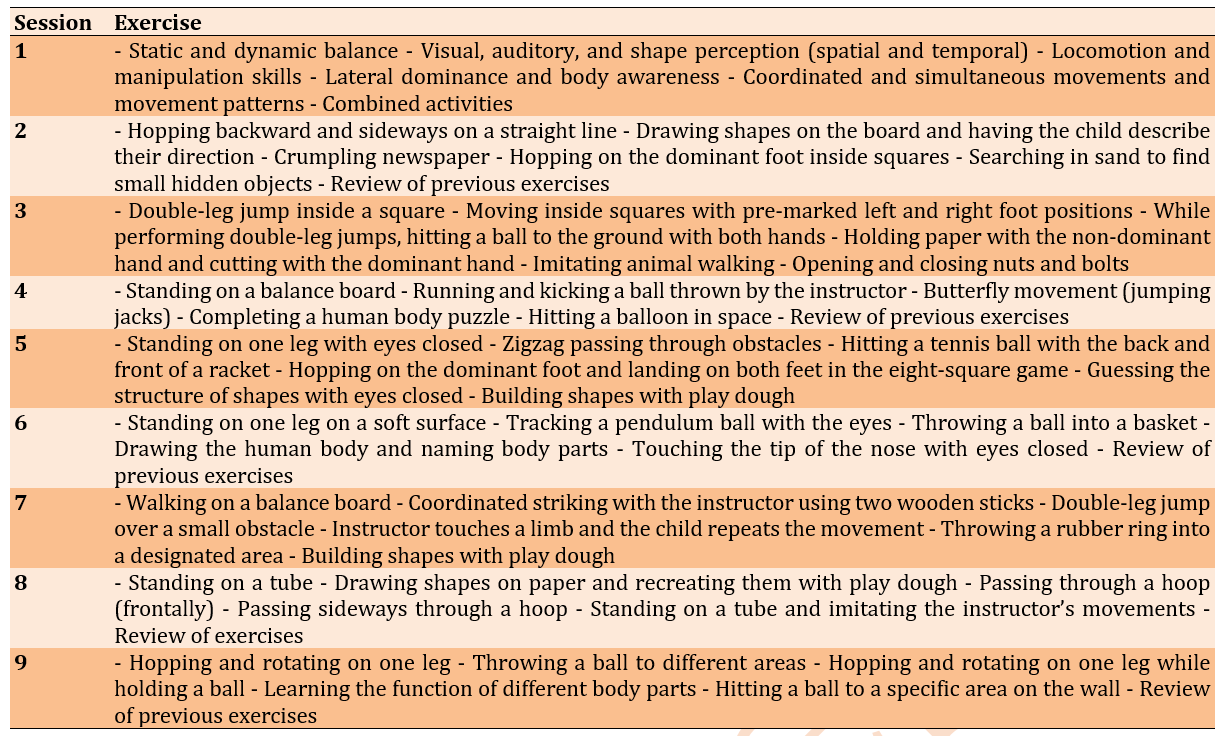
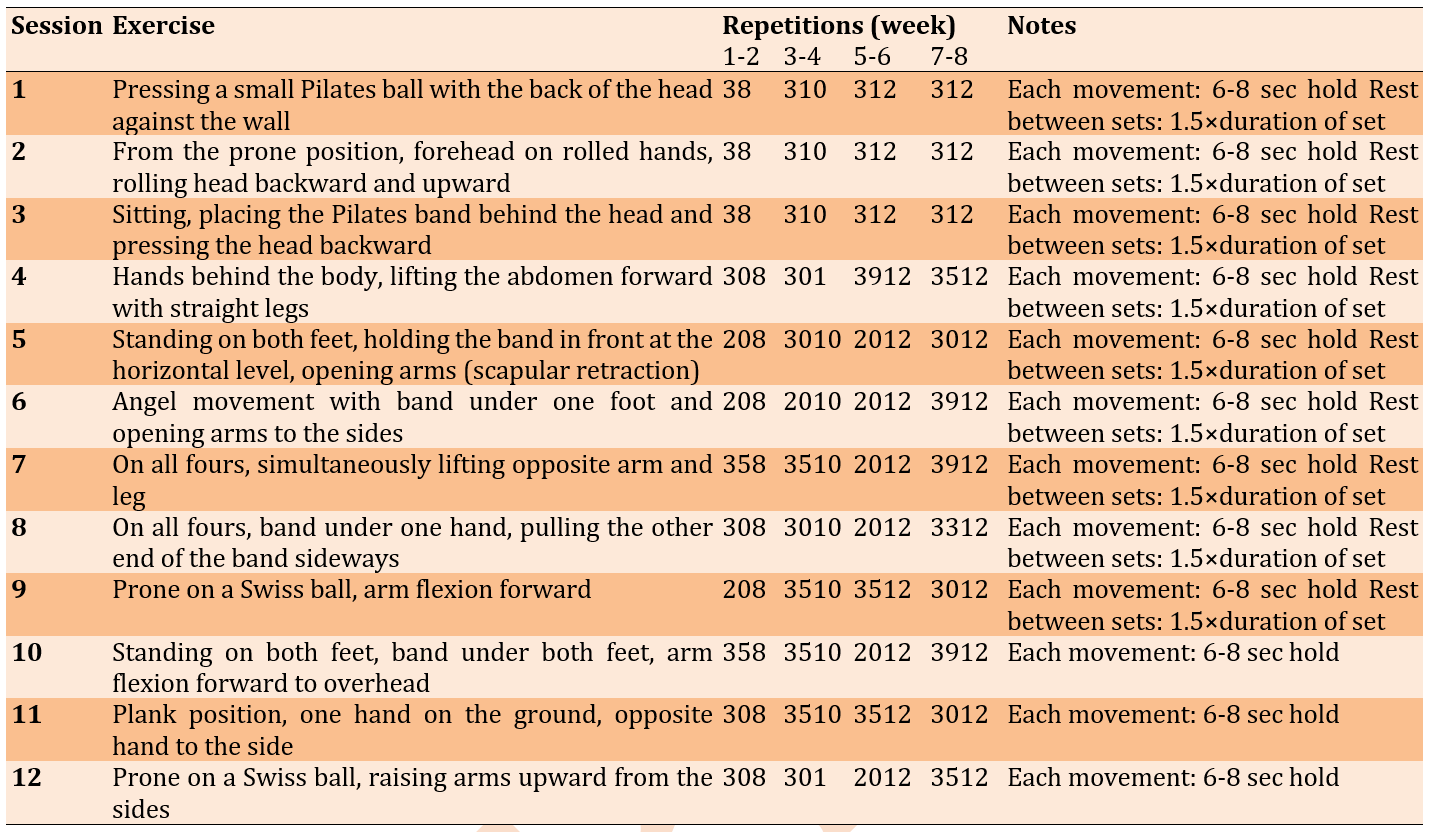
The FBS intervention group also performed combined functional, balance, and strengthening exercises in supine, sitting, and standing positions over eight weeks, with three sessions per week, each lasting approximately 45-60 minutes. The FBS exercises comprised activities that integrated all three characteristics—functional, balance, and strengthening—within a single exercise (Table 2) [26].
Table 2. Functional body system (FBS) exercise
Data analysis
The normality of the data was assessed using the Shapiro-Wilk test, and the homogeneity of variances was evaluated with Levene’s test. Given that the assumptions for parametric tests were met, paired t-tests, one-way analysis of variance (ANOVA), and Tukey’s post-hoc test were employed. All analyses were conducted using SPSS 25.
Findings
Participants in the SPARK group had a mean age of 8.25±0.96 years, weight of 38.42±3.70kg, and height of 148.00±6.42cm. The FBS group showed similar values, with a mean age of 8.75±0.96 years, weight of 38.25±3.28kg, and height of 145.00±6.66 cm. In the control group, the mean age was 9.08±0.79 years, weight was 39.08±2.31kg, and height was 146.30±4.69cm. The groups exhibited comparable baseline anthropometric profiles.
Levene’s test for equality of variances was conducted to assess the homogeneity assumption of the dependent parameters across groups at the pre-test and post-test time points. For all parameters—balance, muscular endurance, flexibility, and aerobic capacity—the test results indicated homogeneous variances (all p>0.05).
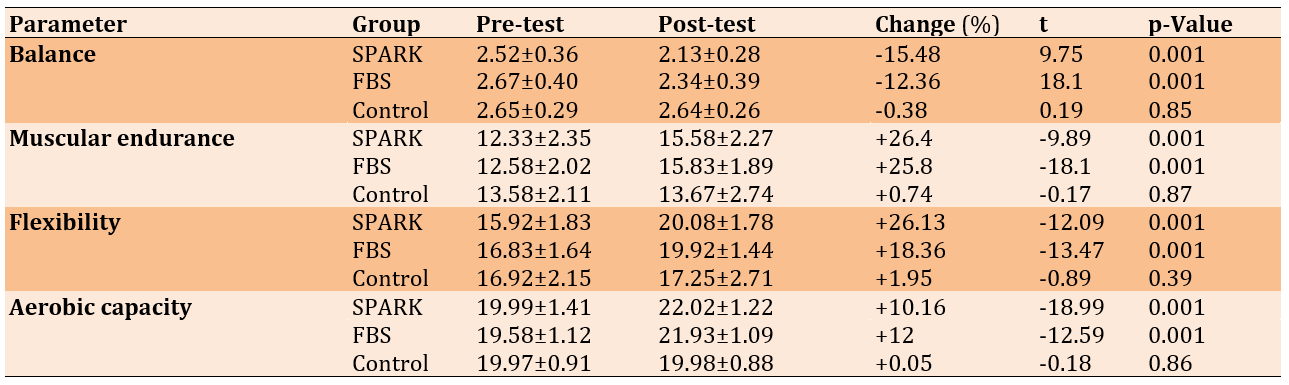
Paired t-tests were performed to evaluate within-group changes in the dependent parameters from pre-test to post-test. In the SPARK group, significant improvements were observed across all parameters. Balance improved by 15.48% (t=9.75; p=0.001), muscular endurance increased by 26.4% (t=-9.89; p=0.001), flexibility increased by 26.13% (t=-12.09; p=0.001), and aerobic capacity increased by 10.16% (t=-18.99; p=0.001). Similarly, the FBS group demonstrated significant positive changes: Balance improved by 12.36% (t=18.1; p=0.001), muscular endurance by 25.8% (t=-18.1; p=0.001), flexibility by 18.36% (t=-13.47; p=0.001), and aerobic capacity by 12% (t=-12.59; p=0.001). In contrast, the control group showed no significant changes in any parameter (all p>0.05), with percentage changes ranging from -0.38% for balance to +1.95% for flexibility (Table 3).
Table 3. Comparison of mean scores of physical fitness indices across the functional body system (FBS), sports, play, and active recreation for kids (SPARK), and control groups
Discussion
This study aimed to examine and compare the effects of a period of SPARK and FBS training on physical fitness indices in children with ID. Eight weeks of implementing the SPARK and FBS exercise programs (three sessions per week, each session lasting 45-60 minutes) significantly improved balance, muscular endurance, flexibility, and aerobic capacity in children with ID, whereas the control group showed no significant changes. Direct comparison of the two exercise programs also revealed no significant differences across any parameters, indicating that both methods were approximately equally effective.
Balance in children improved by 15.48% in the SPARK group and 12.36% in the FBS group. These results are fully consistent with many studies, including those by Rajabi et al. [27] and Moradi et al. [28]. However, some studies have reported different findings; Shafizadeh & Mohamadi report only a 4.7% improvement in dynamic balance and no change in static balance after eight weeks of SPARK [29], and Babadi et al. declare improvement only in static balance following functional-balance exercises in children with autism spectrum disorder accompanied by ID [30]. The observed improvements in the present study are likely due to the progressive increase in training load, the appropriate combination of static and dynamic tasks, and the high motivation of the children resulting from the play-based nature of the SPARK program and the engaging structure of FBS. From a neurophysiological perspective, cerebellar abnormalities are a consistent feature of intellectual disability [31]. Both programs, by creating tasks that require rapid shifts in the base of support, reactive responses, and continuous postural adjustments, strongly activate spinocerebellar and cerebello-cortical pathways, leading to increased synaptic plasticity in lobule VI and Crus I of the cerebellum [31].
On the other hand, muscular endurance of the upper and lower limbs increased by 26.4% and 25.8%, respectively, which is consistent with the studies by Bouzas et al. [32] and Štrucelj et al. [33]. In contrast, Dehghani & Ghasemi report significant improvement only in the sit-up test and no change in the push-up test [34]. The differences in results are likely related to exercise intensity, the actual volume performed, and the level of intellectual disability among participants. Both the SPARK and FBS programs, due to their circuit-based, multi-joint nature and lack of long rest periods, create high oxygen demands, leading to increased mitochondrial density, angiogenesis, conversion of type IIx fibers to IIa, and improved intra- and inter-muscular coordination [35]. These adaptations are of double importance in children with intellectual disabilities, who naturally have lower oxidative capacity.
Flexibility increased by 13.26% in the SPARK group and approximately 18.36% in the FBS group. This finding is consistent with other studies, including those by Salehian et al. [7] and Samatovich [36]; However, Rahmani Chegni et al. report only a non-significant 3.8% improvement following a SPARK training period [37]. Additionally, Konrad et al. emphasize that dynamic stretches typically have less effect than static stretches when performed for less than eight weeks [38]. The intelligent combination of prolonged static stretches with mental focus (SPARK) and repetitive dynamic stretches (FBS), along with stretching durations exceeding 60 seconds per muscle group, led to strong activation of Golgi tendon organs, reduced stretch reflex, sarcomere lengthening, and increased stretch tolerance.
Additionally, following eight weeks of SPARK and FBS training, aerobic capacity increased by 10.16% in the SPARK group and by 12% in the FBS group, representing the first direct report comparing the effects of these two programs on VO₂peak in children with ID. Our results are consistent with studies by Khaliq & Dehghani Zadeh [39] and Maicas-Pérez et al. [40]. These studies have shown that SPARK and FBS training likely increase participants' aerobic capacity by enhancing core and lower-body muscle engagement and improving neuromuscular coordination. On the other hand, Koufaki et al. report only a non-significant 4.2% increase in aerobic capacity and suggest that more time may be required to induce aerobic adaptations from these exercises [41]. The greater improvement in the present study is due to the inclusion of continuous jumping and rope-skipping activities, as well as the interval-like structure of the programs (particularly SPARK), which led to increases in stroke volume, muscular angiogenesis, mitochondrial density, and movement economy [42].
In summary, both SPARK and FBS training programs, as non-pharmacological, safe, low-cost, enjoyable, and feasible interventions in special education schools and rehabilitation centers, demonstrated equal effectiveness in improving physical fitness indices in children with intellectual disabilities. This equivalence, despite apparent differences in the programs' structures, stems from a high degree of overlap among physiological, neurophysiological, and motivational mechanisms. The results of the study emphasize the importance of multidimensional, play-based, and functional programs and indicate that there is no need to choose exclusively between these two methods; rather, either one or a combination of them can be used. Therefore, it is recommended that these programs be incorporated into the physical education curriculum of special education schools, that coaches receive training, and that the programs continue at home and in rehabilitation centers. For future research, it is suggested to investigate long-term effects (more than 12 weeks), post-intervention retention, impacts on cognitive-emotional parameters, and structural brain changes using functional imaging. Additionally, it is recommended to compare these programs with modern methods such as aquatic exercise, virtual reality, and active gaming.
Our results provide strong evidence that SPARK and FBS exercises are effective, generalizable, and sustainable options for improving physical fitness indices in children with intellectual disabilities. They can be integrated into comprehensive rehabilitation programs for these children.
Conclusion
Sports, play, and active recreation for kids, as well as functional body system training programs, are effective, generalizable, and sustainable options for improving physical fitness indices in children with intellectual disabilities.
Acknowledgments: The authors would like to express their sincere gratitude to all participants in this study.
Ethical Permissions: This research has been approved by the Research Ethics Committee of Yazd University (ID number: IR.YAZD.REC.1405.016).
Conflicts of Interest: There are no conflicts of interest.
Authors' Contribution: Goudarzi E (First Author), Methodologist/Main Researcher (30%); Barzegari Marvast H (Second Author), Introduction Writer/Assistant Researcher (30%); Mosayebi Z (Third Author), Assistant Researcher/Statistical Analyst (40%)
Funding/Support: This research is derived from a Master’s thesis conducted at Islamic Azad University, Aligoudarz Branch.
Intellectual disability (ID) is a developmental disorder characterized by significantly below-average intellectual functioning and adaptive behaviors compared to the general population [1]. Individuals with an IQ below 70-75, coupled with significant limitations in adaptive behavior, are classified as having ID based on standardized intelligence tests such as the Wechsler scales. Furthermore, IQ classification categorizes individuals with an IQ of approximately 50-70 as having mild ID, those with an IQ of 35-50 as having moderate ID, those with an IQ of 20-35 as having severe ID, and those with an IQ below 20 as having profound ID [2]. ID manifests before age 18 (during the developmental period), and its prevalence is reported to be approximately 1.5 times higher in males than in females [3]. Moreover, the risk of chronic diseases in individuals with ID is approximately twice that of the general population, and their average life expectancy is estimated to be half that of peers with typical development [4]. The reported prevalence of ID can vary depending on data collection methods and operational definitions of the disorder [5].
According to the latest estimates, the global prevalence of this disorder is approximately 2-3% [6]. In Iran as well, based on available statistics, over 1.5 million people live with some form of ID, with approximately 3% having profound ID—a significant figure in relation to the total population [3]. This disorder is one of the most important developmental challenges, beginning in childhood and characterized by limitations in intellectual functioning and adaptive behavior [7]. Children with ID, due to impaired cognitive functioning, frequently exhibit impairments or delays in the development of motor skills [8]. These children often display atypical and inefficient behaviors in activities that require precise bodily coordination. Their motor problems include poor fine- and gross-motor skills, impaired balance, and difficulties with activities of daily living [9]. Numerous studies have shown that children with ID, compared with their typically developing peers, obtain lower scores in physical fitness components such as muscular strength, cardiorespiratory endurance, agility, speed, reaction time, and balance [10]. For instance, Rahmati Aran & Dehghanizade report a significant correlation between cardiorespiratory fitness, muscular strength, static and dynamic balance, and postural abnormalities in this group [11]. Additionally, Fedulova et al. demonstrate that children with ID exhibit poorer performance in balance, throwing, catching, and jumping than typically developing children [12]. Given that children with ID exhibit poorer performance on physical fitness measures than their typically developing peers, implementing strategies to enhance their physical abilities is particularly important. In this regard, several studies have shown that children and adolescents with ID, through an active lifestyle and regular participation in sports activities, can improve their muscular strength to levels comparable to those of their typical peers [13, 14].
In light of these findings, individuals with intellectual disabilities often experience premature aging. This condition leads to increased disability and a higher incidence of various diseases, consequently placing them at greater risk of impaired balance and reduced physical fitness indices compared to others. Such problems can increase the likelihood of falls, complicate the performance of occupational and social roles, and restrict activities of daily living [15]. Therefore, the need for high-quality fitness programs in this population is particularly pressing. In this regard, improving neuromuscular function, enhancing coordination, strengthening proprioception, increasing static and dynamic balance, and empowering core muscles through resistance and functional training programs can markedly improve their physical capacity and ability to perform these tasks and activities.
The functional body system (FBS) training program is a combined therapeutic and physiotherapy-based regimen that incorporates functional, balance, and strengthening exercises. This program is grounded in the theoretical principles of motor control and learning, postural adjustment, and muscle strengthening [16]. The FBS exercises, as a combination of functional, balance, and strengthening training, have been introduced as an effective method for improving health. Among the benefits of FBS exercises are enhanced muscular strength through hyperplasia (increased muscle fibers) and hypertrophy (increased fiber size), improved coordination and synchronization of motor units, a wide variety of exercises, engagement of all systems involved in maintaining static and dynamic posture, and their cost-effective and practical nature. Such training is particularly effective for preserving balance and coordination [17]. In contrast, the sports, play, and active recreation for kids (SPARK) program is a play- and fun-based activity that, beyond physical benefits, positively impacts the mental and emotional well-being of children with intellectual disabilities [18]. This program, designed to enhance physical fitness and motor skills, has been implemented and evaluated in U.S. elementary schools as a health-related physical education curriculum [19]. Domestic studies have also shown that SPARK training has a significant effect on improving gross motor and manipulative skills in children with intellectual disabilities [20].
Despite the effectiveness of both training approaches, no study to date has directly compared the effects of SPARK and FBS exercises on physical fitness indices and aerobic capacity in children with intellectual disabilities. This research gap underscores the importance of the present study, as maintaining muscular strength, endurance, and dynamic balance is essential for achieving independent living in individuals with intellectual disabilities. Moreover, exercise programs tailored to the physical and psychological characteristics of this population not only improve physical and mental health but also prepare them for more active participation and a better quality of life in society. The present study aimed to examine and compare the effects of a period of SPARK and FBS training on physical fitness indices and aerobic capacity in children with intellectual disabilities.
Materials and Methods
Design and sample
This semi-experimental study using a pre-test/post-test design was conducted on 36 children with intellectual disabilities (Wechsler IQ scores 35–50) attending special education schools in Aligoudarz city in 2025.
The sample size was determined a priori using G*Power 3.1 for repeated-measures ANOVA (time×group interaction) or one-way ANOVA on change scores, using an effect size of 0.25, α=0.05, power=0.8, 3 groups, and 2 measurements. This yielded a minimum of 36-42 (12-14 per group). Due to the limited accessible population (children with IQs of 35-50 in special schools in Aligoudarz), 36 eligible children were purposively selected and randomly assigned to three groups of 12 each (SPARK, FBS, and control). Inclusion criteria were no sensory impairments (e.g., blindness, deafness, or tactile deficits), no illness or inability to perform exercises, and parental satisfaction. Exclusion criteria included withdrawal from the study, injury during training, and absence from more than two sessions.
Instrument
A questionnaire designed by the therapist was used to collect demographic information, including gender, age, medication use, father’s occupation, and parents’ education level.
The Wechsler Intelligence Scale for Children is an analytical test designed for ages 5-15, scored on a performance basis rather than an all-or-nothing approach. It comprises 12 subtests (two optional: digit span and mazes, which can substitute for others). Subtests are divided into verbal (e.g., general information, similarities, vocabulary, and digit span) and performance (e.g., picture completion, block design, mazes, coding) sections. Internal consistency is high within sections but lower between verbal and performance. The test demonstrates acceptable reliability and validity: internal consistency coefficients of 0.96 (full scale), 0.94 (verbal), and 0.9 (performance); good test-retest reliability over one month and two years; and standard errors of measurement of 3.19 (full), 3.6 (verbal), and 4.66 (performance). The highest error was in digit span, and the lowest was in vocabulary [21]. Studies by Abedi et al. confirm good validity and reliability in Iranian samples [22]. In the present study, the Cronbach’s α was 0.92 for the full scale, 0.89 for the verbal section, and 0.86 for the performance section.
Standard tests were used to measure physical fitness indices, like flexibility (sit-and-reach), muscular endurance (modified pull-up and trunk curl), dynamic balance (timed up and go; lower time = higher score; validity 0.79, reliability 81.5% [23]), and aerobic capacity (20-meter shuttle run) [24]. The validity and reliability of these tests have been confirmed in prior studies [12, 13, 19].
Procedure
Written informed consent was obtained from all parents. Participant information remained confidential, and voluntary withdrawal was permitted at any stage. No exercise intervention was provided to the control group during the study. They continued their usual lifestyle and only participated in pre- and post-testing.
The 8-week SPARK program consisted of three 45-60-minute sessions per week, structured in four parts: warm-up, locomotion skills, manipulation skills, and cool-down [25]. Sessions 10-24 repeated earlier sessions for continuity and consolidation (Table 1).
Table 1. Sports, play, and active recreation for kids (SPARK) exercise
The FBS intervention group also performed combined functional, balance, and strengthening exercises in supine, sitting, and standing positions over eight weeks, with three sessions per week, each lasting approximately 45-60 minutes. The FBS exercises comprised activities that integrated all three characteristics—functional, balance, and strengthening—within a single exercise (Table 2) [26].
Table 2. Functional body system (FBS) exercise
Data analysis
The normality of the data was assessed using the Shapiro-Wilk test, and the homogeneity of variances was evaluated with Levene’s test. Given that the assumptions for parametric tests were met, paired t-tests, one-way analysis of variance (ANOVA), and Tukey’s post-hoc test were employed. All analyses were conducted using SPSS 25.
Findings
Participants in the SPARK group had a mean age of 8.25±0.96 years, weight of 38.42±3.70kg, and height of 148.00±6.42cm. The FBS group showed similar values, with a mean age of 8.75±0.96 years, weight of 38.25±3.28kg, and height of 145.00±6.66 cm. In the control group, the mean age was 9.08±0.79 years, weight was 39.08±2.31kg, and height was 146.30±4.69cm. The groups exhibited comparable baseline anthropometric profiles.
Levene’s test for equality of variances was conducted to assess the homogeneity assumption of the dependent parameters across groups at the pre-test and post-test time points. For all parameters—balance, muscular endurance, flexibility, and aerobic capacity—the test results indicated homogeneous variances (all p>0.05).
Paired t-tests were performed to evaluate within-group changes in the dependent parameters from pre-test to post-test. In the SPARK group, significant improvements were observed across all parameters. Balance improved by 15.48% (t=9.75; p=0.001), muscular endurance increased by 26.4% (t=-9.89; p=0.001), flexibility increased by 26.13% (t=-12.09; p=0.001), and aerobic capacity increased by 10.16% (t=-18.99; p=0.001). Similarly, the FBS group demonstrated significant positive changes: Balance improved by 12.36% (t=18.1; p=0.001), muscular endurance by 25.8% (t=-18.1; p=0.001), flexibility by 18.36% (t=-13.47; p=0.001), and aerobic capacity by 12% (t=-12.59; p=0.001). In contrast, the control group showed no significant changes in any parameter (all p>0.05), with percentage changes ranging from -0.38% for balance to +1.95% for flexibility (Table 3).
Table 3. Comparison of mean scores of physical fitness indices across the functional body system (FBS), sports, play, and active recreation for kids (SPARK), and control groups
Discussion
This study aimed to examine and compare the effects of a period of SPARK and FBS training on physical fitness indices in children with ID. Eight weeks of implementing the SPARK and FBS exercise programs (three sessions per week, each session lasting 45-60 minutes) significantly improved balance, muscular endurance, flexibility, and aerobic capacity in children with ID, whereas the control group showed no significant changes. Direct comparison of the two exercise programs also revealed no significant differences across any parameters, indicating that both methods were approximately equally effective.
Balance in children improved by 15.48% in the SPARK group and 12.36% in the FBS group. These results are fully consistent with many studies, including those by Rajabi et al. [27] and Moradi et al. [28]. However, some studies have reported different findings; Shafizadeh & Mohamadi report only a 4.7% improvement in dynamic balance and no change in static balance after eight weeks of SPARK [29], and Babadi et al. declare improvement only in static balance following functional-balance exercises in children with autism spectrum disorder accompanied by ID [30]. The observed improvements in the present study are likely due to the progressive increase in training load, the appropriate combination of static and dynamic tasks, and the high motivation of the children resulting from the play-based nature of the SPARK program and the engaging structure of FBS. From a neurophysiological perspective, cerebellar abnormalities are a consistent feature of intellectual disability [31]. Both programs, by creating tasks that require rapid shifts in the base of support, reactive responses, and continuous postural adjustments, strongly activate spinocerebellar and cerebello-cortical pathways, leading to increased synaptic plasticity in lobule VI and Crus I of the cerebellum [31].
On the other hand, muscular endurance of the upper and lower limbs increased by 26.4% and 25.8%, respectively, which is consistent with the studies by Bouzas et al. [32] and Štrucelj et al. [33]. In contrast, Dehghani & Ghasemi report significant improvement only in the sit-up test and no change in the push-up test [34]. The differences in results are likely related to exercise intensity, the actual volume performed, and the level of intellectual disability among participants. Both the SPARK and FBS programs, due to their circuit-based, multi-joint nature and lack of long rest periods, create high oxygen demands, leading to increased mitochondrial density, angiogenesis, conversion of type IIx fibers to IIa, and improved intra- and inter-muscular coordination [35]. These adaptations are of double importance in children with intellectual disabilities, who naturally have lower oxidative capacity.
Flexibility increased by 13.26% in the SPARK group and approximately 18.36% in the FBS group. This finding is consistent with other studies, including those by Salehian et al. [7] and Samatovich [36]; However, Rahmani Chegni et al. report only a non-significant 3.8% improvement following a SPARK training period [37]. Additionally, Konrad et al. emphasize that dynamic stretches typically have less effect than static stretches when performed for less than eight weeks [38]. The intelligent combination of prolonged static stretches with mental focus (SPARK) and repetitive dynamic stretches (FBS), along with stretching durations exceeding 60 seconds per muscle group, led to strong activation of Golgi tendon organs, reduced stretch reflex, sarcomere lengthening, and increased stretch tolerance.
Additionally, following eight weeks of SPARK and FBS training, aerobic capacity increased by 10.16% in the SPARK group and by 12% in the FBS group, representing the first direct report comparing the effects of these two programs on VO₂peak in children with ID. Our results are consistent with studies by Khaliq & Dehghani Zadeh [39] and Maicas-Pérez et al. [40]. These studies have shown that SPARK and FBS training likely increase participants' aerobic capacity by enhancing core and lower-body muscle engagement and improving neuromuscular coordination. On the other hand, Koufaki et al. report only a non-significant 4.2% increase in aerobic capacity and suggest that more time may be required to induce aerobic adaptations from these exercises [41]. The greater improvement in the present study is due to the inclusion of continuous jumping and rope-skipping activities, as well as the interval-like structure of the programs (particularly SPARK), which led to increases in stroke volume, muscular angiogenesis, mitochondrial density, and movement economy [42].
In summary, both SPARK and FBS training programs, as non-pharmacological, safe, low-cost, enjoyable, and feasible interventions in special education schools and rehabilitation centers, demonstrated equal effectiveness in improving physical fitness indices in children with intellectual disabilities. This equivalence, despite apparent differences in the programs' structures, stems from a high degree of overlap among physiological, neurophysiological, and motivational mechanisms. The results of the study emphasize the importance of multidimensional, play-based, and functional programs and indicate that there is no need to choose exclusively between these two methods; rather, either one or a combination of them can be used. Therefore, it is recommended that these programs be incorporated into the physical education curriculum of special education schools, that coaches receive training, and that the programs continue at home and in rehabilitation centers. For future research, it is suggested to investigate long-term effects (more than 12 weeks), post-intervention retention, impacts on cognitive-emotional parameters, and structural brain changes using functional imaging. Additionally, it is recommended to compare these programs with modern methods such as aquatic exercise, virtual reality, and active gaming.
Our results provide strong evidence that SPARK and FBS exercises are effective, generalizable, and sustainable options for improving physical fitness indices in children with intellectual disabilities. They can be integrated into comprehensive rehabilitation programs for these children.
Conclusion
Sports, play, and active recreation for kids, as well as functional body system training programs, are effective, generalizable, and sustainable options for improving physical fitness indices in children with intellectual disabilities.
Acknowledgments: The authors would like to express their sincere gratitude to all participants in this study.
Ethical Permissions: This research has been approved by the Research Ethics Committee of Yazd University (ID number: IR.YAZD.REC.1405.016).
Conflicts of Interest: There are no conflicts of interest.
Authors' Contribution: Goudarzi E (First Author), Methodologist/Main Researcher (30%); Barzegari Marvast H (Second Author), Introduction Writer/Assistant Researcher (30%); Mosayebi Z (Third Author), Assistant Researcher/Statistical Analyst (40%)
Funding/Support: This research is derived from a Master’s thesis conducted at Islamic Azad University, Aligoudarz Branch.
Keywords:
References
1. Blomqvist S. Postural balance, physical activity and capacity among young people with intellectual disability [dissertation]. Umeå: Umeå University; 2013. [Link]
2. Pratt HD, Greydanus DE. Intellectual disability (mental retardation) in children and adolescents. Prim Care. 2007;34(2):375-86. [Link] [DOI:10.1016/j.pop.2007.04.010]
3. Fadaei Dehcheshmeh M, Shamsi Majelan A, Jafari SR, Samami N, Daneshmandi H. Comparison of the quality of life and physical fitness in males and female athletes with intellectual disability participating in Iranian special Olympics. J Rehabil Med. 2020;8(4):82-91. [Link]
4. Barwick RB, Tillman MD, Stopka CB, Dipnarine K, Delisle A, Huq MS. Physical capacity and functional abilities improve in young adults with intellectual disabilities after functional training. J Strength Cond Res. 2012;26(6). [Link] [DOI:10.1519/JSC.0b013e318234e860]
5. Bakker-Van Gijssel EJ, Lucassen PLBJ, Olde Hartman TC, Van Son L, Assendelft WJJ, Van Schrojenstein Lantman-de Valk HMJ. Health assessment instruments for people with intellectual disabilities-A systematic review. Res Dev Disabil. 2017;64:12-24. [Link] [DOI:10.1016/j.ridd.2017.03.002]
6. Zolghadr H, Sedaghati P, Daneshmandi H. The effect of selected balance/corrective exercises on the balance performance of mentally-retarded students with developmental coordination disorder. Phys Treat J. 2019;9(1):23-30. [Link] [DOI:10.32598/PTJ.9.1.23]
7. Salehian MH, Dehghani M, Peyghan RH, Ghanati P. The effect of spark exercise program on gross and fine motor skills of 6-8 year old boys with mental retardation. REVISTA DE INVESTIGACIONES UNIVERSIDAD DEL QUINDÍO. 2023;35(2). [Link] [DOI:10.33975/riuq.vol35n2.1195]
8. Dehcheshmeh MF, Majelan AS. The impact and long-term effects of exercises and sports games on motor ability and quality of life in children with intellectual impairment: A randomized controlled trial. J Hum Environ Health Promot. 2025;11(1):36-44. [Link] [DOI:10.61186/jhehp.11.1.36]
9. Sheikh M, Ramezani S, Maghsoudy G, Ahmadi K. The effects of spark training on visual-spatial working memory operation in children with mental retardation. SHEFAYE KHATAM. 2019;7(3):13-22. [Persian] [Link] [DOI:10.29252/shefa.7.3.13]
10. Mercer JR. Labeling the mentally retarded: Clinical and social system perspectives on mental retardation. Berkeley: University of California Press; 1973. [Link]
11. Rahmati Aran M, Dehghanizade J. Effect of training on the balance and coordination of the mentally retarded children. Int J Mot Control Learn. 2020;2(2):15-23. [Link] [DOI:10.29252/ijmcl.2.2.15]
12. Fedulova DV, Rogaleva LN, Serova NB. Comparative analysis of psychological characteristics of children-athletes with mental retardation. CyberLeninka. 2022;17(2(eng)):165-9. [Link]
13. Sukumaran C, Sebastian P. Effect of inclusive games and physical exercises on selected physical variables among the intellectually challenged children. Ann Rom Soc Cell Biol. 2022;26:1442-50. [Link]
14. Firdaus F, Irfan I. The effect of bocce games on the physical fitness of children with Grahita SLB AL-GIFARI during the Covid-19 pandemic. J Phys Outdoor Educ. 2023;5(1):27-36. [Link] [DOI:10.37742/jpoe.v5i1.200]
15. Whitehurst MA, Johnson BL, Parker CM, Brown LE, Ford AM. The benefits of a functional exercise circuit for older adults. J Strength Cond Res. 2005;19(3):647-51. [Link] [DOI:10.1519/00124278-200508000-00027]
16. Kaveh MH, Bahadori F, Doosti A, Asadollahi A. The effect of balance exercise training on balance status, and quality of life in elderly women: A randomized controlled trial. Malays J Med Health Sci. 2021;17(2). [Link]
17. Siavoshy H, Heidarianpour A. Effects of three type exercise training programs on FBS and HbA1C of elderly men with type 2 diabetes. Iran J Diabetes Obes. 2017;9(1 & 2):14-9. [Link]
18. Arvin H, Moghadasi M, Rohbanfard H, Arsham S. Effects of SPARK program on fine and gross motor skills and BDNF in educable intellectual disabled children. J Appl Health Stud Sport Physiol. 2020;7(1):19-28. [Link]
19. Zarei H, Norasteh AA, Dehghani N, Lieberman LJ, Ertel MW, Brian A. Effects of exercise training programs on motor skills of individuals with intellectual disabilities: A systematic review and meta-analysis. Disabil Rehabil. 2024;46(25):6001-10. [Link] [DOI:10.1080/09638288.2024.2318486]
20. Faal Moganloo H, Hosseini F, Mikaili Manee F. Effect of spark motor program on the development of gross motor skills in intellectually disabled educable boys. J Transl Med Res. 2013;20(3):262-70. [Persian] [Link]
21. Emami M, Bahramy A, Shiri V. The effect of sport vision training on visual perception in children with intellectual disability. J Sports Mot Dev Learn. 2018;10(2):277-92. [Persian] [Link]
22. Abedi M, Sadeghi A, Rabiei M. Standardization of the wechsler intelligence scale for children-IV in Chahar Mahal Va Bakhteyri state. Psychol Achiev. 2015;22(2):99-116. [Persian] [Link]
23. Christopher A, Kraft E, Olenick H, Kiesling R, Doty A. The reliability and validity of the Timed Up and Go as a clinical tool in individuals with and without disabilities across a lifespan: A systematic review: Psychometric properties of the Timed Up and Go. Disabil Rehabil. 2021;43(13):1799-813. [Link] [DOI:10.1080/09638288.2019.1682066]
24. Marín-Jiménez N, Sánchez-Parente S, Expósito-Carrillo P, Jiménez-Iglesias J, Álvarez-Gallardo IC, Cuenca-García M, et al. Criterion-related validity and reliability of the 2-km walk test and the 20-m shuttle run test in adults: The role of sex, age and physical activity level. J Sci Med Sport. 2023;26(4-5):267-76. [Link] [DOI:10.1016/j.jsams.2023.03.005]
25. Kosari S, Keyhani F, Hemayat Talab R, Arabameri E. Effect of a selected physical activity program on the development of motor skills in attention deficit/hyperactivity disorder (ADHD) and Autism (HFA) children. J Sports Mot Dev Learn. 2012;4(2):45-60. [Persian] [Link]
26. Ahmadi V, Golpayegani M, Ghasemi S. The effect of a course of functional, balance and resistance exercises on the upper cruciate syndrome of elite gymnasts in Arak city. J Mot Behav Sci. 2024;7(2):39-49. [Persian] [Link]
27. Rajabi S, Goodarzi B, Mazidi M. The comparison effects of eight weeks spark and Frenkel exercises on static and dynamic balance in the blinds. Hormozgan Med J. 2017;20(6):401. [Persian] [Link] [DOI:10.18869/acadpub.hmj.20.6.401]
28. Moradi H, Khodashenas E, Sohrabi M, Teymoori S, Shayan-Noshabadi A. The effect of Spark motor program on sensory-motor functions in children with developmental coordination disorder. Feyz Med Sci J. 2015;19(5):391-8. [Persian] [Link]
29. Shafizadeh A, Mohamadi Z. The effect of 8 weeks of core stability training on static and dynamic balance in mentally retarded children 8 to 10 years. Mot Behav. 2017;9(27):105-18. [Persian] [Link]
30. Babadi A, Nazemzadegan G, Hadianfard H. The effect of ball exercises on static and dynamic balance in children with autism spectrum disorders. Sci J Rehabil Med. 2017;6(3):118-24. [Persian] [Link]
31. D'Arrigo S, Loiacono C, Ciaccio C, Pantaleoni C, Faccio F, Taddei M, et al. Clinical, cognitive and behavioural assessment in children with cerebellar disorder. Appl Sci. 2021;11(2):544. [Link] [DOI:10.3390/app11020544]
32. Bouzas S, Martínez-Lemos RI, Ayán C. Effects of exercise on the physical fitness level of adults with intellectual disability: A systematic review. Disabil Rehabil. 2019;41(26):3118-40. [Link] [DOI:10.1080/09638288.2018.1491646]
33. Štrucelj M, Horvat I, Trošt Bobić T. Combined exercise training program leads to different effects on power, muscular endurance and balance of institutionalized persons with intellectual disabilities. Kinesiology. 2024;56(2):249-59. [Link] [DOI:10.26582/k.56.2.7]
34. Dehghani E, Ghasemi G. Effects of eight week of dynamic neuromuscular stabilization exercises on posture, strength and trunk endurance in educable mentally retarded students. Stud Sport Med. 2021;13(29):229-52. [Persian] [Link]
35. Behm D. The science and physiology of flexibility and stretching: Implications and applications in sport performance and health. London: Routledge; 2025. [Link] [DOI:10.4324/9781032709086]
36. Samatovich SB. Development of functional training in students aged 13-14 years: Running, jumping, flexibility exercises. Am J Innov Sci Res Dev. 2025;2(6):18-23. [Link]
37. Rahmani Chegni S, Farzaneh S, Mosaferi M. Comparison of the effect of eight weeks of Spark and core stability training on some physical fitness indicators. Proceedings of the First International Conference on Educational Sciences, Psychology, Sports Sciences and Physical Education. Sari: CIVILICA; 2020. [Persian] [Link]
38. Konrad A, Alizadeh S, Daneshjoo A, Anvar SH, Graham A, Zahiri A, et al. Chronic effects of stretching on range of motion with consideration of potential moderating variables: A systematic review with meta-analysis. J Sport Health Sci. 2024;13(2):186-94. [Link] [DOI:10.1016/j.jshs.2023.06.002]
39. Khaliq A, Dehghani Zadeh J. The impact of the Spark movement program on physical literacy of 8- to 10-year-old children. Proceedings of the Second National Conference on New Findings in Physical Education and Student Health. Bushehr: CIVILICA; 2022. [Persian] [Link]
40. Maicas-Pérez L, Hernández-Lougedo J, Maté-Muñoz JL, Villagra-Astudillo A, García-Fernández P, Suárez-Villadat B, et al. Effect of physical activity interventions on health parameters in children and adolescents with intellectual disabilities: A systematic review. Healthcare. 2024;12(23). [Link] [DOI:10.3390/healthcare12232434]
41. Koufaki P, Mercer TH, Naish PF. Effects of exercise training on aerobic and functional capacity of end‐stage renal disease patients. Clin Physiol Funct Imaging. 2002;22(2):115-24. [Link] [DOI:10.1046/j.1365-2281.2002.00405.x]
42. Gibala MJ, Gillen JB, Percival ME. Physiological and health-related adaptations to low-volume interval training: Influences of nutrition and sex. Sports Med. 2014;44(Suppl 2):S127-37. [Link] [DOI:10.1007/s40279-014-0259-6]